
How to reach out to a recruiter. And write the message they answer.
If you've applied and heard nothing, a short message to the recruiter is a normal next step. The hard part is knowing which recruiter, and what to say without sounding pushy. Here's both, on LinkedIn and by email, with five messages to copy.

The short answer
- Find the recruiter for this job, not just any recruiter. Start with the "Meet the hiring team" box on the LinkedIn job post, then search the company's people for "recruiter".
- Send one short message about the job. On LinkedIn, a connection note of up to 200 characters. By email, five sentences to an address you've checked. Name the job, one reason you fit and one question.
- Follow up once, about a week later, then stop. Send your resume when they ask for it.
On this page
Why recruiters don't reply, and what changes that.
Four reasons messages to recruiters go unanswered, and what to do about each.
“Is it weird to message the recruiter?”
It's a common worry, and recruiters on job forums say the opposite. One said they have no issue with a connection request from an applicant, and that it can help you stand out when your skills fit. It works best when you meet the job's must-haves.
What to do: Write when you fit. Check the posting's must-haves first, then reach out.
“I don't know which recruiter.”
Big companies have many recruiters, and the job posting rarely says which one is yours. Of 1,204 job postings from Blynk's searches for product roles, one named the recruiter for the role.
What to do: Find the one for this job. The steps below show where to look.
“I messaged and never heard back.”
A generic note that says "I'd love to connect" or "any openings?" gives a recruiter nothing to act on. They'd have to work out which job you mean, and whether you fit it.
What to do: Name the job and ask one thing. One question they can answer in a minute.
“I don't want to look pushy.”
Our reading: what reads as pushy is a long message, or one every few days. One short message and one follow-up reads as interested.
What to do: Keep it short, and follow up once. Then let it go.
Recruiter vs hiring manager: which one to contact, and when.
The recruiter runs the hiring process. Recruiters find, screen and interview applicants, says the US Bureau of Labor Statistics, and some contact references and make job offers. They usually handle scheduling and the pay range too. Ask them about the timeline, the steps and the pay.
The hiring manager runs the team you'd join. They interview you on the work itself and usually make the final call. Ask them about the work and what the team needs most.
Who to write to. Both, if you can, each about their own part. If you can reach only one, start with the hiring manager, since they usually decide. The recruiter for the role is a good second, and at large companies often the easier one to reach. Our guide on how to find the hiring manager covers that side.
A real reason to write. Some job postings say the recruiter is the person to ask about pay. Of the 1,204 postings in Blynk's searches, 19 said your recruiter can share the salary range. So "Could you share the pay range for this role?" is a fair, easy question to ask.
How to find the right recruiter, the one hiring for your role.
Do these in order, and stop when you have a name you trust.
Look for "Meet the hiring team" on the LinkedIn job post
Some LinkedIn job posts list the people behind them under "Meet the hiring team", including the person who posted the job. LinkedIn says you can connect with or message anyone listed there. If the job poster is a recruiter, start with them.
Search the company's people for "recruiter"
On the company's LinkedIn page, open People and search for "recruiter" or "talent acquisition". Then pick the one whose title or profile names the job's team, field or location. Someone who recruits for that team is a better contact than the head of all hiring.
Applying for Senior Product Manager, Growth? A "Recruiter, Product" in the same city is a better pick than the "Head of Talent" for the whole company.Know if it's an agency or in-house recruiter
An in-house recruiter works for the company and hires for its own open jobs. An agency recruiter works for a recruiting firm that the employer pays, so you shouldn't pay anything. The US Federal Trade Commission says honest employers never ask you to pay to get a job. With an agency recruiter, say the kind of position, industry, location and pay you want. With an in-house one, name the job you applied for.
Find the recruiter's email, then check it
Recruiters rarely publish their own address: none of the 1,204 job postings in Blynk's searches gave one. Many companies use one email pattern, such as first.last@company.com, so you can work it out from an address the company has published. Our hiring manager guide shows how. Check the address with an email checker before you send, and use LinkedIn if you can't. Or paste the job link below, and Blynk finds the recruiter for the role and checks the address for you.
Pick one recruiter, two at most
Writing to every recruiter at the company looks like a mass mailing, and they may compare notes. One recruiter for the role, and perhaps the hiring manager, is enough.
How to reach out to a recruiter on LinkedIn, inside the 200-character note.
On LinkedIn, the usual route is a connection request with a short note, then a fuller message once they accept.
Make your profile match the job you want
Your note sends the recruiter to your profile, so check it first. Our advice: make sure your headline names the job you want, in the words job postings use, and that your current role and location are up to date.
Connect with recruiters on LinkedIn, with a note
Send a connection request and add a note. LinkedIn Help says each note can be up to 200 characters, and you can add a note to up to three connection requests a month. Premium members can send unlimited personalized invitations, though other limits may still apply. We read this on November 11, 2026, and many posts online still say 300 characters. So save your notes for recruiters of jobs you've applied to, and keep each one to the job and one fact.
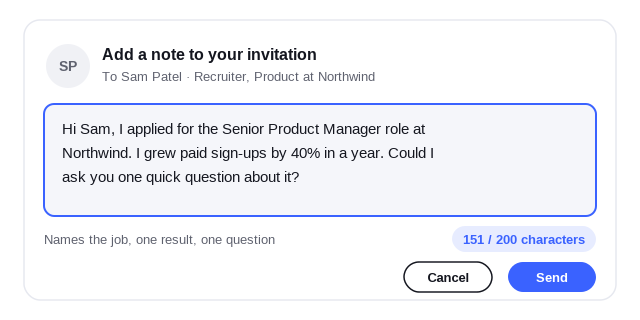
An illustration of a connection note that fits LinkedIn's 200-character limit. The names are made up. Once they accept, message the recruiter on LinkedIn
Now you have room to say a little more: the job and its ID, one result that fits, and one question. Our advice is to send it within a day or two, while they remember you. Short still helps. In LinkedIn's study of messages recruiters sent to candidates, ones under 400 characters got 22% more responses than average.
If they don't accept, try InMail or email
InMail lets you message someone you're not connected to, and it's a Premium feature. LinkedIn Help says Premium Career comes with 5 InMail credits a month. You get a credit back if the person replies, accepts or declines within 90 days. Or email the recruiter instead, as below.

How to email a recruiter, in five sentences.
Email works when you can find and check the recruiter's work address.
Put the job title and ID in the subject line
The recruiter should know which job it's about before they open it. Use the title from the posting, and the job ID if there is one.
Subject: Senior Product Manager, Growth (job 4821): a quick questionWrite the cold email to the recruiter in five sentences
Say which job you applied for and when. Mention one true, relevant result that fits what the posting asks for. Ask one question, such as the pay range or the next step. Thank them, and sign off with your name and a link to your LinkedIn profile. Writing about a job that isn't posted is a different email, covered in our guide to cold emails for a job.
Attach your resume only when asked
Career guides disagree on this. Our advice: leave it off a first email, since your application already has it and a link to your profile is enough. Send it as soon as the recruiter asks, or if the posting says to email it.
Avoid sending it on a Friday or Saturday
In LinkedIn's study of recruiters' messages, those sent on a Friday got 4% fewer responses than average, and on a Saturday 8% fewer. That's recruiters writing to candidates, not the other way round. Still, there's no reason to send yours late in the week.
When to follow up with a recruiter, and when to stop.
Advice varies a lot. Coursera says to follow up after 3 to 4 business days. Fyxer says one follow-up after 5 to 7 business days. Others say within 24 to 48 hours of the recruiter accepting your connection request.
Our rule: once, about a week later. Add something new, such as a result you left out, or ask one short question. If they still don't respond, stop, and put the time into your next application. If they say no, thank them. A polite reply keeps the door open for their next role.
Following up on an application, not a message? Our guide to the follow-up email after applying covers that, with notes to copy.
Message to a recruiter: what to say on LinkedIn and by email.
Each example below is short on purpose. Swap the [square brackets] for your details, keep every result true, and always name the job.
LinkedIn connection note to a recruiter
With your connection request. LinkedIn allows up to 200 characters, so this one is short.
Hi [First name], I applied for the [Job title] role at [Company]. I [one short, true result]. Could I ask you one quick question about it?
LinkedIn message after they accept
A day or two after they accept. Keep it under about 400 characters.
Thanks for connecting, [First name]. I applied for [Job title] ([Job ID]) on [date]. The posting asks for [one thing the role needs], and at [Company] I [one true result, with a number if you have one]. Could you share the pay range, or what the next step looks like?

Thanks,
[Your name]
Email to a recruiter about a job you applied for
To a work address you've checked. Subject line: [Job title] ([Job ID]): a quick question
Hi [First name],

I applied for the [Job title] role ([Job ID]) on [date], and I understand you're recruiting for it. The posting asks for [one thing the role needs]. At [Company], I [one true result, with a number if you have one].

Could you tell me [one question: the pay range, the timeline or the next step]?

Thanks for your time,
[Your name]
[Link to your LinkedIn profile]
Note to an agency recruiter
By LinkedIn or email, to a recruiter at a recruiting firm that covers your field.
Hi [First name],

I'm a [current role] with [number] years in [field]. I'm looking for a [target role] in [location, or remote], at around [pay range]. Most recently, I [one true result].

Are you working on any roles like that? My resume is ready whenever it would help.

Thanks,
[Your name]
Follow-up to a recruiter
Once, about a week after your first message, in the same thread.
Hi [First name], I wanted to follow up on my note about the [Job title] role. Since then, I [one new, true thing: a result, a project or a certificate]. If you're not the right person for this role, could you point me to who is?

Thanks,
[Your name]
Reaching out to recruiters: do this, not that.
Do
- Name the job, with its title and ID.
- Ask one clear question they can answer quickly.
- Save your three LinkedIn notes a month for jobs you've applied to.
- Check the email address is on the company's (or agency's) own domain.
- Follow up once, then stop.
- Reply to a recruiter who wrote to you before, even months later.
Don't
- Attach your resume to a connection request.
- Ask an in-house recruiter for "any openings" without naming a job.
- Message ten recruiters at the same company.
- Send the same note to every recruiter.
- Pay anyone to get you a job. Honest employers never ask, the FTC says.
- Get in touch at all if the posting asks you not to.
Questions about reaching out to a recruiter.
Is it professional to reach out to a recruiter on LinkedIn?
Yes. A short, polite note about a job you've applied for is a normal part of a job search. Recruiters answering job seekers on forums say they don't mind it, especially when your skills fit. Keep it to the job, one reason you fit and one question.
What is the 70/30 rule in hiring?
It's an informal rule of thumb, not a formal standard, and people use it two ways. Some mean hiring someone who meets about 70% of a job's requirements and training the rest. Others mean judging a candidate about 70% on skills and experience and 30% on fit. For reaching out, the first is the useful one: if you meet most of the must-haves, apply, and tell the recruiter the result that covers the biggest one.
Why don't recruiters reach out on LinkedIn?
They do write to people: LinkedIn studied tens of millions of messages that corporate recruiters sent to members in one year. Our reading is that they reach out to people who come up when they search. A profile that doesn't use the words of the jobs you want can be missed. So make your headline name the job you want, and don't wait to be found. Write to the recruiter for a job you've applied to.
What should I say in an email to a recruiter?
Keep it to five sentences. Name the job you applied for, with its title and ID. Give one true result that fits what the posting asks for, and ask one question, such as the pay range or the next step. Then thank them, and sign off with your name and a link to your LinkedIn profile. Put the job title in the subject line; the email above is ready to copy.
Is it appropriate to email a recruiter?
Yes, at their work address and about a specific job. Check the address before you send, and use LinkedIn if you can't. The one exception is a posting that asks you not to contact anyone: respect it.
Can I contact a recruiter directly?
Yes. LinkedIn says you can connect with or message anyone listed in a job post's "Meet the hiring team" section. You can also send any recruiter a connection request with a note, or email them at a work address you've checked. Our advice: it works best after you apply, so you can name the job; before that, an agency recruiter is the one to write to. No real recruiter will ask you for money.
How do I contact LinkedIn Recruiter support?
LinkedIn Recruiter is LinkedIn's paid hiring tool for recruiters. Its support is on LinkedIn's Recruiter Help pages, which have a Contact us link and live chat once you sign in. You don't need it to reach a recruiter: a connection request or InMail from your own account works.
How long should I wait to follow up with a recruiter?
Advice ranges from a day or two to two weeks. Our rule: once, about a week after your first message, with something new or one short question. If there's still no reply, stop and put the time into your next application.
How do I know a recruiter is real?
Check that their email is on the company's own domain, and that their LinkedIn profile shows them working there. Several employers' job postings say genuine job emails come only from their own domain. And never pay: the FTC says honest employers never ask you to pay to get a job. It suggests searching the company or person's name with words like "scam" or "review".
Is there a tool that finds the recruiter for a job?
Contact finders such as Hunter and Apollo find details for people you search for by name, company or title, so you still work out who's hiring. Blynk starts from the job link. It finds the recruiters and senior people hiring for that role, picks the two most likely to read your note, checks their work email and writes the note. Nothing is sent until you approve.
Where the facts come from.
Checked on November 11, 2026, including LinkedIn's limits on connection notes. The advice is ours; facts about LinkedIn and other companies come from their own pages. The posting data is Blynk's own: 1,204 job postings from Blynk's searches for product roles, most of them senior, from company career sites and job boards, first seen between October 31 and November 11, 2026, each read for a named recruiter, a recruiter's own email, what it says recruiters do, and warnings about fake recruiters.
- How to find the hiring manager
- Cold email for a job
- Follow-up email after applying
- Blynk vs LinkedIn Sales Navigator
- Blynk vs Apollo
- Blynk vs RocketReach
- Easy Apply or the company's own site?
- How to ask for a coffee chat
- Is LinkedIn Premium worth it?
- What a recruiter does for you
- How to spot a job scam
- What a hiring manager does
- LinkedIn Help: personalize invitations to connect (200 characters, three a month)
- LinkedIn Help: Meet the hiring team on job posts
- LinkedIn Help: InMail credits with Premium Career
- LinkedIn Talent Blog: the InMails that get the best response rates
- LinkedIn Recruiter Help
- US Bureau of Labor Statistics: human resources specialists
- Underdog.io: recruiter vs hiring manager
- US Federal Trade Commission: job scams
- Coursera: how to reach out to a recruiter on LinkedIn
- Fyxer: how to email a recruiter
- Rewriting the Code: how to message a recruiter
- Mumsnet: connecting with a recruiter on LinkedIn after applying (a recruiter's reply)
- Blind: replying to a recruiter's LinkedIn message a year later (a recruiter's reply)
- Workable: the 70% rule of hiring
- TestGorilla: skills-based hiring and the 70/30 rule
- Homebase: hiring process steps (the 70/30 rule)
- Hunter Email Finder
- Apollo help: search filters
- Blynk Find the Hiring Manager
- Blynk pricing
