
How to address a cover letter. With a name, or without one.
The letter is written and the first line is still blank. The posting names no one, “To Whom It May Concern” feels stiff, and “Dear Hiring Manager” might look lazy. Here's who to address a cover letter to, how to find a name in a few minutes, and what to write when you can't.

The short answer
- Use the hiring manager's name if you can find it: “Dear Dana Ruiz,” or “Dear Ms. Ruiz,”. Not sure of their gender? Use the full name with no title.
- No name? Write “Dear Hiring Manager,” or something more specific, like “Dear Product Hiring Team,”. Both are fine.
- Skip “To Whom It May Concern” and “Dear Sir or Madam”. They read as stiff, and “Dear Hiring Manager” does the same job.
On this page
Does the cover letter greeting matter? Less than you've been told.
Four worries that stall the first line, and what the evidence says.
“Dear Hiring Manager looks lazy.”
Not to most people who read it. Indeed's career guide calls “Dear Hiring Manager” always acceptable when there's no contact name. And in the one greeting survey we could trace to its source, most hiring managers said even “To Whom It May Concern” made little or no difference. More on that below.
What to do: Use a name when you can find one fast. Otherwise, “Dear Hiring Manager” is fine.
“The job posting will tell me who to write to.”
It rarely does. In the 1,204 job postings we read, only about 1 in 100 named an actual person. Far more gave a title instead, like “the VP of Product”. A title is still useful, because you can look it up.
What to do: Read the posting for a title. Then find out who holds it.
“I'll get the name, or the person, wrong.”
Our reading: a misspelled name or a guessed “Mr.” is a bigger slip than a generic greeting. So is writing to the wrong person: Zety, a resume builder, warns that the HR director isn't necessarily the hiring manager for your role.
What to do: Copy the spelling from the company's own page. If you're not sure of their gender, use the full name, as Purdue's writing lab advises.
“I've spent an hour on one line.”
The greeting is the smallest part of the letter. Our advice: give the search for a name about five minutes. If nothing turns up, pick a greeting from the list below and spend the time on the rest of the letter.
What to do: Set a five-minute limit. Then move on.
Who to address a cover letter to, and what 1,204 job postings tell you.
Address it to the hiring manager. That's usually the person the role reports to, who would be your manager. Purdue's writing lab advises writing to a specific person, usually the one in charge of interviewing and hiring.
We read 1,204 job postings to see how often they tell you who that is. They came from Blynk's searches for product roles, most of them senior, from company career sites and job boards. All were first seen between October 31 and November 11, 2026.
About 1 in 5 said who the role reports to, almost always by title. 245 of the 1,204 did. We read a random 20 of them by eye. Every one gave a title, like “the VP of Product” or “our CEO”, and none gave a name.
About 1 in 100 named an actual person anywhere in the text. 12 of the 1,204 did. Only 2 named the hiring manager. 5 gave a person's own email address. Most other emails in the postings were team inboxes, for things like HR, privacy or accommodations.
So the posting usually gives you a title to look up, not a name. That still helps. About 3 in 10 of the postings that named a boss pointed to the CEO, a founder or the president. In our experience, their names are often on the company's own site.
What this doesn't tell you. It covers product roles over 12 days, and the posting text only. LinkedIn's “Meet the hiring team” section and the application page can show names the posting doesn't.
How to find a name to address a cover letter to, in four steps.
Give it about five minutes. If none of these turns up a name, use a greeting from the list further down. Our guide on how to find the hiring manager has the full method.
Read the posting for “reports to”, a team or a contact
Press Ctrl+F (Cmd+F on a Mac) and search for “report”. Then search for “@”: TopResume suggests it, because an email address in the posting may contain a name. Note the title the role reports to and the name of the team.
What you'll usually find: “You'll report to the VP of Product.” What you'll rarely find: “Hiring manager: Dana Ruiz.”Look the title up on the company's own site
Open the company's About, Team or Leadership page and find the person with that title. If the role reports to the CEO or a founder, the name is often there. Copy the spelling of the name and their title exactly as the page shows them.
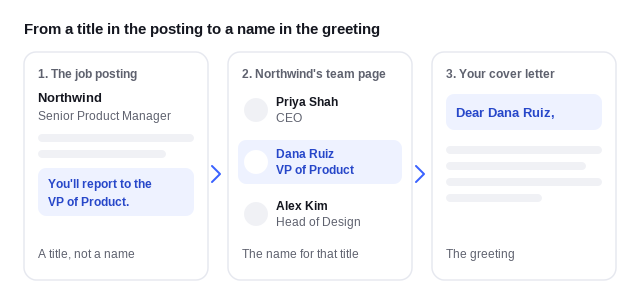
An illustration of turning a title in the posting into a name for the greeting. The company and names are made up. Check LinkedIn's “Meet the hiring team” section
On LinkedIn, open the job's details page. Some job posts show a “Meet the hiring team” section, with the hiring team and the person who posted the job. The poster only appears if they chose to show their profile, and they may be a recruiter rather than the hiring manager. If there's no such section, search LinkedIn for the title at that company.
Only found the recruiter? Use the recruiter's name
A recruiter is a real person who will read your letter, so “Dear Sam Lee,” beats “Dear Hiring Manager,”. If you find both, address the hiring manager, since they usually make the decision. If you're already talking to a recruiter, you can simply ask who the letter should go to. That's our advice. Purdue's writing lab and Indeed also suggest calling the company.

How to address a cover letter without a name, and why “Dear Hiring Manager” is fine.
“Dear Hiring Manager,” is the safe default. Indeed's career guide calls it always acceptable when there's no contact name. It also doesn't guess anyone's gender, which “Dear Sir or Madam” does, Indeed points out.
More specific is better when you know the team. Write to the title the role reports to (“Dear Head of Product,”), the team (“Dear Product Hiring Team,”) or the company's recruiting team (“Dear Northwind Recruiting Team,”). Indeed's guide to writing without a name lists the same kinds of greeting.
If the posting mentions a committee, address the committee. “Dear Search Committee,” fits a posting that says a committee will review applications. Purdue's writing lab uses a committee greeting in its examples when there's no name.
Skip time-of-day greetings. Indeed advises against “Good morning” or “Good afternoon”, since you can't know when your letter will be read.
Is “To Whom It May Concern” okay on a cover letter? What the one survey found.
Most hiring managers in the survey said it made little difference. Resume Companion asked over 1,000 US hiring managers and recruiters in 2020. More than 83% said “To Whom It May Concern” would have little or no impact on whether they'd hire someone.
A few would hold it against you. 6% of the male and 2% of the female hiring managers said they'd be very likely not to hire someone over it. In the Midwest, 22% said it would make them less likely. People aged 18 to 24 were the most likely to reject an applicant for it.
Read it with care. Resume Companion sells cover letter help, and it didn't publish its questions or method. It's still the only greeting survey we could trace to its source. A figure many guides repeat, that 40% of hiring managers prefer “Dear Hiring Manager”, traces back second-hand to a 2011 college survey we couldn't read. So we've left it out.
Our advice: when you're choosing between the two, “Dear Hiring Manager,” does the same job with less risk. And a real name beats both.
Mr., Ms., Dr. or the full name? Getting the salutation right.
The full name is the safest choice. “Dear Dana Ruiz,” works whatever the person's gender. Purdue's writing lab recommends the full name when you don't know it.
Use Mr. or Ms. only when you're sure. Indeed advises a title only when you're certain of the person's gender. Use “Ms.” rather than “Mrs.” or “Miss”, unless the person uses it themselves, as Coursera and Indeed both advise.
Use Dr. or Professor when it's their title. Indeed suggests “Dr.” for someone with a PhD, and Purdue's writing lab says a higher title like Dr. is fine.
First name only? The guides disagree. Indeed lists “Dear [First name]” as an option, while Purdue keeps first names for people you know well. Our advice: use the first and last name, unless you've already been on first-name terms.
Comma or colon after the salutation? For a formal US business letter, Purdue's writing lab uses a colon (“Dear Dana Ruiz:”) and says never a comma. Coursera's examples use a comma, as do most of the cover letter guides we read. Our reading: either is fine in a cover letter, as long as you're consistent.
Cover letter greeting and salutation examples, ready to copy.
Try them in this order, and use the first one that fits. Swap the [square brackets] for real details. Each ends in a comma; a colon also works in a formal US letter.
Their full name
When you've found the hiring manager's name, or you're not sure of their gender.
Dear [First name] [Last name],
Their title and last name
When you're sure of the title the person uses, such as Ms., Mr., Dr. or Professor.
Dear Ms. [Last name],
The recruiter, by name
When the only name you can find is the recruiter's.
Dear [Recruiter's first name] [Last name],
Two people
When you know the hiring manager and the recruiter will both read it. Our advice, since none of the guides we read covers it.
Dear [Full name] and [Full name],
The job title the role reports to
When the posting says who the role reports to, but you can't find their name.
Dear [Job title, such as Head of Product],
The team
When you know the team but not the manager.
Dear [Team name] Hiring Team,
Dear Hiring Manager
When you have no name and no team. Indeed calls it always acceptable.
Dear Hiring Manager,
A committee
When the posting says a search or selection committee will review applications.
Dear Search Committee,
The full heading, for a letter sent as a file
At the top of a PDF or printed cover letter, above the greeting. Leave the recipient's details out of an email.
[Your name]
[Your email] · [Your phone]

[Date]

[Hiring manager's full name]
[Their job title]
[Company name]
[City, State]

Dear [First name] [Last name],
Email, PDF or form box? Where the cover letter greeting goes.
A letter sent as a file. Put your details and the date at the top, then the recipient's name, title and company, then the greeting. Purdue's writing lab starts the recipient's address one line below the date. The company's street address is optional: Resume Genius points out that cover letters are almost always sent electronically.
A cover letter in an email. Leave out the recipient's address, and start with the greeting. Coursera suggests a subject line with your name, the job title and what's attached.
A text box on an application form. Start with the greeting, and leave out the address block, since the form already knows who you are and which job it is. That's our advice. Boxes like this are common: of 168 application forms we read, 87 offered an optional cover letter box, 2 required a cover letter and 79 had no place for one.
Cover letter greeting mistakes, and what to do instead.
The small things that really can make a greeting look careless.
Do
- Copy the name's spelling from the company's own page or the person's LinkedIn profile.
- Use the title the person uses, such as Dr. or Professor.
- Use the full name when you're not sure of their gender.
- Write to the person the role reports to, even when that's the CEO of a small company.
- Match the company's tone: use a first name only if you've already been on first-name terms.
- Check the name and the company name once more before you send it.
Don't
- Guess a gender, as in “Dear Sir” or “Dear Mrs. Ruiz”.
- Fall back on “Dear Sir or Madam” or “Ladies and Gentlemen”.
- Open with a time of day, like “Good morning”. Indeed advises against it.
- Leave the greeting out. TopResume says never to leave it blank.
- Assume the HR director is the hiring manager. Zety warns they may not be.
Questions about how to address a cover letter, answered.
How do I address a cover letter to an unknown recipient?
Write “Dear Hiring Manager,”, or something more specific if you know it: the title the role reports to (“Dear Head of Product,”), the team (“Dear Product Hiring Team,”) or the company's recruiting team (“Dear Northwind Recruiting Team,”). Indeed calls “Dear Hiring Manager” always acceptable when there's no contact name, and lists team greetings like these. Avoid “Dear Sir or Madam”, which Indeed says assumes a gender.
Is “Dear Hiring Manager” okay, or is it outdated?
It's fine. Indeed's career guide calls it always acceptable when you don't have a contact name, and it doesn't assume anyone's gender. A real name is better when you can find one in a few minutes. In the 1,204 job postings we read, only about 1 in 100 named a person, so you'll often be using it.
When is “To Whom It May Concern” acceptable?
It rarely sinks an application, but there's a better option. In Resume Companion's 2020 survey of over 1,000 US hiring managers and recruiters, more than 83% said it would have little or no impact on whether they'd hire someone. A small group said they'd be very likely not to hire over it. Our advice: use “Dear Hiring Manager,” instead.
Should a cover letter go to the hiring manager or the recruiter?
The hiring manager, if you can find their name, since they usually make the decision. That's usually the person the role reports to. If the only name you can find is the recruiter's, address the recruiter by name: they're a real person who will read it. That's our advice.
Should I use Mr., Ms. or Mrs.?
Use Mr. or Ms. only when you're sure of the person's gender, as Indeed advises. Choose “Ms.” over “Mrs.” or “Miss” unless the person uses it themselves (Coursera, Indeed). If you're not sure, use the full name with no title, as Purdue's writing lab recommends: “Dear Dana Ruiz,”.
Do you put a comma or a colon after a cover letter salutation?
Either works. In a formal US business letter, Purdue's writing lab uses a colon (“Dear Dana Ruiz:”). Coursera's examples use a comma, as do most of the cover letter guides we read. Our reading: pick one and use it consistently.
How do I address a generic cover letter?
Use “Dear Hiring Manager,” and change the company name and job title in every copy. Our advice is to change more than the greeting: one line about this job does more than the right salutation. Our guide to the best AI cover letter generators compares tools that help, or Blynk can write a cover letter for each job, written for the role and not copied from the last one.
Do cover letters need an address?
Not usually. Resume Genius points out that cover letters are almost always sent electronically, so a physical address isn't needed. For a PDF or printed letter, you can add the recipient's name, title and company below the date. In an email, Coursera says to leave the recipient's address out.
How do I address an email cover letter?
Start the email with the same greeting you'd use in a letter, such as “Dear Dana Ruiz,”, with no address block. Coursera suggests a subject line with your name, the job title and what's attached. Indeed and Zety call “Hi” too casual, while TopResume allows it at casual workplaces. Our advice: “Dear” unless you've already been on first-name terms.
What is the rule of 3 in a cover letter?
It's a rule of thumb, not a standard, and we found no study behind it. Most often it means three paragraphs. Eastern Florida State College's career blog, for example, suggests one about you, one about the company and a short thank-you to close, and suggests naming three of your strongest qualifications in the first. Some guides use it for three points tied to the job instead. Either way, the greeting sits above the first of the three.
Where the facts come from.
Checked in November 2026. The advice is ours, and we say so where it's given. Greeting conventions come from Purdue's writing lab and the career guides named in the text, the survey from its publisher, and the facts about LinkedIn from LinkedIn Help. The posting counts are Blynk's own: 1,204 job postings from Blynk's searches for product roles, most of them senior, from company career sites and job boards, first seen between October 31 and November 11, 2026. Each was searched for a reporting line, for people named in the text and for email addresses, and every match was read by eye. The form counts come from our guide on whether you need a cover letter.
- How to find the hiring manager
- Do I need a cover letter?
- The best AI cover letter generators
- Cold email for a job
- How long a cover letter should be
- How to start a cover letter
- How to end a cover letter
- Purdue OWL: addressing cover letters
- Purdue OWL: basic business letters
- Resume Companion: “To Whom It May Concern” survey (2020)
- AACSB Insights: getting the hiring manager's attention (reports the Resume Companion survey)
- Indeed: how to address a cover letter
- Indeed: how to address a cover letter without a name
- Coursera: how to address a cover letter
- Resume Genius: how to address a cover letter
- TopResume: how to address a cover letter
- Zety: how to address a cover letter
- LinkedIn Help: meeting the hiring team
- LinkedIn Help: the job poster's profile on a job post
- Eastern Florida State College: how to write a cover letter in 3 easy paragraphs
- Blynk Find the Hiring Manager
