
Job application questions. What each one asks, and how to answer it.
You're on your fifth application form this week, and a required box asks if you'll need sponsorship, or why you want to work here. We read 218 live application forms to see which questions really come up, then checked what the law and the hiring systems' own help pages say.

The short answer
- Answer the yes/no screening questions exactly. Work authorization, sponsorship, office days and years of experience are the ones an employer is most likely to set a rule on.
- Treat “Why do you want to work here?” as two sentences: one specific thing about them, and one thing you'd do in the role.
- Gender, race, veteran and disability questions are voluntary. You can decline. Keep your standard answers in one document, so each form takes minutes.
On this page
Why job application questions feel like a test, and what's really going on.
Four worries people have about the boxes on an application form, and what the evidence says.
“One wrong answer and the system rejects me.”
Only if the employer set a rule for it. Greenhouse says its auto-reject rules can only be set on yes/no, single-select and multi-select questions. Ashby's rules run when you submit, and can match an answer that equals a value, contains certain words or is empty. So the risk sits mostly in a few short questions, and in leaving a required box empty.
What to do: Answer the yes/no questions exactly. Take your time on those, and write the rest in your own words.
“If I say yes to sponsorship, I'm out.”
Some employers don't sponsor, and the question helps them tell. And they're allowed to ask. The Justice Department says an employer may generally ask if you have the legal right to work in the US, and if you'll need visa sponsorship. On our forms, 124 of the 132 sponsorship questions asked about the future too.
What to do: Answer both parts truthfully. Then spend your time on employers that sponsor.
“If I tick disability, the hiring manager will see it.”
Greenhouse, the system behind 97 of the 218 forms we read, says it isn't possible to link answers to its EEOC questions to a single person's application. The EEOC's rules say a voluntary disability form must be kept separate and confidential. And on each of the 5 forms we saw in full that made a question required, declining was a choice.
What to do: Answer only what you want to. “I don't wish to answer” is there for a reason.
“Every form wants an essay.”
Most don't. Only 22 of the 218 forms we read had a “why us” box (10%). The questions that repeat are short: LinkedIn, location, sponsorship, start date, how you heard. You can write those once.
What to do: Keep one document of answers. Save your effort for the one box that needs it.
What 218 real application forms ask, and how often.
We read the forms, not just the advice. On November 12, 2026, we read the live application forms for 218 open jobs in Blynk's searches, at 199 companies. They're on Greenhouse (97), Ashby (96) and Lever (25), and we read each system's public job-board data without submitting anything. Most are senior product roles at tech companies, and 158 are US jobs.
The questions you'll meet most. 8 in 10 forms asked for your LinkedIn profile (174, or 80%). 7 in 10 asked where you live (150). 6 in 10 asked if you'll need visa sponsorship (132, or 61%), and for US jobs it was 7 in 10 (110 of 158). Half had a voluntary self-identification section (110).
The ones you'll meet sometimes. About 1 in 3 asked what pay you want (67, or 31%), and 1 in 3 asked for a preferred name or pronouns (71). About 1 in 4 asked how you heard about the job (59, or 27%). 1 in 5 asked about office days or hybrid work (44). About 1 in 10 asked for a start date (25) or had a short “why us” box (22).
New boxes the other guides don't mention. 38 forms had legal or consent boxes, such as a non-compete question or consent to record an interview. 29 asked if you've worked there before or have relatives there. 29 asked about AI: how you use it at work, or a rule on using it in the application.
Most forms are short. The median form had 12 fields. Beyond your name, contact details, resume and cover letter, that's a median of 7 questions (from 0 to 28). 40 forms also had an open essay question about the role.
What we didn't read. Only three hiring systems are here. Workday, iCIMS, Oracle and LinkedIn Easy Apply forms aren't. So treat these numbers as a guide to what's common, not a rule for every form.
Common job application questions, and how to answer each one.
In about the order a form asks them. The first three are the screening questions that matter most.
Are you legally authorized to work in the United States?
This asks if you can work in the US today, under any status that allows it. US citizens, green card holders and people with a valid work permit answer yes. 88 of the 218 forms asked it as its own question, and all 88 made it required. It usually sits right above the sponsorship question.
On OPT or another work permit? In our reading, you can work now, so this one is usually yes. The next question is the one about the future.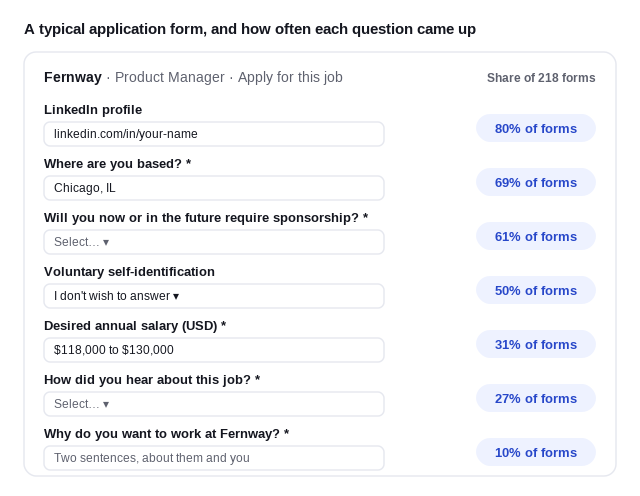
An illustration of a typical form, with how often each question came up on the 218 forms we read. The company is made up. Will you now or in the future require sponsorship? Answer both parts
This was the most common screening question we found. 132 of the 218 forms asked it, and 131 made it required. The usual wording is one of two questions the Justice Department's Immigrant and Employee Rights Section has called appropriate to ask. The other is the authorization question above. 124 of the 132 asked about the future too, with words like “now or in the future” or “at any time”, so answer both parts truthfully.
Students and recent graduates. The University at Buffalo's career team says international students and recent graduates should answer yes “in most cases”, because a student visa ends. 11 forms named OPT, F-1 or EAD in the question. About 10 asked for more, such as visa type or nationality, and we don't judge whether each is lawful. For your own case, ask your school's international office or an immigration lawyer. And before you apply, check if the company sponsors visas.Are you willing to relocate, or come into the office?
Read which one the form asks. Office days are far more common than moving: 44 forms asked about working in the office or hybrid (20%), and 13 asked about relocating (6%). 150 forms (69%) asked where you live. Say yes only if you'd really do it.
If it depends, and there's a text box, say what you would do, such as “Yes, from June” or “Yes, 3 days a week”. If it's yes or no, answer for the job as posted.When could you start? Give a date or your notice period
25 forms asked (11%), and 21 made it required. If you're working, give your notice period, such as “Two weeks after an offer”. If you're free now, give a date. Don't pick a date you'd have to change later.
Desired salary: a number you'd accept
67 of the 218 forms asked for your desired pay (31%), and 58 made it required. Look for a pay range in the posting first, and answer inside it. With no range, type a number you'd accept for this role, level and place, from market data. Don't type 0 or 999999.
Years of experience and other yes/no questions about the role
39 forms (18%) asked questions about the role, such as how many years you've used a tool, and 36 made them required. Count honestly, the way your resume shows it. If you're close but not exact, answer as asked, and explain in a text box if there is one. These are the questions an employer is most likely to set a rule on, as the knockout section below explains.
How did you hear about this job? Name the real source
59 forms asked (27%), and 46 made it required. 40 of the 60 questions were a pick-list, such as LinkedIn, the company's website, a referral or other. Pick where you really found it. If a person referred you, say so, because 19 forms had a box for their name. Our reading is that employers use the answer to see which sites and people bring them applicants.
LinkedIn profile, website and portfolio links
This is the box you'll see most. 174 of the 218 forms asked for your LinkedIn profile (80%), though only 77 made it required. 83 (38%) asked for a website, portfolio or GitHub. Paste the full address, and check your profile says the same as the resume you're sending.
Preferred name and pronouns
71 forms (33%) asked for a preferred name or pronouns, and 22 made one of them required. Use the name you want people to call you. If pronouns are optional and you'd rather not say, leave them blank.
Have you worked here before, or do you know anyone here?
29 forms (13%) asked if you've worked there before, or have relatives or conflicts there, and all 29 made it required. Answer truthfully. If there's a box, add one line of context, such as the team and the year.
Questions about how you use AI
29 forms (13%) had a question about AI. 22 asked how you use AI in your work, and 9 set a rule on using AI in the application itself. Answer the first like any skill question, with one real example. If the form has a rule, follow it.
Legal and consent boxes: read them before you tick
38 forms (17%) had them. 13 asked about a non-compete, 22 asked you to consent to data use, texts or interview recording, 4 were about arbitration, and 3 asked you to certify your answers. Read each one, and for a non-compete, check your own agreement rather than guess. 3 forms asked about background checks or convictions. In California, employers with five or more employees generally can't ask about conviction history before a job offer.
If a tool fills in forms for you, these boxes should stay yours to tick. Blynk, for one, ticks legal or policy boxes only if you turn that on.

Why do you want to work here? Answers for the form, in under 300 characters.
On the form, this is a short written box, not an interview question. 22 of the 218 forms had one, 16 made it required, and all took free text, with one asking for under 50 words. Two sentences do it: one specific thing about them, then one thing you'd do in the role. Swap in your own facts. If the form also has a cover letter box, our guide on whether you need a cover letter helps you decide.
The two-sentence structure
Fill in the brackets. Sentence one is about them, sentence two is about you in the role.
I want to work at [Company] because [one specific thing you know about them, in your own words]. In this role I'd [the part of the job you'd do well], as I did when [one short example from your work].
When you use their product
The strongest reason, if it's true. Say how you use it.
I've used Northwind to plan stock for my sister's shop for two years, and it saves us hours every week. I'd like to help more small businesses get that, by running the onboarding tests this role owns.
When the mission is the reason
Tie the mission to something you've seen, not just to the words on their website.
Kestrel Health is making it easier for nurses to swap shifts, and I spent four years watching that go wrong on paper. I'd bring that view, and my scheduling project work, to this product team.
When the role's problem is the reason
Use a problem the posting names, and a time you worked on the same one.
Your posting says the team needs to cut checkout drop-off. I led a checkout redesign at my last company, and I'd like to solve that problem again at Orbit Pay's scale.
When you're changing careers
Name what you bring from before, and why this company is the bridge.
After eight years as a teacher, I want to build the tools teachers use, and Lumen's lesson planner is one I recommended to my whole school. I'd bring that classroom view to this support role.
Early in your career
One thing about how they work, and one project of yours that fits.
I want to start my career at Fernway because your team writes in public about how it makes product choices, and I learn best that way. In this internship I'd bring the data skills from my final project, where I cleaned and charted 40,000 survey answers.
When you're returning to work
Say it plainly in a few words, then move to what you'd bring.
I'm returning to work after three years caring for family, and Lattice Labs' focus on flexible teams fits where I am now. I'd bring six years of project work and a habit of keeping launches on schedule.
Why are you interested in this position? Two sentences
When the box asks about the role, not the company. Lead with the work.
This role is about growing self-serve sign-ups, which is the work I've done for the last three years. I'm interested because it adds pricing, the part I most want to learn next.
Why are you interested in this position? When it's a step up
Show you've done part of the job already, and say what's new for you.
I've run two product launches as an analyst, and this position would let me own the next ones. I'm interested in Kestrel Health's team because it ships every two weeks, so I'd learn fast.
Voluntary self-identification on job applications, who sees it, and what you can skip.
What it is. A separate set of questions about gender, race or ethnicity, veteran status and disability, usually at the end of the form. 110 of the 218 forms had one (50%), and so did 87 of the 158 US jobs (55%). Gender was asked on 109 forms, race or ethnicity on 101, veteran status on 90 and disability on 30.
It's voluntary. On one Greenhouse form we opened as an applicant sees it, the section said completing it “is entirely voluntary” and “will not be considered in the hiring process”. 13 forms marked a self-identification question as required. On the 5 of those we saw in full, each had a choice like “I don't wish to answer”. So required meant picking an option, and declining was one of them.
Who sees it. Greenhouse's help pages say it isn't possible to link answers to its EEOC questions to a single application. They also say the report is anonymized, and only admins with a special permission can open it. Other hiring systems may work differently, and we can't speak for each one.
Veteran status. Law firms report that the federal rules asking contractors to invite veterans to self-identify still apply. So expect that question to stay, even as the disability one changes.
Our advice. Answer the questions you're happy to answer. If you're unsure about one, decline it. That's what the option is for.
Should you disclose a disability on a job application? What the rules say, and what changed in 2026.
The form can't ask, outside self-identification. The EEOC says employers “are explicitly prohibited from making pre-offer inquiries about disability”. The exception is a voluntary self-identification form used for affirmative action. The EEOC's guidance says that form must say it's voluntary, be kept confidential and separate from the application, and refusing it must bring no adverse treatment.
What changed in 2026. Federal contractors used to invite applicants to fill in a disability self-identification form. The Labor Department's OFCCP discontinued that form in a final rule published August 21, 2026, effective September 21, 2026. Law firms report the requirement to invite applicants to self-identify disability is gone, while veteran self-identification continues. Even so, 30 of the 218 forms we read on November 12, 2026 still asked about disability.
Asking for an adjustment is different. The EEOC says an employer may ask if you'll need an accommodation for the hiring process, such as an interview or a test. 5 of our forms asked. If you'll need one, say so there, or tell the recruiter when they invite you to interview.
So, should you disclose? It's your choice, and the form can't make it for you. Some people decline on the form and raise an accommodation only when they need one. This isn't legal advice, and the EEOC's own pages set out your rights.
Screening and knockout questions, the few that can end an application.
What a knockout question is. A screening question with an answer the employer needs, such as work authorization, sponsorship, office days or a required license. If the employer set a rule on it, the wrong answer can end the application before a person reads it.
Screening question examples. On our forms, the screening questions were about work authorization, visa sponsorship, coming into the office on set days, years of experience with a skill or tool, and, on 5 forms, being 18 or over. These are the job application screening questions to slow down on.
The hiring systems' own rules. Greenhouse says its auto-reject rules can only be set on yes/no, single-select and multi-select questions, on its Plus and Pro plans. Ashby's rules run when you submit, and match answers with conditions such as “equals”, “contains” or “is empty”. In both, the employer chooses the rule.
Where the rules can act. In our forms, 137 of the 142 sponsorship questions were yes/no or a pick-list, the kind a rule can act on. So the short yes/no questions are the ones to answer exactly. Greenhouse's rules can't read a long text box, though an Ashby rule can look for words in one, or for an empty box.
Never guess a yes. If you say yes to a license or 5 years you don't have, our reading is that it comes out at the interview or the background check. If you're close, answer as asked, and use any text box to explain.
How to fill out a job application faster, without cutting corners.
Most of the time on a form goes on typing the same answers again. Six habits cut that down.
Keep one document of your standard answers
Write each answer once. Put in your work authorization and sponsorship answers in the exact words you'll use, your LinkedIn and portfolio links, your notice period, where you'll work, and your pay range. Then each form is copy, check and paste. Update it when something changes, such as a new visa or a move.
Read the whole application form before you start
Scroll to the end first. Across the 218 forms we read, the median had 7 questions beyond the basics, and the longest had 28. Note any essay question early, so it doesn't catch you at the end.
Attach the resume made for this job
Use the version of your resume tailored to this posting, and make your answers match it. If the form says 5 years and your resume says 4, a person will notice.
Write the “why us” box fresh
It's two sentences, and it's the one answer you can't reuse. Use the structure above, with one fact about this company.
Read the legal and consent boxes
Tick only what you've read. If you don't understand a box, look it up before you tick it, rather than guess.
Keep a record of what you sent
Save the confirmation email, and note the job, the date and what you answered. If you're choosing between LinkedIn Easy Apply and the company's form, our guide on Easy Apply vs the company site helps you pick. Later, if the status says under review, you'll know what they're reviewing. For Workday forms, see what each Workday application status means.
Job application questions do's and don'ts, for every form.
The habits that keep each answer honest and quick.
Do
- Answer the yes/no screening questions exactly as asked.
- Answer both parts of the sponsorship question, now and in the future.
- Name one specific thing about the company in the “why us” box.
- Pick the real source for “How did you hear about this job?”, and name a referrer.
- Use “I don't wish to answer” freely on self-identification.
- Keep one document of your standard answers.
Don't
- Guess a yes on authorization, sponsorship, licenses or years.
- Paste the same “why us” answer into every form.
- Write “see resume” in a required box.
- Tick legal, arbitration or consent boxes without reading them.
- Say you'll relocate or come in 5 days a week if you won't.
- Type 0 or 999999 for desired pay.
Your questions about application forms, answered.
What is the best way to answer this question on a job application?
First, see what kind of box it is. A yes/no or pick-list question, like work authorization or sponsorship, needs the exact, true answer, because an employer can set a rule on it. A text box needs a short, specific answer, usually two sentences. A self-identification question is voluntary, so you can decline. If you're unsure what a question means, answer the words as written, and explain in a text box if there is one.
What are 10 good questions?
If you mean the questions to expect on an application form, these 10 came up most on the 218 forms we read. LinkedIn profile (80%), where you live (69%), visa sponsorship (61%), voluntary self-identification (50%), work authorization (40%), website or portfolio (38%), preferred name or pronouns (33%), desired pay (31%), how you heard about the job (27%) and office days (20%). Questions you'd ask the employer belong in the interview, not on the form.
What are 10 common job interview questions?
Indeed's list of top interview questions starts with these 10. Tell me about yourself, what makes you unique, why should we hire you, why do you want to work here, what interests you about this role, what motivates you, your greatest strengths, your greatest weakness, what you hope to achieve in five years, and your career goals. Two of them reach the application form as a short written box. 22 of our 218 forms asked “why us” or “why this role”, and the answers to copy above fit them.
What are the 5 hardest interview questions?
Extern, a career training site, names these five. Tell me about yourself, what's your biggest weakness, why are you leaving your current job, what are your salary expectations, and are you applying for other jobs. Only one shows up often on application forms. 67 of our 218 forms asked for desired pay, so it's worth having your number ready before you start a form.
What is the best answer to tell me about yourself?
Our advice is three short parts. What you do now, one result you're proud of, and why this role is your next step. Indeed puts the question first on its list of top interview questions. Forms rarely ask it in those words, but 40 of our 218 forms had an open question about the role, and the same three parts work there in writing.
What are the 7 parts of an application letter?
Northern Michigan University's writing center lists the parts of a business letter as the heading, the recipient's address, the salutation, the body, the complimentary close, the signature line and enclosures. On an online application form, a letter is usually an upload or a long text box, and a short “why us” box needs none of these parts. Our guide on when you need a cover letter helps you decide if it's worth writing one.
How do I answer “Will you now or in the future require sponsorship?”
Answer both parts truthfully. If you'll need an employer-sponsored visa later, the honest answer is usually yes. The University at Buffalo's career team says international students and recent graduates should answer yes “in most cases”. 124 of the 132 sponsorship questions we saw asked about the future. For your own case, ask your school's international office or an immigration lawyer.
Do I have to answer the voluntary self-identification questions?
No. The questions about gender, race, veteran status and disability are voluntary. 13 of our forms marked one as required, and each of the 5 we saw in full had a “don't wish to answer” or “decline” choice. Greenhouse says answers to its EEOC questions can't be linked to a single application.
Should I disclose a disability on a job application?
It's your choice. The EEOC prohibits employers from asking about disability before an offer, apart from a voluntary self-identification form, and refusing that form must bring no adverse treatment. The federal contractors' disability self-identification form was discontinued on September 21, 2026, though 30 of our forms still asked. If you'll need an accommodation to interview, you can ask for it then.
What are knockout questions, and can one answer end my application?
Knockout questions are screening questions with an answer the employer needs, such as work authorization, sponsorship, office days or years of experience. If the employer set an auto-reject rule, one answer can end it. Greenhouse allows those rules only on yes/no and pick-list questions, and Ashby can also check a typed answer for words or an empty box. Answer them exactly, and never guess a yes.
Where the facts come from.
Checked in November 2026. The advice is ours, and none of it is legal advice. Facts about Greenhouse and Ashby come from their own help pages, the rules from the agencies' own pages, and the 2026 disability change from the Labor Department, with law firms' summaries marked as such. Blynk's counts are its own. On November 12, 2026, we read the application forms of 218 open jobs from Blynk's searches, at 199 companies (Greenhouse 97, Ashby 96, Lever 25), through each system's public job-board data. Most are senior product roles at tech companies, and 158 are US jobs. Each question's label was matched to a type, then read by eye. Workday, iCIMS, Oracle and LinkedIn Easy Apply forms weren't read, and Lever's self-identification sections weren't visible to us, so those counts are low. Nothing was submitted.
- Companies that sponsor H1B visas
- Do I need a cover letter?
- LinkedIn Easy Apply vs the company site
- What “under review” means on a job application
- Workday application status, explained
- What DOE salary means
- What to say as your reason for leaving
- What a hybrid job means
- Justice Department (IER): letter on pre-screening questions about sponsorship, September 9, 2022
- Justice Department (IER): frequently asked questions
- EEOC: prohibited employment policies and practices
- EEOC: enforcement guidance on pre-employment disability-related questions
- Labor Department (OFCCP): self-identification forms
- Federal Register: Section 503 final rule, August 21, 2026 (document 2026-17115)
- DLA Piper (law firm): OFCCP eliminates the disability self-identification requirement
- Greenhouse: the EEOC questionnaire
- Greenhouse: EEOC answers and individual applications
- Greenhouse: configure auto-reject rules
- Greenhouse: application rules overview
- Ashby: auto-reject applications
- Greenhouse: Job Board API documentation
- California Civil Rights Department: Fair Chance Act
- University at Buffalo Career Design Studio: how to answer the sponsorship question
- Indeed: top interview questions and answers
- Extern: the 5 hardest interview questions
- Northern Michigan University Writing Center: parts of a business letter
- Blynk Auto-Apply
