
How to find remote jobs. That are real, and actually remote.
If every remote job you open has a thousand applicants, turns out to be hybrid, or only hires in one state, you're not imagining it. Here's where to look, what to search, how to read a posting's location line, and a quick check that a remote job is real.

The short answer
- Search for the remote you can actually take. Put a job title plus “remote” into LinkedIn or Indeed with the remote filter on, and try one or two remote job sites that filter by country.
- Read the location line before anything else. Remote usually comes with a where: one country, a few states or a time zone. Then check the fine print for office days and travel.
- Confirm it's real, then apply only where you fit. Find the same job on the company's own careers page, never pay to get a job, and apply early to the few roles you match.
On this page
Why finding a remote job feels so hard, and what helps.
Five things people say about the remote job search, what's really going on, and the change that helps.
“Every remote job has a thousand applicants.”
Remote jobs are a small share of postings and a big share of applications. The next section has LinkedIn's numbers.
What helps: Fewer, closer fits, early. Apply in the first days to roles where you meet most of the must-haves, and write to a person.
“Half of them turn out to be hybrid.”
Some do. In our experience, a big job board can show hybrid and local jobs unless you set its remote filter, and office days can sit in the fine print.
What helps: Read the location line and the fine print first. Check where you can work from, how often you'd be in an office, and how much travel there is.
“It's remote, but only if you live in Texas.”
Indeed's guide says some remote jobs are limited to a city, state or time zone for tax and payroll reasons.
What helps: Search for the remote you can take. Add your country to the search, and your time zone if the hours matter to you.
“I can't tell what's real.”
The FBI warns that scammers copy real companies' job postings onto job sites.
What helps: Confirm it on the company's own site. And never pay to get a job.
“The good sites want a subscription.”
Some remote job sites charge job seekers. Many don't.
What helps: Start with the free ones. Himalayas is free for job seekers, We Work Remotely has a free account, and LinkedIn and Indeed both have remote filters.
Why remote jobs draw so many applicants, and what the numbers say.
Remote jobs are few, and wanted by many. In March 2026, 9% of paid US job postings on LinkedIn offered remote work and 11% offered hybrid work. Those remote jobs drew 37% of applications and 31% of views, according to LinkedIn's Economic Graph team. By our arithmetic, that's about four times their share of postings.
It has eased a little. A year earlier, in March 2025, remote jobs were 8% of paid postings on LinkedIn and drew 41% of applications.
What online jobs are in high demand? In 2025, 22.4% of people at work in the US teleworked or worked from home for pay for at least some of their hours, the Bureau of Labor Statistics says. Only 10.5% did so for all of their hours. We haven't found a source we trust that ranks online jobs by demand, so we won't guess. Our advice: the remote job most within reach is the one you're already qualified for.
So the crowd is a reason to aim, not to send more. Ten applications to remote jobs that fit beat a hundred to jobs that don't.
How to find remote jobs, in six steps.
The order matters: decide what you can take, search for it, read the fine print, check it's real, then put your effort into the few that fit.
Decide which kind of remote job you want
Remote comes in kinds: remote from anywhere, remote in your country, remote in certain states or time zones, remote with regular travel, and hybrid. Indeed and FlexJobs both explain that employers limit where remote staff can live, because of tax, payroll, employment law or licensing. Write down what you can actually take before you search.
Example: “Remote in the US, Eastern or Central hours, travel once a quarter at most.” Not just “remote.”Run your remote job search with the words employers use
On LinkedIn, search for your title, then choose Remote in the filters at the top, and turn on a job alert. On Indeed, type “Remote” in the Where box. Search your title plus “remote”, and try the other words employers use: “distributed”, “remote first” and “work from home”. On remote job sites, set the location and time zone filters to where you can work. There are phrases to copy further down.
Read the location line before anything else
Before the title, the pay or the perks, read where the job can be done from. Then scan the description for the fine print: days in an office, travel, where you must live, and the hours you'd need to keep. If the posting doesn't say, ask before you spend an evening on it.
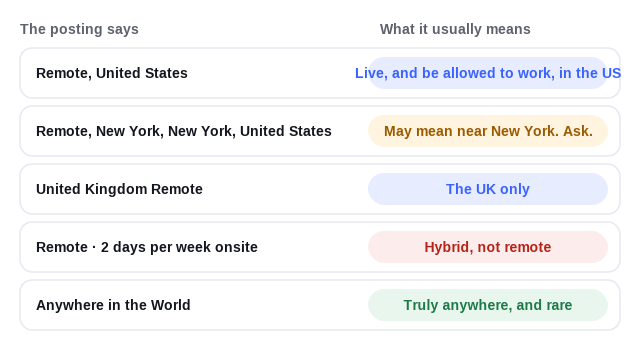
An illustration of five location lines and what each usually means. The wording is typical of real postings; the meanings are our reading, so check the posting or ask. Check the job is real on the company's own site
The FBI's advice is to confirm a posting on the company's own website, because scammers copy real companies' jobs onto job sites. Find the same job on the employer's careers page and apply there. The one-minute check below covers the rest.
Apply early, and only where you fit
With remote jobs drawing so many applicants, a generic application to every remote role gets lost. Pick the ones where you meet most of the must-haves, apply in the first days, and use the posting's own words for things you've really done. Show you can work remotely with a result, not an adjective. Our guides to tailoring your resume and getting a job fast have the details.
Instead of “Strong remote communicator,” write what happened: “Ran weekly planning for a team across three time zones,” if that's what you did.Write to a person about the role
The hiring manager or the recruiter can tell you what no listing will: whether the job is still open and how remote it really is. A short note the day you apply also puts your name in front of a person, not just a queue. In the first call, ask how the team works across time zones and how often people meet in person; in our view, those answers tell you more than the listing. Our guide to finding the hiring manager has every step.

Remote jobs, but remote where? What the location line really says.
In the postings we counted, “remote” almost always meant remote somewhere. We looked at 1,477 job postings from Blynk's searches, mostly senior product roles, first seen between October 31 and November 11, 2026. 699 of them list a remote location. Only 9 of those 699 say anywhere or worldwide without naming a country, and 54 say just “Remote.” The other 636, or 91%, name a country, region, state or city.
Most name the US. 462 name the US and no other country. 84 name only other countries or regions, such as “United Kingdom Remote” or “MX Remote.” 27 name the US and another country. Some add a city, like “Remote, New York, New York, United States,” which in our reading can mean a state rule or an office nearby, so ask.
A few are hybrid, and the fine print adds more. 26 of the 699 say hybrid, in person or office in the location line, or state a clear office rule in the text (one says “2 days per week onsite”). That's a floor: 183 of the 699 had little or no description to read. 32 mention travel, and 22 say where you must live or be allowed to work.
Remote postings listed pay more often. 300 of the 699 list pay (43%), against 228 of the 778 others (29%). Pay transparency laws differ by state, so the gap may come from where employers are, not from remote work.
How can I make $2000 a week working from home? $2,000 a week is about $104,000 a year, so it's a salaried professional job, not a side gig. Of the 300 remote postings above that list pay, 287 start at $104,000 or more, but they're senior product roles. An offer of that pay for easy work, with no interview, is a warning sign in our view: run the check further down.
These counts describe what Blynk's searches found in 12 days, not the whole job market.
The best remote job sites, and what each is good for.
There's no single best site for remote jobs. The right one depends on your field and where you can work. These are well-known places, each described from its own pages, in no particular order. Whichever you use, read the location line on every listing.
LinkedIn and Indeed. The big general boards, both with remote filters: Remote in LinkedIn's search filters, and “Remote” in Indeed's Where box. Set the filter every time. Compared with Blynk: LinkedIn Jobs and Indeed.
We Work Remotely. A remote-only board with a free Basic account for browsing and saving jobs. Its FAQ says unlimited applications need the paid Pro plan, $14.95 a month on a 12-month commitment. Employers pay $299 to post a job, and each listing shows the countries it accepts, or “Anywhere in the World.”
Himalayas. Says it's free for job seekers with no subscription required, and lets you filter remote jobs by time zone, location and salary.
Remotive. Lists fully remote jobs from companies it says it vets, with a location on each listing, such as USA, Worldwide or Europe. A paid tier adds early access and more location filters.
Working Nomads. Collects remote jobs from around the web, with region and country filters and free job alerts. It also has a paid Premium plan.
Wellfound and Built In. Startup and tech jobs. Wellfound lists startups that post there, and Built In lists tech jobs posted by employers or synced from their hiring systems. Compared with Blynk: Wellfound and Built In.
Free or paid remote job sites? When paying makes sense.
FlexJobs charges job seekers. It hand-screens remote and flexible jobs. A paid plan is needed to see employer names and apply: a $2.95 trial, then $23.95 every 4 weeks, on its pricing page as of November 10, 2026. Blynk vs FlexJobs, compared.
Is it worth paying for a remote job site? It can be, if hand-screened listings save you hours. But paying isn't the only way to stay safe. Several remote job sites are free for job seekers, and the only place to confirm a job is the employer's own careers page.
Don't forget the companies themselves. Some companies hire remotely by design, and their careers pages are free to search. We Work Remotely keeps a list of top remote companies, and a few are named in the questions below.
Legit remote jobs, or a scam? A one-minute check before you apply.
Job scams are common, and growing. Reported losses to job and employment agency scams rose from $90 million in 2020 to $501 million in 2024, the FTC says. Five checks take about a minute, in our experience.
1. The location line. A real remote job says where it can be done from. Big pay for easy work, with no company details, is a reason to slow down.
2. The same job on the company's own site. Confirm the posting on the company's website, as the FBI advises. Then search the company's name with “scam,” “review” or “complaint,” as the FTC suggests.
3. Who's writing to you, and how. Task scams usually start with an unexpected text or WhatsApp message offering paid work, the FTC says. A real recruiter usually writes from the company's own email address, in our experience, not a free account.
4. Money. “Never pay anyone to get paid,” in the FTC's words. Never deposit a check and send money back: the FTC says fake checks bounce, and you owe the bank. Reshipping packages is never a real job.
5. Your details. Real employers ask for bank and personal details after they hire you, the FBI says, not before.
Still not sure? Ask a person at the company whether the role is open and how remote it is. Blynk can find the hiring manager and write them a short note, and sends it only when you say send. Report scams at ReportFraud.ftc.gov and ic3.gov. If the company is real but the opening may not be, read our guide to ghost jobs.
Remote job search phrases, ready to copy.
Examples to paste into a job board's search box. Swap in your own job title and the place you can work from.
A title plus remote, for the big boards
Put the title in the search box. On Indeed, put Remote in the Where box instead of the search box.
senior product manager remote
head of product remote United States
product manager remote US
Other words employers use for remote
Try each with your title. Then read the location line, because none of these promise where.
senior product manager distributed
senior product manager remote first
senior product manager work from home
Narrow it to where you can work
For a country, a region or the hours you can keep.
product manager remote Canada
product manager remote EMEA
product manager remote Eastern time
Find the company's own posting
Paste into a search engine to check a job on the employer's careers page.
[Company] careers [Job title]
[Company] jobs remote
Questions about finding remote jobs, answered.
How to find remote jobs without getting scammed?
Use the one-minute check above. Confirm the job on the company's own careers page, as the FBI advises, and apply there. Never pay to get a job, and never deposit a check and send money back: the FTC says fake checks bounce and you owe the bank. Be wary of unexpected texts or WhatsApp offers, which is how task scams usually start, the FTC says. Give bank details only after you're hired.
What is the best way to find a remote job?
Decide which remote you can take: the country, the hours, any office days. Search a job title plus “remote” on LinkedIn or Indeed with the remote filter on, and on one or two remote job sites. Read each posting's location line first, confirm the job on the company's careers page, and apply early to the few you fit. A note to the hiring manager helps too.
Where is best to look for remote jobs?
Three places work together. First, a big board with its remote filter on: Remote on LinkedIn, or “Remote” in Indeed's Where box. Second, a remote-only board such as We Work Remotely, Himalayas or Remotive. Third, the careers pages of companies that hire remotely, which is also where you confirm a remote job is real.
Which is the best site for remote jobs?
There's no single best one; it depends on your field and where you can work. For most people, start with LinkedIn or Indeed with the remote filter on, plus one remote-only board. We Work Remotely shows the countries each listing accepts, and Himalayas lets you filter by time zone. For startups, try Wellfound or Built In. If you'd pay for hand-screened listings, that's what FlexJobs does.
What is the most legit site for remote jobs?
No site can promise every job is real, but some check more. FlexJobs hand-screens its remote job listings, and We Work Remotely charges employers $299 to post. The most legit source of all is the employer's own careers page: the FBI's advice is to confirm any posting there before you apply.
Which company is 100% remote?
Several well-known companies say so on their own sites. Automattic calls itself a distributed company, with 1,347 people in 80 countries. Zapier says it has worked remotely since day one, with 800+ people across 38 countries. Buffer says it committed in 2013 to being a fully remote, distributed team, and We Work Remotely keeps a longer list. Even fully remote companies may hire only in some countries, so read the location line.
What is the easiest remote job to get right now?
There isn't an easy one, because remote jobs draw a crowd, as LinkedIn's numbers above show. Remote is a location, not a kind of job. So in our view the easiest remote job to get is the one you're already qualified for: search your current title plus “remote.”
How to get a legit remote job with no experience?
It's harder, and scams aim at exactly this search. The FTC counted about 20,000 reports of task scams, which offer easy paid work by text, in the first half of 2024, against about 5,000 in all of 2023. Look for entry-level roles, such as customer service, on employers' own careers pages, apply there, and never pay to start. Keep the work you've done, paid or not, on your resume.
Does Amazon really pay you to work-from-home?
Yes. Amazon hires Customer Service Associates, including virtual ones who work from home. Its careers site describes full-time and part-time roles with “flexible remote work options” as an added perk. Apply only on Amazon's own sites, amazon.jobs and hiring.amazon.com.
Is Amazon Work From Home real?
The jobs are real, and so are scams that borrow Amazon's name. Amazon's careers site describes Virtual Customer Service Associate roles. But an unexpected text offering easy, well-paid Amazon work at home is a warning sign: the FTC says task scams usually start with an unexpected text or WhatsApp message. If you can't find the job on amazon.jobs or hiring.amazon.com, don't apply.
Sources, and where to go next.
Checked on November 11, 2026. The advice is ours. Facts about other companies come from their own pages; FlexJobs' price comes from its pricing page as checked for our comparison on November 10, 2026. Remote job demand comes from LinkedIn's own Economic Graph report, telework from the US Bureau of Labor Statistics, and scam advice from the FTC and the FBI. Blynk's counts are its own: 1,477 job postings from Blynk's searches, mostly senior product roles, first seen between October 31 and November 11, 2026. A posting counts as remote when its location contains the word “remote.” Office, travel and residence rules were found in the posting text with a text search and spot-checked by hand; they are floors. We Work Remotely's plans come from its FAQ, read on November 12, 2026.
- How to get a job fast
- Ghost jobs: how to spot a posting that isn't a real opening
- How to find the hiring manager
- The best job search apps, compared
- Remote and need sponsorship?
- How to spot a job scam
- What a hybrid job means
- How to get a job in another state
- Four-day work week jobs
- LinkedIn Economic Graph: US Monthly Economic Insights, April 2026 (remote and hybrid postings, March 2026)
- BLS: telework or work at home for pay, 2025 annual averages
- FTC: job scams
- FTC: reported fraud losses in 2024, including job scams
- FTC data spotlight: task scams and paying to get paid
- FBI IC3: scammers using fake job postings
- LinkedIn Help: search for remote jobs
- Indeed career guide: how to find a remote job
- FlexJobs: how to find a remote job
- We Work Remotely
- We Work Remotely: frequently asked questions (plans for job seekers)
- We Work Remotely: top remote companies
- Himalayas
- Remotive
- Working Nomads
- FlexJobs pricing
- Wellfound jobs
- Built In knowledge base: why aren't my jobs showing
- Amazon jobs: Customer Service Associates
- Amazon hiring
- Automattic: work with us
- Zapier: about
- Buffer: about
- Blynk Find Jobs
- Blynk pricing
- Blynk homepage (Find the Hiring Manager)
