
Contract to hire, explained. And what to ask before you say yes.
A recruiter has offered you a contract-to-hire role, or you keep seeing them in job postings. Two questions follow. Will they actually hire me, and what do I give up meanwhile? Here's what it means for you, what the agency's pages leave out, and what to ask before you sign.

The short answer
- Contract to hire means you start on a contract for a set time, usually employed by a staffing agency. At the end, the company can offer you a permanent job, extend the contract or let it end.
- A permanent offer isn't promised, and no reliable figure says how often one comes. Ask this company how many people it has converted, and what decides it.
- Before you say yes, get five answers in writing: who employs you (W-2 or 1099), the rate, which benefits start and when, how long the contract runs, and what the permanent job would pay.
On this page
Contract to hire meaning, and who you'd really work for.
Contract to hire is a trial with a job at the end, maybe. You're hired for a set time to do the work. During that time you're usually employed by a staffing agency, not by the company where you work each day. At the end, the company decides whether to offer you a permanent job. “To hire” is what it hopes to do, not a promise.
There are three of you. You do the work. The agency pays you and handles your taxes. The company, often called the client, runs your day and makes the call on an offer. It also pays the agency for your time.
How it differs from other jobs. A direct hire is the company's own employee from day one. A plain contract has an end date and no plan to hire. Temp-to-hire is often used for the same thing as contract to hire. We found no official line between the two, so read the terms you're offered.
Two more you may meet. An independent contractor is paid as a business, on a 1099, and Upwork describes its own contract-to-hire jobs as starting that way. Some IT roles use corp-to-corp (C2C), where you bill through your own company. Aerotek and Aston Carter, two large staffing firms, say they generally don't hire that way.
This page is about the US. The tax, benefit and unemployment rules below are American, and they differ elsewhere.
How contract to hire works, from the job posting to the offer.
Five steps, in the order you'll meet them. The details vary by agency, so ask about each one.
The job posting, and the agency recruiter
When a staffing agency runs the contract, a recruiter there is the person you'll talk to. The company pays the agency, so in our reading the recruiter works for the company's side, not yours. Here's who recruiters work for, and how to answer one. You shouldn't pay anything. The US Federal Trade Commission (FTC) says honest placement firms “do not typically charge a fee to job candidates.”
Who employs you: usually the agency, on a W-2
Aerotek and Aston Carter both say on their own pages that they hire US contract workers on a W-2. They withhold your taxes, and they charge job seekers nothing. Upwork's version is different: on its platform, contract to hire usually starts as freelance work. The label alone doesn't settle which you are. The IRS looks at who controls the work, the money side and the relationship, and says “no one factor stands alone.”
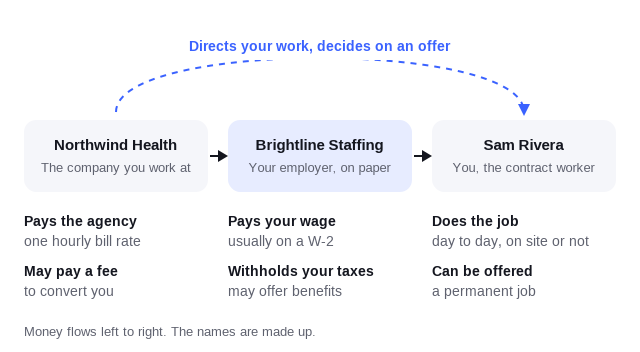
An illustration of who does what in a contract-to-hire job. The names are made up. The trial: often a few months
No official figure exists for how long it lasts. Kelly, a staffing firm, says three to six months is typical. 4 Corner Resources, another, sees three to twelve months. You do the job like anyone on the team, and the company watches how you fit.
The decision: an offer, an extension or the end
At the end date, one of three things happens. The company offers you a permanent job, extends the contract, or lets it end. An extension isn't a no, but it isn't an offer either. Ask for the next decision date in writing.
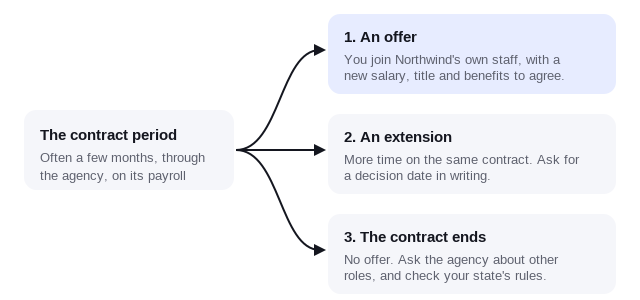
An illustration of the three ways the contract period can end. The company name is made up. The offer: a new job, with new terms
If you're converted, you leave the agency's payroll and join the company's. That means a new salary, title and benefits, and you can negotiate them. Here's how to negotiate salary. To compare an hourly rate with a salary, multiply it by 2,080, which is 40 hours times 52 weeks.
$45 an hour × 2,080 hours = $93,600 a year, if you're paid for every week. A contract with no paid time off pays nothing for the weeks you take off.


Will they actually hire you? What the contract-to-hire numbers really say.
No reliable contract-to-hire conversion rate exists. We looked for one from a named survey with a stated method, and found none. Staffing firms' pages say people “often” convert, or give a range with no source.
The one named figure covers all contract jobs. The American Staffing Association (ASA) and LinkedIn published it in February 2026. Among US LinkedIn members who held staffing-industry roles in the past 10 years, it counts the share of all moves out of contract roles that went to permanent full-time roles. That was 14% in 2025, down from 56% in 2016. It counts every contract role, not only contract-to-hire ones, so it can't tell you the odds for yours.
Blynk's own job postings had none. We checked every posting from Blynk's searches, first seen October 31 to November 12, 2026, and none was contract to hire. Those searches come mostly from employers' own career sites, where staffing agencies' postings are largely absent. So we have no count to give you either.
So ask this company for its own number. “How many people in this role have you converted in the past year?” A clear answer helps you decide. In our reading, a recruiter who can't answer has told you something too.
Watch for extensions instead of offers. On Ask A Manager, readers describe extensions instead of offers; one reader's got shorter each time, six months, then three, then one. If yours is extended, ask what has to happen for an offer, and by when. If the answer is vague, start looking again. That's our advice, not a rule.
The conversion fee, and what it means for your offer.
The company pays the agency for every hour you work. It pays one hourly bill rate, which covers your wage and the agency's costs and margin. 4 Corner Resources, a staffing firm, says contract to hire costs about 1.5 to 1.8 times the worker's pay per hour.
Hiring you away from the agency can cost the company a fee. 4 Corner Resources says most agencies tie it to the hours you've worked. The fee shrinks as your hours add up, and drops to zero once the agency has made back its recruiting cost. KORE1, an IT staffing firm, says fees are usually 15% to 25% of the first year's salary. In both firms' descriptions, the company pays it, not you.
What that can mean for you, in our reading. If the fee shrinks with your hours, converting you later can cost the company less than converting you now. That's one reason an extension can come before an offer. And once you're converted, the company stops paying the agency's markup. That's worth knowing when you talk about salary.
The question to ask. “Is there a conversion fee, and does it change with the hours I've worked?” The recruiter may not give you the number. The answer to the second half still tells you a lot.
Health cover and unemployment on a contract-to-hire job.
Fewer agency workers get health cover through work. In the US Bureau of Labor Statistics (BLS) survey of July 2023, 16.6% of temporary help agency workers had health insurance from their employer. For workers in traditional jobs, it was 54.4%.
Some agencies do offer plans. Aerotek and Aston Carter say they offer contract workers medical, dental and vision plans that you pay into. Cover starts on the first day of the month after you're hired, so a mid-month start can leave a few weeks before it begins. Both say some assignments may include paid time off. Kelly says agencies typically don't offer it.
Leaving a job with health cover? The US Department of Labor (DOL) says you have 60 days to choose COBRA, which keeps your old plan, usually for up to 18 months. You usually pay the full premium.
Or a Marketplace plan. Losing job-based cover also opens a window to buy a Marketplace plan. DOL's COBRA guide says you must pick one within 60 days before or after the old cover ends. Being offered COBRA doesn't make you ineligible. If you drop COBRA early with no new reason to enroll, you wait for open enrollment.
If the contract ends, unemployment is a state program. DOL says it's usually for people unemployed “through no fault of their own”, and each state sets its own rules. On a W-2, your employer pays unemployment tax on your wages, the IRS says. DOL's unemployment page lists self-employment only under special programs, such as disaster aid. Either way, check your state's unemployment office before you count on it.
Contract-to-hire pay and taxes, W-2 or 1099.
On a W-2, the agency is your employer. The IRS says employers withhold income tax, Social Security and Medicare from your pay, and pay a matching share. Unless your job is exempt, DOL says you get overtime at time and a half for hours over 40 in a week.
On a 1099, you're paid as a business, and nothing is withheld. If your net earnings are $400 or more, you owe self-employment tax, the IRS says. The rate is 15.3%, made up of 12.4% for Social Security and 2.9% for Medicare. As an employee, you'd pay half and your employer would pay the other half. The IRS lets you deduct the employer-equivalent half when you work out your income tax.
The rules, as of November 2026. For taxes, the IRS decides employee or contractor by control, money and the relationship (page reviewed May 19, 2026). Either side can ask the IRS to decide with Form SS-8, which takes at least six months.
Wage and overtime rules are being rewritten. For those, DOL proposed replacing its 2024 rule on February 26, 2026. Comments closed April 28, and DOL says it no longer applies the 2024 rule in investigations. No final rule was out when we checked.
A higher hourly rate isn't always more. In the same BLS survey, full-time temporary help agency workers had median weekly earnings of $818, and contract company workers $1,014. Workers in traditional jobs had $1,132. Count benefits, unpaid time off and taxes before you compare. For your own case, ask the agency, or a tax professional.
Questions to ask before you accept a contract-to-hire job.
Ask the agency recruiter, and ask for the answers in writing. The email below puts them all in one message.
Who employs me, and on a W-2 or a 1099?
It decides your taxes, overtime and unemployment cover. If it's a 1099 but the company will run your day like an employee's, ask why.
What's the hourly rate, and is overtime paid?
Ask how often you're paid, and whether holidays and sick days are paid or unpaid.
Which benefits start, and when?
Health, dental and vision, paid time off, and retirement. Ask the start date and your share of the cost.
How long is the contract, and can it be extended?
Ask how long others in this role stayed on contract before an offer.
What decides the offer, and who decides?
Ask what a good trial looks like, when the decision is made, and how many people in this role were converted in the past year.
What would the permanent job pay, and is there a conversion fee?
Ask for the salary range and title, whether a fee applies, and whether it changes with your hours. Ask what happens if the contract ends early, and what notice either side must give.
An email to the recruiter, with every question in one place.
Swap the [square brackets] for your details. Keep it short, and ask for the answers in writing so you have them later.
Before you accept
Once they've offered you the role. Subject line [Job title] contract, a few questions
Hi [First name],

Thanks for the offer for the [Job title] contract with [Company]. Before I say yes, could you send me a few answers in writing?

1. Am I employed by [Agency] on a W-2, or paid on a 1099?
2. What is the hourly rate, and is overtime paid?
3. Which benefits start, and on what date?
4. How long is the contract, and how are extensions decided?
5. What decides a permanent offer, and roughly when?
6. What salary range and title would the permanent role have?
7. Is there a conversion fee, and does it change with my hours?

Thanks, and I look forward to it.
[Your name]
When they extend instead of offering
When the end date comes with an extension and no offer.
Hi [First name],

Thanks for letting me know about the extension. I'd like to stay and keep growing with the team. Could you tell me what would need to happen for a permanent offer, and when that decision will be made?

Thanks,
[Your name]
Contract to hire, do this, not that.
The advice is ours, unless a source is named.
Do
- Get the rate, benefits, length and permanent pay in writing.
- Ask how many people in this role were converted last year.
- Treat the trial as the job, from day one.
- Know the date your health cover starts before you leave a job.
- Ask for a decision date when they extend.
- Keep looking until you have a written offer.
Don't
- Pay anyone to get the job. The FTC says honest placement firms don't typically charge candidates.
- Assume “to hire” means you will be hired.
- Accept a 1099 for a job run like an employee's without asking why.
- Count on a promise made only on the phone.
- Accept extension after extension with no date.
- Let your old cover lapse without checking COBRA and the Marketplace window.
Is contract to hire worth it? When it helps, and when to be careful.
It can be a good way in. A contract gets you inside a company or a new field, and you show what you can do on the job. It can suit someone between jobs. The ASA says 64% of the people who work through staffing firms do it to fill the gap between jobs or to help land one. And on Ask A Manager, some readers describe companies that converted nearly everyone who worked out.
Be careful in three cases. Our reading: leaving a permanent job with benefits for a contract with none; extension after extension with no decision date; and a 1099 for a job run like anyone else's. In each, get the answers in writing first, and weigh them against the other jobs you could get.
Either way, the answers decide it, not the label. The same words can mean a fair trial with good odds, or months without benefits and no offer. The questions above tell you which one you're looking at.
Questions about contract to hire, answered.
Can you quit a contract to hire?
Yes, Upwork says, but both sides should keep to the contract's terms unless they agree to end it early, so read your agreement first. Since the agency employs you, our advice is to tell your agency recruiter before you tell the company, and give the notice the agreement asks for. Leaving well keeps the agency willing to place you again.
What is the 70/30 rule in hiring?
It's an informal rule of thumb, not a standard, and it has two meanings. TestGorilla uses it for hiring someone who meets about 70% of the requirements and training the rest. Homebase uses it for weighing skills at 70% and fit at 30%. A contract-to-hire trial is a way for a company to see both before it commits.
What are the different types of job contracts?
In the US job sense, there are six you'll meet. A direct hire is permanent, on the company's own staff. A fixed-term contract has an end date and no plan to hire. A temp or contract job runs through an agency, and contract to hire is a trial that may turn permanent. An independent contractor is paid on a 1099, and in some IT roles, corp-to-corp (C2C) means you bill through your own company.
What is a red flag in a contract?
In a job contract, our list starts with being asked to pay a fee to get the job. The FTC says honest placement firms don't typically charge candidates. Also watch for a 1099 for a job run like an employee's, and no written terms for when or how you'd be converted. Pay or an offer promised only out loud is another, and so are open-ended extensions. For fake job offers, see how to spot a job scam.
What are the four types of contracts?
There's no official list of four for jobs. Our grouping for a job seeker: permanent (direct hire), fixed-term contract, contract to hire, and independent contractor (1099). Agency temp work and corp-to-corp (C2C) sit alongside these. What matters most is who employs you and whether a permanent offer is planned.
What does contract to hire mean?
You're hired for a set time, usually through a staffing agency that employs and pays you, with the chance of a permanent job at the company at the end. The company can offer you the job, extend the contract or let it end. A permanent offer isn't promised.
Do contract-to-hire jobs usually convert?
No one can say for sure. We found no reliable contract-to-hire conversion rate. The one named figure, from the ASA and LinkedIn, covers all contract roles. Among US LinkedIn members who had worked through staffing firms, 14% of moves out of contract roles in 2025 went to permanent full-time jobs. Ask the company how many people in this role it has converted.
Do contract-to-hire employees get benefits?
Sometimes, from the agency. Aerotek and Aston Carter say they offer medical, dental and vision plans you pay into, from the first of the month after hire. Some assignments may include paid time off. In the BLS survey of July 2023, 16.6% of temporary help agency workers had health insurance from their employer, against 54.4% in traditional jobs.
Can you negotiate a contract-to-hire salary?
Yes, twice. Negotiate the hourly rate before you start, and the salary when you're offered the permanent job. At conversion, the company stops paying the agency's markup, which in our reading gives you room to ask. Here's how to negotiate salary.
How do I put a contract-to-hire job on my resume?
List the company you worked at, with the agency in parentheses or a short note, such as “Northwind Health (via Brightline Staffing)”. If you were converted, our advice is to show it as one job, with the date you joined the company's staff. Here's more on putting contract and freelance work on a resume.
Where the facts come from.
Checked on November 12, 2026. The advice is ours, and where a line is our reading we say so. This is general information, not tax or legal advice. Tax and benefit facts come from the IRS and the US Department of Labor (including its Bureau of Labor Statistics). Facts about staffing firms come from each firm's own pages. Blynk's check covered 1,501 postings and 792 job feed entries from Blynk users' searches, first seen October 31 to November 12, 2026. We searched them for contract to hire, temp to hire, temp to perm and C2H, and read every use of the word contract by eye. None was a contract-to-hire job.
- What is a recruiter
- How to negotiate salary
- Freelance and contract work on a resume
- How to spot a job scam
- How to decline a job offer
- What to say as your reason for leaving
- What fractional jobs are
- IRS: Independent contractor (self-employed) or employee? (reviewed May 19, 2026)
- IRS: Self-employment tax (Social Security and Medicare taxes) (reviewed October 30, 2026)
- US Department of Labor: Misclassification of employees as independent contractors
- US Department of Labor: 2026 proposed rule on independent contractor status
- US Department of Labor: news release, February 26, 2026
- US Department of Labor: Overtime pay
- US Department of Labor: Unemployment insurance
- US Department of Labor: COBRA continuation coverage
- US Department of Labor: An Employee's Guide to Health Benefits Under COBRA (September 2022)
- BLS: Contingent and Alternative Employment Arrangements, July 2023 (released November 8, 2024)
- American Staffing Association: Staffing industry statistics
- American Staffing Association and LinkedIn: The State of Staffing and Search (February 2026)
- FTC: Job scams
- Aerotek: Job seeker questions
- Aston Carter: Job seeker questions
- Kelly: Contract, temp and permanent employment options (February 17, 2026)
- 4 Corner Resources: Contract-to-hire pros and cons (updated November 3, 2026)
- KORE1: Contract-to-hire, the employer's guide (updated September 12, 2026)
- Upwork: What is contract to hire (June 2, 2026)
- Ask A Manager: Is contract-to-hire worth it? (October 24, 2019, with readers' comments)
- TestGorilla: skills-based hiring and the 70/30 rule
- Homebase: hiring process steps and the 70/30 rule
