
How to list promotions on a resume. So a quick reader sees you moved up.
If you’ve moved up at one company, your resume can read like one long job, or like three short ones. Here’s how to list promotions so your career progression is obvious, what resume software really does with stacked titles, and examples for the awkward cases.

The short answer
- List the company once, then each job title under it, newest first, each with its own month-and-year dates.
- Put each title’s own two or three bullets under it, showing what grew when you were promoted. Our advice is to avoid one list after all the titles.
- Use one date format on every line. RChilli, which makes resume parsing software, documents reading each title with its own dates as its own role at the same employer.
On this page
How hiring software reads a promotion, from the parser makers’ own documents.
Most advice on this is a guess. Some formatting tips say stacked titles confuse an applicant tracking system (ATS), so you should list the company twice. Others say the opposite. None of the top-ranking guides we read cited the companies that build the software. Two of those companies document it, and that information beats any guess.
RChilli makes resume parsing software, which turns resumes into fields a hiring system can search. Its help center covers a resume with several job titles under one employer, over different but continuous periods. RChilli says it pulls out each role as its own work history entry, all under the same employer name. Its example is one company with three titles, each with its own month-and-year range.
Textkernel, another parser maker, provides every position in its resume data with its own job title, start date and end date. Positions at the same employer are linked to each other.
Lever, an applicant tracking system, lets recruiters filter candidates by company and job title. It also filters by years of experience, which it says is “calculated based on parsed dates.” So your dates do real work.
What it means, in our reading. The choice that matters isn’t whether you stack or separate, but whether every title has its own dates. We read two parser makers’ documents, not every system’s. And none of the hiring-system help pages we checked (Greenhouse, Lever, Workday, Ashby and Taleo) mentions stacked titles at all. So use whichever layout gives a person the most clarity, and keep the dates consistent.
Why a promotion gets missed on a resume, and what’s really going on.
Three worries people often have about showing a promotion, and what the evidence says about each one.
“It looks like I had the top title the whole time.”
When every bullet sits under your newest title, a reader can’t tell you moved up, or when. Alison Green, a hiring manager, writes the Ask a Manager column. She tells readers to list both titles “so that you’re not making it sound like you had the higher title the whole time.” Background checks look at this too. HireRight says an employment verification typically confirms each job’s title and its start and end dates, and notes any mismatch on the report.
Check: Can a reader see each title, and when you held it? That’s your career growth, at a glance.
“If I list the company twice, I’ll look like a job hopper.”
Ask a Manager warns that separate entries for one employer can make quick readers miss that you stayed for years. Green says she has caught herself reading it that way. Separate entries still make sense when the roles were distinct, as the examples below show.
Check: Does the company appear once, with your total time there? Unless the roles had little in common.
“Recruiters won’t read closely enough to notice.”
In a 2018 eye-tracking study by Ladders, recruiters spent about 7.4 seconds on a first scan of a resume, as HR Dive reported it. Simple layouts with clear headings and bold titles did well. Ladders didn’t give a sample size. In our reading, that’s why your career progression should show in the layout, not in a line inside your third bullet.
Check: Do your job titles get attention, in bold, with dates that are easy to find? That’s what a quick look catches.
How to list promotions on a resume, in six steps.
Marquette University’s business career center calls this the promotion format. It works for multiple roles at one company. Follow the steps in order.
Write the company line once
In your work experience section, put the company name on its own line, with the city or “Remote”. You can add your total time there, such as “Mar 2019 to Present”. That single line tells a reader how long you stayed. Syracuse University’s Newhouse career center suggests listing the company once with your overall tenure, then stacking the roles under it.
Give each title its own dates, newest first
Under the company, list each job title you held in reverse chronological order, your current position at the top. Give each one its own month and year to month and year. Only your current role says “Present”. Use the same type of date everywhere, such as “Mar 2021”, and, our advice, avoid seasons or years alone. These dates are the important part, since they let a parser, and a person, see two roles instead of one.
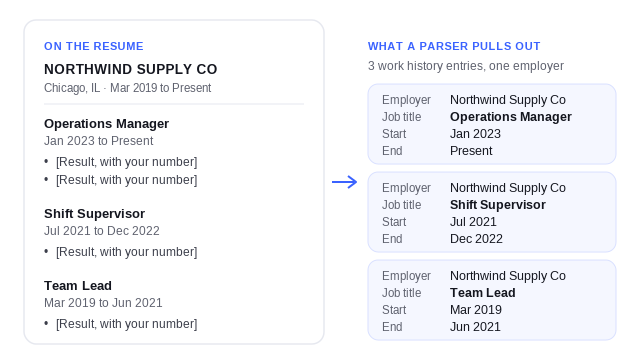
An illustration based on RChilli’s and Textkernel’s documents. The company and titles are made up. Put two or three bullets under each title
Each title gets its own bullet points, directly beneath it, so a reader can tell which title did what. Give your newest title the most, and earlier positions one to three. Lead each bullet point with action verbs like led, built or managed, then what you did and its impact. That means accomplishments, not a list of job duties. The resume bullet points guide covers how to write them.
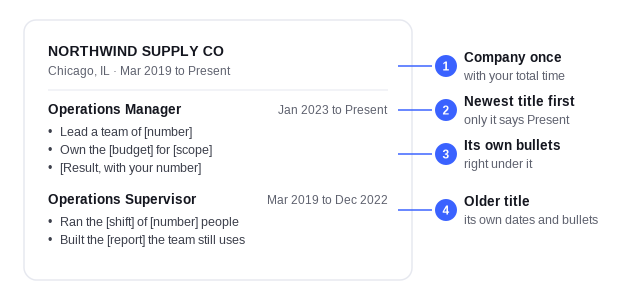
An illustration of the stacked layout. The person, company and bracketed details are made up. Show what grew, and cut what repeats
A promotion is evidence of good performance. So the newer title’s bullets should highlight what changed, such as new responsibilities, team leadership, a larger budget or new skills you use. Measurable results and metrics help when they’re real, so quantify only what you can explain. If the older title did the same work, don’t repeat it, and keep what it did first or what led to the promotion. Take your last performance review and the note announcing the promotion, and look for what changed.
Say “promoted” only when the layout can’t
Two titles with their own dates already say you were promoted. No source we found requires a “Promoted to” bullet. Our advice is to use the word when the layout can’t show the step. That means one title line for a short stint, more scope with the same title, or a promotion that came fast and was earned by something specific.
Use one layout for every job, then check it reads cleanly
Ask a Manager and Marquette’s career center both say that once one job is listed company first, every job should be, even jobs with one title. Then check the formatting, since Greenhouse lists tables, columns, headers and footers, mixed formats and incomplete job titles among the causes of a failed parse. Workday says results can vary with format and word order. The ATS-friendly resume guide has the rules. Or upload your resume to ATS Check to see for yourself how hiring software reads it, and what could get it skipped.


Stacked, separate or one line, how to choose the best layout for a promotion.
Stacked titles are the best choice for most people. They show one employer, your total time and an upward career trajectory, in the order it happened. Use them when each role grew out of the one before, with increasing scope, which is what most promotions are. It’s the approach both career centers on this page show.
Separate entries work when the roles were very different. An engineer who moved into product management, or a lateral move between departments where you gained new skills, can read more clearly as two jobs. The cost is that a quick reader sometimes misses how long you stayed.
One title line works for a small step or a short stint. It saves space, which makes it a fair option. But the older title has no dates of its own, so in our reading it gives software the least to go on.
Not sure? Consider what the reader should see first (our advice). If it’s your growth at one company, stack the titles. If it’s the difference between two kinds of work, separate them. Whatever you choose, keep that consistency through the whole resume.
Multiple positions at the same company, resume examples for each layout.
Five layouts for showing promotions within one company, and a set of bullets, in plain text, ready to copy. Every bullet sits under the title it was done in. The names are made up, and the [square brackets] are for your own facts and numbers.
Stacked titles under one company
The default for most promotions, and the clearest way to show career advancement at one company.
NORTHWIND SUPPLY CO · Chicago, IL · Mar 2019 to Present

Operations Manager · Jan 2023 to Present
- Lead [number] employees across [sites or shifts], up from [number] as a supervisor
- Reduced [costs or errors] by [number] after [what you changed]
- Hired and trained [number] supervisors, [the result]

Operations Supervisor · Mar 2019 to Dec 2022
- Ran the [shift or area] of [number] people, [the result]
- Built the [process or report] the team still uses
Bullets that show what grew, under the newer title
Pick only the lines that are true for you, and fill in the brackets. Each one belongs under the title where it happened.
[Newer title] · [Month year] to Present
- Led a team of [number], up from [number] before the promotion
- Took on [responsibility] when promoted, and [the result]
- Managed a budget of [amount] for [program or department]
- Increased [sales, revenue or another metric] by [number] in [time]
- Improved [process], reducing [time, costs or errors] by [number]
- Developed and implemented [program or process] used by [team or client]
- Delivered [project] for [client or department] on [schedule or budget]
- Trained and coached [number] new hires
- Recognized with [award] for [what you achieved]
Separate entries, for very different roles
Use it when the jobs weren’t closely related, such as an engineer who moved into product management. Each entry names the company, so the first bullet says you moved inside it. Changing fields where you work? The career change resume guide covers the wording.
Product Manager · Lakeview Health · Boston, MA · Jun 2022 to Present
- Moved from the engineering team into product in [month year]
- Own the [product area] roadmap for [number] [users or customers]
- [One result, with your number]

Software Engineer · Lakeview Health · Boston, MA · Aug 2018 to May 2022
- Built [the feature or system] used by [number] [users or teams]
- [One result, with your number]
One title line, for a short stint or a small step
Use it when the new title came quickly or changed little. It’s the one layout where the older title has no dates of its own, so keep it for short stints.
Senior Account Executive · Brightline Media · Remote
Feb 2024 to Present (promoted from Account Executive in [month year])
- Promoted after [number] months, for [what earned it]
- Manage [number] accounts and [amount] in annual sales, up from [number]
- [One more result, with your number]
Multiple promotions, with a move to a new city
Put the new team or city on the title line, so it’s clear it was the same employer.
HARBOR AND PINE BANK · Mar 2017 to Present

Branch Manager, Denver, CO · Apr 2022 to Present
- Moved to open the [branch or team], with [number] staff
- [One result, with your number]

Assistant Branch Manager, Tulsa, OK · Jan 2020 to Mar 2022
- Ran [what you ran], [the result]

Personal Banker, Tulsa, OK · Mar 2017 to Dec 2019
- [One result, with your number]
A full experience section, one layout throughout
A sample resume section for a promotion within the same company. The older job has one title, but it uses the same layout.
EXPERIENCE

NORTHWIND SUPPLY CO · Chicago, IL · Mar 2019 to Present

Operations Manager · Jan 2023 to Present
- [Result, with your number]
- [Result, with your number]

Operations Supervisor · Mar 2019 to Dec 2022
- [Result, with your number]

CEDAR FREIGHT · Milwaukee, WI · Jun 2016 to Feb 2019

Shift Lead · Jun 2016 to Feb 2019
- [Result, with your number]
One promotion, rewritten, with the same facts and nothing added.
Many examples online are full of numbers that come from nowhere. This one only moves each bullet under the title it was done in, and rewords it. The older title and its dates come from a bullet in the “before”.
Before, every bullet under the newest title
It reads like four years as a manager. The promotion is buried in the last bullet.
Operations Manager · Northwind Supply Co · Mar 2019 to Present
- Manage [number] supervisors across [number] shifts
- Responsible for the [process] budget
- Ran the night shift of [number] people
- Set up the [report] the team still uses
- Promoted from Operations Supervisor in Jan 2023
After, each bullet under the title it was done in
The only changes are where each fact sits and how it’s worded. The last bullet became the older title and its dates.
NORTHWIND SUPPLY CO · Mar 2019 to Present

Operations Manager · Jan 2023 to Present
- Manage [number] supervisors across [number] shifts
- Own the [process] budget

Operations Supervisor · Mar 2019 to Dec 2022
- Ran the night shift of [number] people
- Set up the [report] the team still uses
When it isn’t a simple promotion, acting roles, renamed companies and same duties.
The challenges most guides skip, each with a layout to copy. Where it’s our advice rather than a source’s, we say so.
An acting or interim title
None of the guides we read covers this. Our advice is to give the acting role its own dated line, with “Acting” or “Interim” as your employer wrote it. HireRight says a verification typically confirms each title and its dates. If you went back to your old role afterwards, keep the acting line anyway.
NORTHWIND SUPPLY CO · Chicago, IL · Mar 2019 to Present

Operations Manager · Jan 2024 to Present
- [Result, with your number]

Acting Operations Manager · Jul 2023 to Dec 2023
- Led the [team or site] of [number] while the role was open
- [One result, with your number]

Operations Supervisor · Mar 2019 to Jun 2023
- [Result, with your number]
The company was bought or renamed
Ask a Manager suggests the new name with the old one in brackets, and says the brackets aren’t needed if the new name contains the old one. For Dummies says to list the names a merged employer used, since background checks will show them. If you moved to the buyer’s own company after the deal, Ask a Manager says two separate entries are fine.
RIDGEWAY FOODS (formerly Bell Street Bakery) · Mar 2018 to Present

Production Director · Jun 2022 to Present
- [Result, with your number]

Production Manager · Mar 2018 to May 2022
- [Result, with your number]
A new title with the same duties
Still list both titles, each with its own dates, so you don’t seem to have held the higher one the whole time (Ask a Manager). Put most bullets under the newer title. If the company only renamed everyone’s title, that title change isn’t a promotion. Our advice is to show the title as it is now, with the old one in brackets, such as “Customer Success Manager (formerly Account Manager)”. Ask a Manager suggests the same for a title that doesn’t say what the job was.
CLEARWATER INSURANCE · Hartford, CT · Jun 2021 to Present

Senior Claims Analyst · Jan 2024 to Present
- [Result, with your number]
- [Result, with your number]

Claims Analyst · Jun 2021 to Dec 2023
- [The work you started, in one line]
More scope, same title
There’s no second title to stack. Monster suggests a short note line saying when you took on expanded responsibilities. For one title over many years, Marquette’s career center groups the bullets under themed sub-headings, each with its own dates.
Project Coordinator · Westfield Builders · Sep 2019 to Present
Took on [the new scope] in [month year]
- [Result after the change, with your number]
- [Result before it, with your number]
You left and came back
If you’re returning to a company you left, our advice is to list it twice, once for each stretch, in date order with your other jobs. The gap then shows honestly, and the first bullet of the newer entry can say you were rehired.
Senior Designer · Ostrava Studio · Apr 2024 to Present
- Rehired after [number] years at [other company]
- [Result, with your number]

Designer · Pinecrest Agency · Jan 2021 to Mar 2024
- [Result, with your number]

Junior Designer · Ostrava Studio · Jun 2018 to Dec 2020
- [Result, with your number]
A lateral move to another team
Our advice is to stack it like a promotion, with the new team in the title line. If the move was your choice and shows a strength, say why in the first bullet.
BRIGHTLINE MEDIA · Remote · May 2020 to Present

Marketing Analyst, Growth team · Mar 2023 to Present
- Moved from finance to [what the team needed]
- [Result, with your number]

Financial Analyst, Finance team · May 2020 to Feb 2023
- [Result, with your number]
The online application form
When a form’s work history section asks for one job at a time, Ask a Manager’s advice is to enter each title as its own job. It also suggests keeping a version with separate entries ready for systems that need it.
Job title Operations Manager
Employer Northwind Supply Co
From Jan 2023
To Present

Job title Operations Supervisor
Employer Northwind Supply Co
From Mar 2019
To Dec 2022
How to show a promotion on LinkedIn, so it matches your resume.
On LinkedIn, add each promotion as a new position at the same company. LinkedIn’s help center says positions at one company are grouped automatically when the new start date is within one month of the previous end date. The group shows the company once, your total time there, and each position with its own dates.
That fixes the “I’ve only been here a year” look. Your total time at the company shows at the top, even if your newest title is recent.
To show positions apart, LinkedIn says to change the company name on one of them.
Keep it matching (our advice). Use the same titles and dates on LinkedIn as on your resume, so anyone who checks both sees the same professional story.
Mention the promotion in your summary, your cover letter and the interview.
In your resume summary, one line is enough if the promotion is one of your strongest points. Name the step and what it led to, with facts you can talk about. For example (made up), “Operations manager, promoted from supervisor in [number] years at a regional supplier, now leading [number] people across [number] sites.”
In a cover letter, the promotion can carry a sentence the resume can’t, about why you were chosen and what changed after. Keep it to one or two lines, and point to the achievement that matters most for the new role, using the job description’s words where they’re true.
In the interview, be ready for the question of what changed (our advice). Know your responsibilities before and after, the decisions you made, your contributions to the team, and what you achieved during each role. It’s worth keeping your offer letter or the announcement, if you have one, in case anyone asks.
Applying for a promotion where you already work? The same layout works. Lead your summary with the role you want, and let the dated titles show your track record there.
Promotion mistakes on a resume, and what to do instead.
Common mistakes when people list promotions, from the sources on this page, the guides that rank for this search and our own advice.
Do
- List the company once, with your total time.
- Always give every title its own month-and-year dates.
- Put each title’s bullets directly under it.
- Highlight achievements and new responsibilities, not job duties.
- Use one layout and one date format for every job.
- Focus the most detail on your current position.
- Keep the employer’s real titles, including Acting or Interim, and let the bullets carry the job description’s keywords.
- Match the titles and dates on LinkedIn.
Don't
- Put all your bullets after the last title.
- Bury the promotion in your last bullet.
- Hide the older title under the newer one’s dates.
- Repeat the same bullets under each title.
- Write “Present” on two roles.
- Mix date formats, such as “2021” on one line and “Mar 2021” on the next.
- Add a number you can’t explain in an interview.
Frequently asked questions about promotions on a resume, answered.
Should I list a promotion as a separate job on my resume?
Usually not. List the company once and stack the titles under it, each with its own dates and bullets. Ask a Manager warns that separate entries can make quick readers miss a long tenure. Use separate entries only when the multiple roles were very different, such as engineering then product management.
How do ATS read multiple positions at one company?
RChilli, a parser maker, documents reading each title as its own role. RChilli pulls out each title under one employer as a separate entry with its own dates, all under the same employer name. Textkernel gives every position its own title and dates and links positions at the same employer. We read their documents, not every system’s, so give each title its own dates.
Should I include every promotion on my resume?
Yes, for the years your resume covers, especially the recent ones. If you have multiple promotions at one company, list every one with its own dates. Each one helps demonstrate your track record. For a very long career at one company, older titles can shrink to a title and dates. The resume length guide covers how far back to go.
Should I write “promoted” on my resume?
Only when the layout can’t show it, such as one title line for a short stint or more scope with the same title. Two dated titles already say it. If you do, plain words work, such as “promoted to”, “named”, “moved up to”, “advanced to”, “selected to lead” or “took on”.
How do I show a promotion without a title change?
Add a short note line under the title saying when your responsibilities grew, as Monster suggests, then put the more complex work you took on first in your bullets. For one title over many years, Marquette’s career center groups bullets under themed sub-headings, each with its own dates.
Will separate entries for one company make me look like a job hopper?
They can. Ask a Manager says separate entries can make quick readers miss that you stayed with one employer, and its author has caught herself reading it that way. Listing the company once with your total time avoids it.
Do I put dates for each position at the same company?
Yes. Give each title its own month and year to month and year, and add your total time on the company line if you like. Lever says years of experience in its search are calculated from parsed dates. Use your real dates, since HireRight says a verification typically confirms each title and its dates.
Should I mention a promotion in my resume summary or cover letter?
Yes, if it adds value for the job you want. One plain line is enough, such as “Promoted twice in [number] years at [company]”. In a cover letter, one or two lines can say why you were chosen and what changed. Awards or recognition go in a bullet under the title you earned them in.
How do I show an internal transfer on my resume?
Stack it like a promotion, under the company, with the new team or department on the title line and its own dates. If the move shows a strength, say why in its first bullet. If it was a switch into a new field, separate entries can read more clearly.
How do I fit a long career at one company on my resume?
Keep every title and its dates, and give the older, less relevant ones a line or none. That’s how a long career fits a one page resume, if you need one. Put most of your bullets under your newest two titles. If space is still tight, Marquette’s themed sub-headings group similar work. How long a resume should be covers the rest.
Sources, and where to read more.
Checked in November 2026. The advice is ours where we say so. We read two resume parser makers’ documents (RChilli and Textkernel) and the help pages of five applicant tracking systems; none of those systems’ pages mentions stacked titles. The people, companies and bracketed details in the examples are made up.
- Resume bullet points, how to write them
- Career change resume, how to write one
- How long should a resume be?
- What an ATS-friendly resume means
- How does an ATS work?
- RChilli help: how it parses several job titles under the same organization
- Textkernel: the resume data model for a position
- Lever help: advanced search and rediscovery
- Greenhouse help: unsuccessful resume parse
- Workday: resume parsing for candidates
- Ask a Manager: job title or company name first, and several roles at one company
- Ask a Manager: speed round (a job title that doesn’t describe the job)
- Marquette University Business Career Center: sample resume with the promotion format
- Syracuse University Newhouse career development: creating a résumé
- LinkedIn Help: position grouping in your profile’s experience section
- HireRight: what is in an employment verification
- For Dummies: how to list employers that have merged or been acquired
- HR Dive: the Ladders eye-tracking study
- Monster: how to show promotions on a resume
- Blynk Resume Builder
- Blynk ATS Check
