
How to write a letter of interest. Short, to one person, about one team.
There's a company you'd love to work for, and nothing posted fits. Most letter of interest examples run 200 to 260 words. This one shows how to keep it short, who to send it to, and what usually happens next.

The short answer
- A letter of interest asks a company to consider you for a kind of role it hasn't posted. If the job is posted, write a cover letter instead.
- Send it to one person who could hire you, usually the head of the team you'd join. Keep it under about 200 words.
- Say why them, show two or three true things you've done that fit, and ask for one small thing. Then follow up once.
On this page
What is a letter of interest for a job? Also called a letter of inquiry or prospecting letter.
The University of Cincinnati describes it as a letter sent to a company "to express your desire to work with them, even if no specific job opening is advertised". Career offices also call it a letter of inquiry, or a prospecting letter. Here's what people worry about before they send one.
“Can I write to a company that isn't hiring?”
Yes. That's what a letter of interest is for. You may have read that 80% of jobs are never posted. A career center article that looked into it found the claim hard to trace to any single source. Some roles are filled through people before they're posted, but nobody knows how many.
What to do: Write about one team, not the whole company. A clear fit is easier to say yes to.
“Will anyone even read it?”
Indeed's guide for employers says they don't have to reply to a letter of interest. If they aren't hiring, it suggests keeping the letter on file for later. So silence, or "nothing right now", is the usual answer, not a verdict on you.
What to do: Make it easy to read and easy to answer. One person, a short note, and one follow-up.
“Who do I even send it to?”
James Madison University's career center says to write to a specific person. With no posting, nobody tells you who that is.
What to do: Find the head of the team you'd join. Step 2 below shows how.
“Isn't this just a cover letter?”
Close, but not the same. A cover letter answers a job that's posted. A letter of interest asks about one that isn't.
What to do: Check for a posting first. The difference is next.
Letter of interest vs cover letter, and when a posting asks for one.
A cover letter answers a posted job. The University of Cincinnati says it "is tailored to a specific job posting", so it follows what that posting asks for. Not sure you need one? See our guide on whether you need a cover letter.
A letter of interest asks about a job that isn't posted. In the words of James Madison University's career center, it "asks about possible job opportunities rather than responding to a specific job announcement". So it's about the team and the kind of work you'd do, not a list of requirements.
A statement of interest is usually the same letter, with one exception. Morehouse College's career office says a statement of interest is "also called a letter of intent", and is used when a company isn't advertising. It adds that some postings ask you to send one. A school district in Washington, for example, lists a "Letter of Interest" first in what a complete application includes.
When a posting asks for a letter of interest, write a cover letter for that posting. Follow its instructions and its word or page limit, as Morehouse advises. Our guide to cover letter length helps there.
Moving to another team at your own employer? Resume Genius suggests an internal cover letter for that, not a letter of interest. And this page is about jobs. "Letter of intent" also means other things, such as a school application or a business deal. Those work differently.
How to write a letter of interest, in seven steps.
Most of the work is in the first two steps. A good letter to the wrong person, or about no team in particular, goes nowhere.
Pick one company, one team, and a reason to write now
Our advice: choose the team whose work you could help with, not the company in general. Then do a few minutes of research, and find one true reason to write now, from the company's own website or news. A product launch, a new office or a team that's growing all work. If you can't find a reason, the letter will read as generic.
Instead of "I've always admired Northwind." try "I saw Northwind is opening a Denver office for its support team."Find the one person who could hire you
That's usually the person who leads the team or department you'd join, not human resources and not a careers inbox. Our advice: the hiring manager first, since they usually decide, and a recruiter at the company second. Even job postings rarely say who that is. In 1,204 job postings Blynk read from its searches for product roles in November 2026, about 1 in 5 said who the role reports to, and fewer than 1 in 200 gave a person's own email. With no posting, you'll be finding them yourself.
Our guide to finding the hiring manager shows how to work out who leads a team. Then find their email address and check it before you send. If the team does have a job posted, start from that posting instead.Open with why you're writing to them
Your first line says why this person, and why now. Name the team and the reason you found in step 1. If someone referred you, say so here. Skip "To whom it may concern" and the paragraph about your life story.
Show two or three true things you've done that fit
Pick what their team most likely needs, and match it with your most relevant experience and results. Use your real numbers if you have them. Two or three lines is enough, and one strong result beats a list of skills.
Instead of "I'm a passionate, results-driven support leader." try "At Fernway, I set up a support team of [number] people and cut first reply time from [before] to [after]."Ask for one small thing
James Madison University's career center puts it plainly: "If you want an interview, ask for it." A short call is the usual ask. Being kept in mind for the next opening is a softer one. Our advice: one ask, and an easy way to say no.
Write a plain subject line, and sign off with links
The subject line names the kind of role and the team. Sign off with your name and a link to your LinkedIn profile or portfolio. Guides disagree on attachments: Monster says attach your resume, and The Muse suggests pointing people to your LinkedIn profile instead. Our advice: link in the first email, and send your resume when they ask. Here's a finished one, with its parts labelled.
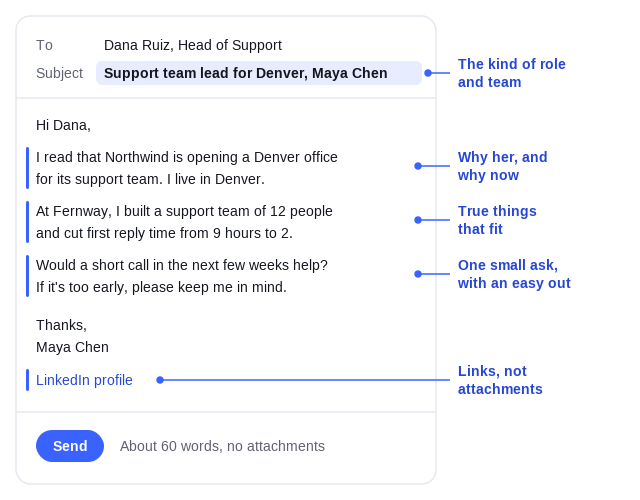
An illustration of a finished letter of interest. The names are made up. Send it by email, then follow up once
Guides suggest following up after anything from about a week (The Muse) to two weeks (the University of Cincinnati). Our advice: one follow-up after about two weeks, in the same email thread, with something new. If there's still no reply, stop there.

Letter of interest format, by email or as a formal letter.
Send it by email, in most cases. Our advice: send it by email. It's the easiest for a busy manager to read and answer. Put it in the body of the email, not in an attached document.
The email format. A subject line that names the kind of role and the team. A greeting with their name, such as "Hi Dana," or "Dear Ms. Ruiz," if the company is formal. Then three short paragraphs: why you're writing to them, what you've done that fits, and your ask.
Closing the email. End with "Thanks," or "Best regards," your name, and your contact information: a link to your LinkedIn profile and, if you like, a phone number.
The business letter format, for paper or a PDF. Your name and contact information at the top, then the date. Then the recipient's name, title, organization and address.
The rest of the business letter. Open with "Dear [Name]," and keep the same three paragraphs: an opening paragraph, the body, and a closing paragraph with your ask. Sign off with "Sincerely," and your name. Keep it well under one page, which is James Madison University's limit.
If a posting asks you to upload one, it's a cover letter for that job. Use the business letter format, save it as a PDF, and follow the posting's instructions.
Letter of interest examples, and a template to copy.
Each one is about 100 words, short enough to read on a phone. Swap the [square brackets] for your details. The people and results in the examples are made up, so use your own true ones.
Letter of interest template
Fill in every bracket. Subject line idea, [Kind of role] on your [team], [Your name]
Hi [First name],

I'm writing because [the true reason you found, such as a launch, a new office or a growing team]. I'd love to be considered for a [kind of role] role on your [team] when one opens.

At [Company], I [one true result that fits their team]. I also [a second true result or skill they need].

Would you be open to a short call in the next few weeks? If the timing isn't right, I'd be glad if you kept me in mind.

Thanks,
[Your name]
[Link to your LinkedIn profile or portfolio]
Letter of interest example, from an experienced professional
Maya has led support teams for eight years and writes to the head of support. Subject line idea, Support team lead for Denver, Maya Chen
Hi Dana,

I read that Northwind is opening a Denver office for its support team. I live in Denver, and I'd love to be considered for a team lead role there when one opens.

At Fernway, I built a support team of 12 people from scratch. In the first year we cut first reply time from 9 hours to 2.

Would a short call in the next few weeks be useful? If it's too early, I'd be glad if you kept me in mind.

Thanks,
Maya Chen
[Link to Maya's LinkedIn profile]
Letter of interest example, for a career change
Leo is a teacher moving into training and writes to the head of learning. Subject line idea, Customer training at Brightline, Leo Park
Hi Priya,

I saw Brightline's new academy for customers, and it's the kind of work I want to move into. I'd love to be considered for a customer training role on your team when one opens.

For six years I've taught high school science. I wrote a course that other teachers in my district now use, and I run training days for new staff.

Would you be open to a short call? I'd value your view on what your team looks for, even if nothing is open now.

Thanks,
Leo Park
[Link to Leo's portfolio]
Letter of interest example, after a referral or a meeting
Ana met someone at an event, or a friend passed on the name. Subject line idea, Sam Lee suggested I write, Ana Silva
Hi Marcus,

Sam Lee suggested I write to you. He mentioned your data team is planning to grow next year.

I'm a data analyst at Tallow. I built the weekly sales report our leaders use, and I moved it from spreadsheets to a dashboard.

I'd love to be considered for an analyst role on your team when one opens. Would a short call be useful in the next few weeks?

Thanks,
Ana Silva
[Link to Ana's LinkedIn profile]
Job inquiry email, asking about job openings.
A job inquiry email is a shorter letter of interest. It asks one person whether their team is hiring, before anything is posted. Writing about a role that's already posted? Our guide to the cold email for a job has those templates.
Email asking about job openings on one team
To the person who leads the team. Subject line idea, Question about your [team], [Your name]
Hi [First name],

I've followed [their team's work, such as a product or a project] for a while, and I'd like to work on it. Do you expect to hire for [kind of role] on your team this year?

At [Company], I [one true result that fits].

If there's someone else I should ask, I'd be grateful for a pointer.

Thanks,
[Your name]
[Link to your LinkedIn profile]
Email asking for a job opportunity when the team is growing
When you've seen real news that the team is growing. Subject line idea, Your [team] and [the news], [Your name]
Hi [First name],

Congratulations on [the news, such as a launch or a new office]. If your team is growing because of it, I'd love to be considered for a [kind of role] role.

I [one true result that fits], and I [one more true detail that matters to them].

Would a short call be useful? If now isn't the time, no problem at all.

Thanks,
[Your name]
[Link to your LinkedIn profile]
LinkedIn note asking about a job, under 200 characters
A connection request note has a 200-character limit, so keep yours under it.
Hi [First name], I'd love to work on [their team's work]. I [one short true result]. Is your team likely to hire for [kind of role] this year?
The follow-up, about two weeks later
Reply in the same thread, so they see your first note. Add one new thing.
Hi [First name],

Following up on my note about [kind of role] on your [team]. Since I wrote, I [one new true thing, such as a project or a result].

If the timing isn't right, I understand, and I'd be glad to stay in touch.

Thanks,
[Your name]
What happens after a letter of interest, and how to stay in view.
Often, nothing, and that's normal. Indeed's guide for employers says they don't have to reply. When they do and aren't hiring, its sample reply says there's no role now and that it will keep the letter on file. We found no study that measures how often these letters get answered, so be wary of any number you see.
Follow up once, then stop. One follow-up, about two weeks later, is our advice. Indeed's guide also tells employers they don't need to answer repeated requests for updates. Chasing every week won't help.
When a role is posted, apply through the posting. Then write a short note to the person you wrote to before, and mention your first letter. Our guide to the follow-up email after applying has the words.
Use the careers page too. Some companies have a "talent community" or a general application form for people who don't fit an open role. Our advice: use it, and still write to a person.
If they offer a chat, take it. A short call is a good outcome even with no job open now. Our guide to the informational interview shows how to use it well.
Stay in touch only with something new. One short update in a few months is fine, if you've done something worth sharing. Our advice: no more than that unless they reply.
A letter of interest that gets read, and one that doesn't.
Do
- Write to one named person who leads the team.
- Write about one team and one kind of role.
- Keep it under about 200 words.
- Give two or three true results that fit.
- Ask for one small thing.
- Follow up once, about two weeks later.
Don't
- Send the same letter to ten companies.
- Send it to a careers inbox when you can find a person.
- Write a full page, like a long cover letter.
- Attach files to a first email to a stranger.
- Ask "Do you have any openings?" and nothing else.
- Chase them every week.
Questions about letters of interest for a job.
What does a letter of interest look like?
Usually a short email to one named person. It opens with why you're writing to them. Then it gives two or three true things you've done that fit their team, and asks for one small thing, such as a short call. It ends with your name and a link to your LinkedIn profile. The examples above are each about 100 words.
What is the difference between a cover letter and a letter of interest?
A cover letter answers a job that's posted and follows what the posting asks for. A letter of interest goes to a company with no matching opening and asks to be considered for a kind of role. One exception: if a posting asks for a "letter of interest", write a cover letter for that posting and follow its instructions.
How do I professionally say I'm interested in a job?
Say it plainly, and name the role or team. In a letter or email, try "I'd love to be considered for a [kind of role] role on your [team]". For a posted job, try "I'm applying for the [job title] role, and I'd like to tell you why I fit". A LinkedIn connection note has a 200-character limit, so keep it to one line and one question. Then back it up with one true result.
What is a good template for writing a short letter of intent for a job?
For jobs, a letter of intent is usually the same letter as a letter of interest. Morehouse College's career office says a statement of interest is "also called a letter of intent." So the template above works. Keep it to a greeting, why you're writing to them, two or three true results, and one small ask. Outside job hunting, "letter of intent" means other things, such as a school application.
How do I write a strong letter of interest for a job?
Write to one person who could hire you, about one team. Give a true reason for writing now, from the company's own site or news. Then show two or three real results that fit their work, and ask for one small thing. Follow up once. Most of the strength comes from the right person and a clear fit, not from clever wording.
How do you write a simple interest letter?
Use five or six sentences. Say why you're writing to them, what kind of role you'd like, one true result that fits, and one small ask. Sign off with your name and a link. The job inquiry emails above are this short.
Who do I address a letter of interest to?
The person who leads the team you'd join, by name. Career offices such as James Madison University's say to write to a specific person, not "To whom it may concern". If you can't find them, a recruiter at the company is a good second. Our guide on how to address a cover letter covers greetings and titles.
How long should a letter of interest be?
Advice varies, and none of it cites a study. Zety says under 200 words, Resume Genius 250 to 350, and Career Contessa up to 500. James Madison University says one page at most. Our advice: under about 200 words, since it's usually best sent by email and read on a phone. The examples above are about 100.
Should I attach my resume to a letter of interest?
Guides disagree. Monster says attach it, and The Muse suggests pointing people to your LinkedIn profile instead. Our advice: put a link in the first email, and send your resume as a PDF when they ask for it. A stranger may be wary of opening a file from someone they don't know.
Is a statement of interest the same as a letter of interest?
Usually, yes. Morehouse College's career office uses the names for the same letter, sent when a company isn't advertising. But some job postings ask you to include a "statement of interest" or "letter of interest". Then it's a cover letter for that job, so follow the posting's instructions and length limit.
Where the facts come from.
Checked in November 2026. The advice is ours. Definitions come from university career offices, the employer's side from Indeed's guide for employers, LinkedIn's limit from its help center, and what other guides recommend from those guides. The posting count is Blynk's own: 1,204 job postings from Blynk's searches for product roles, most of them senior, from company career sites and job boards, first seen between October 31 and November 11, 2026, each read for who the role reports to and for a person's email.
- How to write a cold email for a job
- Do I need a cover letter?
- How to find the hiring manager
- How to find someone's email address
- Networking email templates
- Follow-up email after applying
- How to email your resume
- University of Cincinnati: how to write a letter of interest
- James Madison University Career Center: cover letters and letters of inquiry
- Lasell University Career Center: professional correspondence
- Morehouse College Career Services: tips for writing a statement of interest
- University Place School District: how to apply
- Indeed for employers: how to respond to a letter of interest
- UCF Career Services: is it true that 80% of job openings are not advertised?
- LinkedIn Help: personalize invitations to connect
- Monster: how to write a letter of interest
- Zety: letter of interest
- Resume Genius: letter of interest
- Career Contessa: letter of interest
- The Muse: how to write a letter of interest
- Blynk Find the Hiring Manager
