
How long should a cover letter be? And how to cut yours to the right length.
Your draft runs a page and a half, or you've cut it so short you worry it looks lazy. Here's the cover letter length that works, where the usual numbers come from, what real application forms let you send, and how to cut a long letter down without losing the point.

The short answer
- 250 to 400 words, on one page at most outside academic jobs. That's what Indeed, Monster, Kickresume and Resume.io's length page say. Our advice: stay near the low end, in three short paragraphs.
- A box on the form? Paste the same letter. The cover letter boxes we checked set no word limit, so set your own. For a “Why do you want to work here?” question, our advice is two or three sentences.
- Cut whatever your resume already says. Each paragraph does one job: why this role, one or two proofs, then the close.
On this page
Why every answer on cover letter length is different, and what the numbers really say.
Four worries about cover letter length, and what the evidence behind them shows.
“Every site says 250 to 400 words. Is that a rule?”
It's a habit, not a finding. Indeed, Monster and Kickresume all say 250 to 400 words. No experiment we found has tested cover letter length. Some sites cite a 2022 study in the Journal of Applied Psychology with 53% more callbacks for short letters, but we couldn't find that paper. The 53% matches ResumeGo's experiment, which compared tailored cover letters with none, not short with long.
What to do: Treat 400 words as a ceiling, not a target. Stop when each paragraph has done its job.
“Half a page looks lazy.”
The people who hire disagree with each other. ResumeLab, a resume company, asked 205 US HR professionals in 2021, as The Muse reports. 40% preferred a cover letter under half a page, 42% half a page to a page, and 18% more than a page. Ask a Manager, a hiring-manager advice blog, says half a page usually isn't enough to make the case.
What to do: Short is fine if it makes the case. It's too short when it only says you're applying.
“Will anyone even read a full page?”
Many people skim. Resume Genius, a resume builder, asked 625 US hiring managers through the survey panel Pollfish. 36% said they spend under 30 seconds on a cover letter, 48% between 30 seconds and 2 minutes, and 15% longer. Those who read cover letters preferred about 400 words on average.
What to do: Write for the skim. Put why you fit in the first two lines.
“My draft is 800 words. Can it be two pages?”
Only for an academic job, where two pages is normal. For other jobs, Indeed, Monster, Kickresume and Resume.io all say one page at most. In ResumeLab's survey, 18% of the HR professionals preferred more than a page.
What to do: Cut it to one page. The five steps below show what goes first.
Cover letter length, by situation: a file, a form box, an email, an internship or an academic job.
A file or PDF: 250 to 400 words, near the low end. Indeed, Monster and Kickresume say 250 to 400 words. Resume.io's length page says the same, with 300 as “a dependable target”, and Kickresume calls 250 to 300 the ideal. All four say one page at most. Our advice: about 250 to 300 words, in three short paragraphs.
A box on the form: the same letter. Paste it in as it is. The boxes we read set no word limit (more on that below), so the limit is yours.
A “Why do you want to work here?” question: two or three sentences. When employers set a length for their own questions, it's 1 to 8 sentences, or under 50 words.
An email: shorter. Resume.io suggests 150 to 200 words in the body of the email. If the cover letter is attached, our advice is to keep the email itself to two or three sentences.
An internship or first job: shorter, 150 to 250 words. Kickresume suggests about 200 words for junior candidates, Resume.io 200 to 250 for entry level, and ResumeAdapter 150 to 200 for interns.
A senior role: still one page. Monster allows a longer letter for senior and executive jobs. Indeed, Kickresume and Resume.io keep the one-page limit. Our reading: a senior letter needs stronger proof, not more of it.
An academic job: up to two pages. The University of Chicago's graduate career office says academic cover letters should be two pages, or one for some STEM research positions. Northwestern describes a single-spaced, two-page letter.
A US federal job: check the announcement. We found no official length rule for federal cover letters. The two-page limit from the Office of Personnel Management is for resumes. Read the job announcement's Required Documents section.
What application forms let you send, and whether the cover letter box has a limit.
Most guides say to follow the form's limit, so we checked whether forms set one. On November 12, 2026, we read the public application forms of 211 open jobs in Blynk's searches. 89 were on Greenhouse at 76 companies, 95 on Ashby at 91 companies and 27 on Lever at 25. Most are senior product roles at tech companies. Nothing was submitted.
Greenhouse lets you upload or type. 77 of its 89 forms had a cover letter field. Every one of them offered a file upload and a typed box, behind a button called “Enter manually”.
Ashby and Lever mostly want a file, or nothing. On Ashby, 18 forms had a cover letter upload and only 1 had a typed box. On Lever, 2 forms had an “Additional information” box that suggests adding a cover letter there.
None of the typed boxes set a limit. We found no word or character limit in the forms' data. The boxes we opened on one live Greenhouse form and one live Ashby form had none either. We didn't submit anything, so we can't rule out a limit after you press submit.
The one published limit we found is Indeed Apply's. A cover letter typed there can be up to 4,000 characters. By our arithmetic, that's roughly 650 to 700 words, well past what any guide suggests.
So the length is yours to set. A box with no limit isn't a reason to write more. Paste the same letter you'd put in a file. Whether you need a cover letter at all is a separate question: of 168 forms we read the day before, only 2 required one. Our guide do I need a cover letter? has a one-minute check.
How long should a short cover letter answer be? What employers' own questions ask for.
The short questions have their own limits. On the same 211 forms, we found 148 long-answer questions on 77 forms, not counting the resume and cover letter. 6 of them state a length: 1 to 2 sentences, 2 to 4, 3 (twice), 5 to 8, and “under 50 words”. 8 more ask for a brief, short or concise answer. None of the stated lengths goes past 8 sentences.
One form says it outright. It tells you to answer its why-this-role question instead of sending a cover letter, and says one or two sentences are more than enough.
Few guides mention these questions. Coursera is the only one we read that does. It suggests 100 to 250 words per answer, without a source. 5 of the 6 stated lengths on our forms are four sentences or fewer, or under 50 words.
Our advice: two or three sentences. Give one reason about them and one thing you've done that fits. Stay under any limit the question gives. Instead of “I've always admired your company and its mission.” try “Your move into small-business payments is why I applied. At Harbor Health, I built invoicing that 1,200 clinics use.”
How to cut a cover letter to the right length, in five steps.
Start from the draft you have. Most long cover letters get short by cutting, not by rewriting.
Give each paragraph one job
Three jobs, three paragraphs: why this role, your proof, and the close. Anything that doesn't serve one of them can go. Monster's word counts for each part add up to a short letter too.
Monster's guide: about 50 to 75 words for the opening, 75 to 100 for a body paragraph and 50 to 75 for the close. With one body paragraph, that's 175 to 250 words.Cut every sentence your resume already says
Your skills, job titles and duties are on your resume. A cover letter adds what a bullet point can't hold: why you want this job, and the story behind one result. It can also explain what your resume can't, like a move or a career change. If a sentence would fit on your resume, cut it.
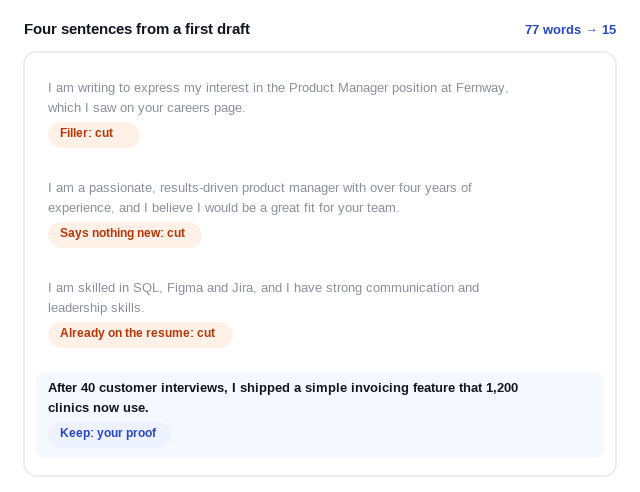
Four sentences from the first draft in the example below, cut. The names are made up. Keep one or two results, not five
Pick the result that matches the posting's biggest need, and maybe one more. Our advice: one clear result, with a number if you have it, is easier to remember than five. The rest are on your resume.
Cut the opener and the filler
Most first lines tell the reader what they already know. Start with the job and the reason instead. Then cut words that carry nothing, like “passionate”, “results-driven” and “team player”. The Muse's list of things to trim includes phrases like “I think”, clichés, and counting up your years of experience.
Instead of “I am writing to express my interest in the Product Manager position at Fernway.” try “I'm applying for the Product Manager role at Fernway. Your job description asks for experience in small-business payments.”Count the words, then read it where it'll be read
In Google Docs, open Tools, then Word count. In Word, the count is in the bar at the bottom. Then paste the cover letter into the form's box, or read it on your phone. If your first result is a long scroll down, cut the opening.

Cover letter format: what goes where, on one page.
Six parts, from top to bottom. The labelled page shows a cover letter of about 200 words.
Your name and contact details at the top
Your name, email, phone number and a LinkedIn link. Then the reader can reach you even if the cover letter gets separated from your resume.
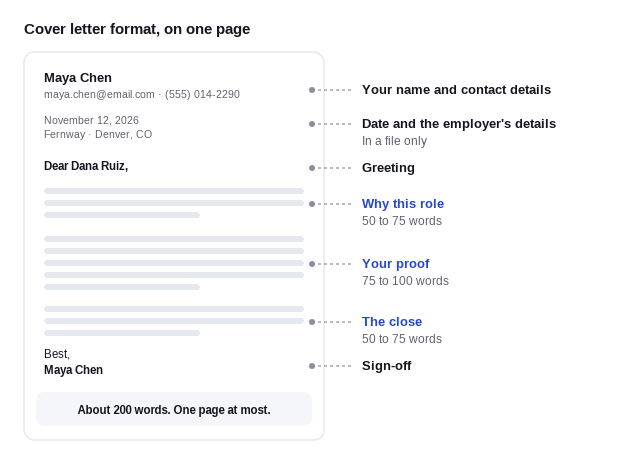
An illustration of the format. The per-part word counts are Monster's; the names are made up. The date and the employer's details, in a file
In a letter you upload, the date and the company's name and address go under your details. Our advice: in a form box or an email, leave them out. They take space and add nothing there.
A greeting, with a name if you have one
Our advice: use a name if you have one. Our guide on how to address a cover letter covers what to write with a name or without one.
Three short paragraphs
Why this role, your proof, and the close. Monster's counts for each part add up to 175 to 250 words with one body paragraph, and a second proof paragraph takes it to about 250 to 350. Keep them single-spaced, with a blank line between paragraphs.
A sign-off and your name
“Best,” or “Sincerely,”, then your name on the next line. That's the end of the letter.
A plain font, 10 to 12 points, and 1-inch margins
Monster and The Muse say 10 to 12 points, Indeed 12, and all three say 1-inch margins. Don't shrink the font or the margins to fit more in. Save the cover letter as a PDF unless the form asks for another file type. Greenhouse forms, for example, take PDF, DOC, DOCX, TXT and RTF files.

A short cover letter example, the same letter before and after cutting.
One made-up letter for a made-up job, first at full length, then cut. The short version uses only facts from the long one. Then a fill-in version to copy. Swap the [square brackets] for your details.
The first draft: 299 words
Inside most guides' 250 to 400 words. But much of it repeats the resume or says nothing.
Maya Chen
maya.chen@email.com · (555) 014-2290 · linkedin.com/in/mayachen

Dear Dana Ruiz,

I am writing to express my interest in the Product Manager position at Fernway, which I saw on your careers page. I am a passionate, results-driven product manager with over four years of experience, and I believe I would be a great fit for your team.

In my current role at Harbor Health, I manage a team of six engineers and two designers. I own the roadmap for our clinic software, run sprint planning, and work closely with sales, support and marketing. I also present our roadmap to the leadership team every quarter. I am skilled in SQL, Figma and Jira, and I have strong communication and leadership skills.

Before that, I spent two years on the support team at a dental software company, answering questions from front-desk staff. That is where I learned how small practices really handle billing.

One of my biggest achievements was building invoicing for the clinics we serve. Most of them are small practices with no billing staff. After 40 customer interviews, I shipped a simple invoicing feature that 1,200 clinics now use. I also led a redesign of our scheduling flow that cut no-shows by 18%.

Your job description says you are looking for someone with experience in small-business payments. I believe my work on clinic invoicing has prepared me well for this challenge. I am also relocating to Denver this spring, so I would be able to work from your office.

I am a fast learner and a team player, and I am confident that my skills and experience make me a strong candidate for this position.

Thank you for taking the time to consider my application. I look forward to hearing from you at your earliest convenience.

Sincerely,
Maya Chen
The same cover letter, cut to 156 words
Only facts from the draft, some moved or reworded. The skills list, the duties and the filler are gone. At 156 words it's below most guides' 250 to 400. Our view: it isn't too short, because every paragraph does its job, and it's the length Resume.io suggests for the body of an email.
Maya Chen
maya.chen@email.com · (555) 014-2290 · linkedin.com/in/mayachen

Dear Dana Ruiz,

I'm applying for the Product Manager role at Fernway. Your job description asks for experience in small-business payments, and building invoicing for small clinics is one of the biggest things I've done.

At Harbor Health, most of the clinics we serve are small practices with no billing staff. After 40 customer interviews, I shipped a simple invoicing feature that 1,200 clinics now use. I also led a redesign of our scheduling flow that cut no-shows by 18%.

Before Harbor Health, I spent two years on the support team at a dental software company, answering questions from front-desk staff. That's where I learned how small practices really handle billing.

I'm relocating to Denver this spring, so I'd be able to work from your office. I'd welcome the chance to talk about how my work on clinic invoicing could help Fernway with small-business payments.

Best,
Maya Chen
A short cover letter to fill in, about 140 words
For a file, a box on the form or the body of an email. In a file, our advice is to give the proof a little more detail, toward 250 words. Keep every claim true and specific.
[Your name]
[Email] · [Phone] · [LinkedIn profile link]

Dear [Hiring manager's name, or "Hiring Manager"],

I'm applying for the [Job title] role at [Company]. Your job description asks for [the posting's main requirement, in its own words], and [one true sentence on where you've done that]. [One specific thing about the company, like its product, its customers or a plan from the posting] is why this role stood out.

At [Current or last company], I [one result that matches that requirement, with a number if you have one]. I also [a second, shorter proof, only if it fits the posting].

[One sentence your resume can't say, like the move, the career change, the gap, or who referred you.] I'd welcome the chance to talk about how I could help with [a goal from the posting].

Best,
[Your name]
Cover letter length and format mistakes, and what to do instead.
The habits that keep a cover letter short enough to be read.
Do
- Keep it to one page at most, unless the job is academic.
- Stay near the low end of 250 to 400 words, in three short paragraphs.
- Use a plain font at 10 to 12 points, with 1-inch margins.
- Use the posting's own words for the skills you really have.
- Stay under any word or sentence limit the form gives.
- Use a few bullets for results, if they save words. The Muse suggests three or four bullets of one or two sentences each.
Don't
- Shrink the font or the margins to squeeze more in.
- Paste your resume into paragraphs.
- Write to hit a word count. Ask a Manager advises against it.
- Send two pages for a job outside academia.
- Open with “I am writing to express my interest”.
- Pad a short letter with adjectives like “passionate” or “hard-working”.
Questions about cover letter length, answered.
Can a cover letter be too short, or just one paragraph?
Yes, if it doesn't make the case. Ask a Manager, a hiring-manager advice blog, says half a page usually isn't enough, but 40% of ResumeLab's 205 US HR professionals preferred under half a page. Our advice: one paragraph is enough only in a form box or an email. One form we read says one or two sentences answering its why-this-role question are more than enough. Anywhere else, a letter that says why this job and shows one real result isn't too short, and one that only says you're applying is.
Is a 500, 600 or 1,000-word cover letter too long?
For most jobs, yes. Resume.io's length page says above 500 words is where cover letters lose their impact, and Kickresume gives 500 words as the maximum, so 600 is past both. Kickresume answers “Is a 1000-word cover letter too long?” with “Yes, it is”, and 1,000 words runs to about two pages. Cut it to 400 or less, and closer to 250 if you can. Academic jobs are the exception, where two pages is normal.
Is 400 words OK for a cover letter?
Yes. 400 words is the top of the range most guides give: Indeed, Monster, Kickresume and Resume.io's length page say 250 to 400. In Resume Genius's survey, hiring managers who read cover letters preferred about 400 words on average. Our advice is still to stay nearer 250 to 300, because many readers skim.
Should a cover letter be one page, or can it be two?
One page at most, outside academia. Indeed, Monster, Kickresume and Resume.io all say so. Academic jobs are different: the University of Chicago's graduate career office says two pages, or one for some STEM research positions. For any other job, a second page means something can go.
How many paragraphs should a cover letter have?
Three or four, say Indeed and Monster, and The Muse allows three to five. Our advice is three: why this role, your proof, and the close. Add a fourth only for a second proof the job really asks for.
How long should a cover letter be for an internship?
About 150 to 250 words. Kickresume suggests about 200 words for junior candidates, Resume.io 200 to 250 for entry level, and ResumeAdapter 150 to 200 for interns. Use the space for why you want this role and one thing you've done, from school, a project or a part-time job.
How long should an email cover letter be?
Shorter than a letter in a file. Resume.io suggests 150 to 200 words in the body of the email. If you attach the cover letter, our advice is to keep the email itself to two or three sentences, so nobody reads the same thing twice.
Can I use bullet points to shorten a cover letter?
Yes, for results. The Muse suggests three or four bullets of one or two sentences each, and Monster a short bulleted list. Bullets save words when you have two or three results to show. Keep the opening and the close as sentences.
Do recruiters read long cover letters?
Many skim. In Resume Genius's survey of 625 US hiring managers, 36% said they spend under 30 seconds on a cover letter. So put why you fit in the first two lines. Whether they read cover letters at all, and when you can skip one, is in our guide do I need a cover letter?
Do recruiters check for ChatGPT, and can AI get the length right?
We found no count of how many recruiters check. OpenAI says ChatGPT can't reliably tell whether text was AI-generated, and it withdrew its own AI text detector for its low rate of accuracy. In TopResume's survey of 600 US hiring managers, 19.6% said they would reject a candidate with an AI-generated resume or cover letter. AI can get the length right if you ask for about 250 words in three paragraphs, then cut anything it repeated from your resume or that isn't true. Our guide to the best AI cover letter generators compares the tools, or Blynk can write one for each job and show you every change.
Where the facts come from.
Checked in November 2026. The advice is ours. Length advice comes from each guide's own page, survey figures from their publishers or from The Muse where it reports them, and academic and federal rules from the universities and the Office of Personnel Management. Facts about Indeed Apply and Greenhouse come from their own help and developer pages, and about AI detection from OpenAI's own pages. Blynk's counts are its own. Forms, November 12, 2026: the public application forms of 211 open jobs from Blynk's searches (89 on Greenhouse at 76 companies, 95 on Ashby at 91, 27 on Lever at 25), mostly senior product roles at tech companies, read through Greenhouse's and Ashby's public job-board data and Lever's public apply pages, with one live Greenhouse and one live Ashby form opened to check the typed box. Required cover letters: the 168 forms read on November 11, 2026 for our guide on whether you need one. Nothing was submitted.
- Do I need a cover letter?
- How to address a cover letter
- The best AI cover letter generators
- How to tailor your resume to a job description
- Follow-up email after applying
- ChatGPT prompts for a cover letter
- How to start a cover letter
- How to end a cover letter
- What to include in a cover letter
- Indeed: what's the ideal cover letter length?
- Monster: how long should a cover letter be?
- Kickresume: how long should a cover letter be?
- Resume.io: cover letter length
- ResumeAdapter: how long should a cover letter be?
- The Muse: the ideal length for a cover letter (ResumeLab survey)
- Silicon Republic: ResumeLab's survey of US HR professionals, 2021
- Resume Genius: cover letter statistics
- Ask a Manager: how long should a cover letter be?
- ResumeGo: cover letter field experiment
- Coursera: how long should a cover letter be?
- University of Chicago Graduate Career Development: job resources
- Northwestern PhD and postdoc careers: academic cover letters
- OPM: guidance on the two-page limit on resume length
- Indeed Help: adding or uploading cover letters
- Greenhouse: Job Board API documentation
- Greenhouse support: application attachments
- OpenAI: new AI classifier for indicating AI-written text (withdrawn July 2023)
- OpenAI Help: does ChatGPT tell the truth?
- TopResume: AI in hiring survey, 2025
- Blynk Auto-Apply
