
Companies that sponsor H1B visas. And how to check a job before you apply.
If every application asks whether you'll need sponsorship, and every list shows the same big names, you're missing one thing: sponsorship is decided job by job. Here's who has sponsored H-1B visas, how to check any company, and how to tell if the job in front of you will.

The short answer
- The biggest H-1B sponsors are big tech, IT services and consulting firms. In fiscal year 2024, Amazon led with 7,011 approvals, then Infosys, TCS and Cognizant (USCIS's H-1B Employer Data Hub, as tallied by GMAC). You can look up any employer in USCIS's free H-1B Employer Data Hub.
- But sponsorship is decided job by job. A company with a long record can still post “no sponsorship” for the role you want. Read the posting before you apply.
- If the posting says nothing, ask early, and answer the sponsorship question honestly. Most postings don't say either way.
On this page
Why a list of companies that sponsor H-1B isn't enough on its own.
Four things that trip people up when they search by company, and what to do instead.
“They're on every top-sponsor list, so they'll sponsor me.”
The lists come from past approvals. USCIS's data hub counts workers it approved in each fiscal year. It says nothing about who is hiring today, or about any one job.
What helps: Check the posting, not just the list. The list tells you who has sponsored. The posting tells you about this job.
“Most postings don't even say.”
That's true. In the job postings from Blynk's searches, mostly senior product roles first seen from October 31 to November 11, 2026, most said nothing either way about visa sponsorship.
What helps: Ask early. One short question to the recruiter saves an evening on a job that can't hire you. The words are below.
“Every site gives a different number.”
They count different things. USCIS counts workers approved on its first decision. The Department of Labor (DOL) counts Labor Condition Applications, which employers file before they petition USCIS. One company can have far more applications than approvals.
What helps: Know what's being counted. Use USCIS for who was approved. Use DOL's data for which job titles and pay an employer filed for.
“Will anyone sponsor now, with the $100,000 fee?”
The fee was set for certain new petitions for people outside the US. USCIS says it doesn't apply to an approved change of status inside the US. And on June 8, 2026, a federal court vacated the guidance that put it in place.
What helps: Check whether it applies to you. If you're in the US on F-1 or H-1B now, it may not. The details, from USCIS, are below.
How to find companies that sponsor H-1B visas, and jobs that sponsor visas now.
Use the government's data to build a list, then check each job. Seven steps.
Build a target list in USCIS's H-1B Employer Data Hub
The hub is free on uscis.gov. You can search by fiscal year, employer, city, state, ZIP code and industry code, and download the data. It runs from fiscal 2009 to the fourth quarter of fiscal 2026. Search your industry and your city, and note the employers with recent approvals. Sites such as MyVisaJobs and H1BGrader offer their own searches; check what each one counts.
What the numbers mean, per USCIS: each count is workers approved on USCIS's first decision, dated by when it decided. USCIS splits approvals into initial and continuing; its glossary lists six kinds, including new employment, continuation with the same employer and change of employer. Addresses are mailing addresses, not where people work, and one employer can appear in several rows.Check job titles and pay in DOL's data
Before an employer petitions USCIS, it files a Labor Condition Application with DOL, which reviews it within seven working days. The employer must pay the higher of its actual wage or the prevailing wage for the job and place. DOL publishes these records case by case; as of November 2026, the latest file covers October 2025 to June 2026. They show which titles an employer files for, but they are applications, not approvals.
Look at employers that skip the lottery
Some employers are “cap-exempt”: universities and their related nonprofits, nonprofit research groups and government research groups. Their H-1B jobs don't count against the yearly cap, so there's no lottery. Keep in mind, per USCIS, that a later move to a company that is subject to the cap needs the lottery.
Search for jobs that sponsor visas, not just companies
On a job board, search your job title with “visa sponsorship” or “H-1B”, and sort by newest. Then open the careers page of each employer on your list. Our advice: treat a board's sponsor label as a lead. The posting's own words are the answer.
Read the posting's own words
Scroll to the end, where the visa line usually sits. Sponsoring a new visa, taking a transfer and saying no all read alike at a glance. The next section explains each phrase.
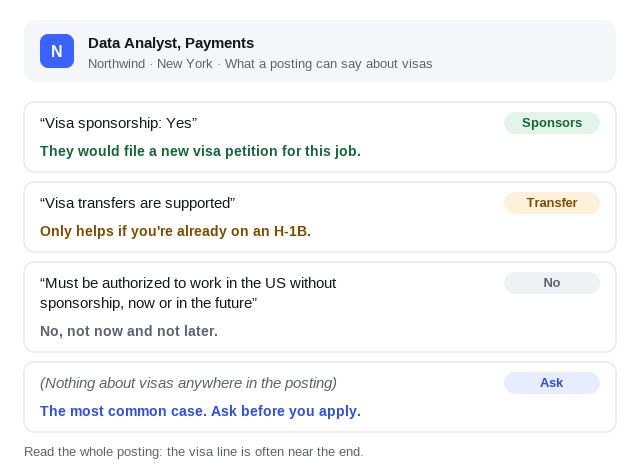
An illustration of four kinds of sponsorship line. The wording is the kind seen in real postings; the company is made up. If the posting says nothing, ask early
Write to the recruiter or the hiring manager before you spend an evening on the application. Say what you'll need in one line and ask if the role can support it. There's a message to copy below, and our guide shows how to find the hiring manager.
Answer “Will you now or in the future require sponsorship?” honestly
OPT lets F-1 students work without an employer petition. The 24-month STEM extension needs an employer that uses E-Verify and signs a training plan (Form I-983). An H-1B later does need an employer to file. That's why a University at Buffalo career page says that “in most cases” students and recent graduates should answer yes. Say when your OPT ends, so they can see the timing.

What “will sponsor” and “transfer” mean in a job posting.
“Will sponsor” or “Visa sponsorship: Yes.” The employer says it can file a visa petition for this role. For most readers, that's the line to look for.
“Visa transfers are supported.” A transfer is a new H-1B petition from a new employer for someone already on an H-1B. USCIS says workers already counted under the cap aren't counted again in the same period. So it helps if you hold an H-1B now. On F-1 OPT, you'd still need the lottery, unless the employer is cap-exempt. Ask which they mean.
“May engage in immigration sponsorship for this position if needed.” A maybe. Ask what it depends on.
“Without sponsorship, now or in the future” or “US citizen/visa only.” No, including later. Don't spend an application here.
“Unable to sponsor or take over sponsorship.” No new petition, and no transfer either.
A recruiter's posting. Agencies often post for a client. The sponsor would be the client, so ask the recruiter who it is.
Nothing at all. The most common case. Silence doesn't mean no. Ask.
Asking about sponsorship, in words you can copy.
Fill in the [square brackets]. Keep each one short and plain.
A question to the recruiter
Before you apply, when the posting says nothing.
Hi [First name],

I'm interested in the [Role] role ([link]). I'm on [F-1 OPT / STEM OPT / an H-1B], and I would need [H-1B sponsorship / an H-1B transfer] [now / when my OPT ends in month year].

Is that something the team can support for this role?

Thanks,
[Your name]
Answering the question on OPT
On a call, or in a free-text box on the application.
Yes, in the future. I can work on [OPT / STEM OPT] until [month year] without sponsorship. After that I would need an H-1B, which the employer would file. Happy to explain the timing.
Answering the question on an H-1B
If you hold an H-1B with another employer now, and it was counted under the cap.
Yes, an H-1B transfer. I'm on an H-1B with [current employer], so I've already been counted under the cap. The new employer would file a new petition for me.
The $100,000 H-1B fee in 2026, and what it means for sponsorship.
Where it came from. A presidential proclamation on September 19, 2025, added a $100,000 payment to certain new H-1B petitions. It covers petitions filed on or after September 21, 2025, for people outside the US who don't have a valid H-1B visa. The employer pays it on pay.gov before filing.
Who it doesn't cover. USCIS says it doesn't apply to an approved change of status, amendment or extension for someone inside the US. Our reading: if you're in the US now, and your employer's change of status or extension for you is approved, the payment wasn't set for you.
What the court did. On June 8, 2026, a federal court vacated the agency's guidance for the payment. The First Circuit appeals court denied a stay on July 24, 2026. DHS says it will follow the order, and still plans to collect the payment if the order is lifted. That's USCIS's H-1B page as last reviewed on September 21, 2026, read on November 11, 2026.
How many have paid it? We found no published count on USCIS's pages. This may change, so check USCIS's H-1B page before you rely on it.
Is H-1B sponsorship harder now? USCIS's own numbers.
The cap is full, with fewer people trying. Each year allows 65,000 new H-1Bs, plus 20,000 for people with a US master's degree or higher. On July 17, 2026, USCIS said it had received enough petitions to reach both caps for fiscal 2027. Registrations fell from 780,884 for fiscal 2024 to 479,953 for 2025 and 358,737 for 2026.
The odds, in plain numbers. For fiscal 2026, 343,981 registrations were eligible and 120,141 were selected.
The new rule for picking. For fiscal 2027, USCIS weighted the lottery by wage level. A Level IV offer was entered four times, Level III three times, Level II twice and Level I once. It's still a lottery, but a higher wage level gets more chances.
What it costs an employer. Registration is $215. Then come USCIS filing fees (listed on its fee page, G-1055), the lawyer, and premium processing if they want speed. Under a DHS rule effective September 9, 2026, employers with 50 or more US staff, more than half of them on H-1B or L-1, pay the 9-11 Response and Biometric Entry-Exit fee on every H-1B and L-1 petition.
Pay and length of stay. There's no single minimum salary. The employer must pay the higher of its actual wage or the prevailing wage for the job and place, as it states to DOL. An H-1B is generally granted for up to 3 years, and can be extended to 6. Some green card cases allow more.
This page explains how to find employers and read job postings. It isn't legal advice. For your own case, or questions about enforcement such as whether ICE is targeting H-1B holders, talk to an immigration attorney or the employer's immigration team.
What to do when you need sponsorship, and what wastes applications.
Habits that save you from jobs that can't hire you, and the ones that cost you.
Do
- Read the visa line of every posting before you apply.
- Ask early when a posting says nothing.
- Say what you'll need, and when, in one honest line.
- Check past approvals in the USCIS hub for your field and city.
- Look at universities and research nonprofits, which skip the lottery.
- Save the posting's wording, since postings close.
- Take questions about your own case to an immigration attorney.
Don't
- Hide that you'll need sponsorship later.
- Rely on a list from 2024 as if it were today.
- Read “transfers supported” as a new H-1B for someone on OPT.
- Assume a recruiter is the employer that sponsors.
- Apply where the posting says “now or in the future”.
- Treat silence as a no without asking.
Questions about companies that sponsor H-1B visas, answered.
What companies sponsor H-1B the most?
Big tech, IT services and consulting firms led in fiscal year 2024, whether you ask who hires the most H-1B visas or who the top sponsors are. In fiscal year 2024 approvals, new and continuing (USCIS's H-1B Employer Data Hub, as tallied by GMAC), the top were Amazon (7,011), Infosys (5,913), TCS (5,273), Cognizant (5,080), Meta, Google and Microsoft. For 2026, search USCIS's H-1B Employer Data Hub yourself: its data runs to the fourth quarter of fiscal 2026. These are past approvals, so check each posting too.
Who will pay $100,000 for an H-1B visa?
The employer, under a September 19, 2025 proclamation, for certain new petitions filed on or after September 21, 2025 for people outside the US without a valid H-1B visa. USCIS says it doesn't apply to a change of status, amendment or extension inside the US. On June 8, 2026, a federal court vacated the guidance, and a stay was denied on July 24, 2026. DHS says it will comply, but plans to collect if the order is lifted.
Which companies accept H-1B transfers?
Any employer that files H-1B petitions can take one, since a transfer is a new petition from the new employer. Per USCIS, you can usually start once it properly files, if you haven't worked without permission since you last entered the US and it files before your stay runs out. And if you were counted under the cap before, you aren't counted again during the same H-1B period. After a job ends you may have up to 60 days to find work, change status or leave. A posting that says “visa transfers are supported” means this.
Which US employers are offering H-1B visa sponsorship?
The useful answer is the ones whose postings say so today. Past sponsors are in USCIS's data hub, but each job decides for itself. Look for “will sponsor” or “visa sponsorship: yes” in the posting, and ask the recruiter when it says nothing.
Which companies do not sponsor H-1B?
There's no official list of companies that don't, and policies change by role. DOL publishes the employers it has barred from the H-1B program. Asking whether Walmart has stopped, or whether Amazon or Deloitte still sponsor? Look up their recent approvals in USCIS's hub, then read the posting for the role.
Are companies sponsoring H-1B anymore?
Yes. On July 17, 2026, USCIS said it had received enough petitions to reach both caps for fiscal 2027, so employers are still filing H-1B petitions. Is H-1B declining? Registrations fell, from 780,884 for fiscal 2024 to 358,737 for 2026. The cap stayed full anyway.
How hard is it to get a H-1B visa?
For fiscal 2026, 120,141 of 343,981 eligible registrations were selected in the lottery. For fiscal 2027, USCIS weighted the draw by wage level, so a higher-paid offer gets more chances. A cap-exempt employer, such as a university, skips the lottery.
Which companies are exempt from H-1B?
None is exempt from the rules, but some are exempt from the yearly cap: universities and their related nonprofits, nonprofit research organizations and government research organizations. Their H-1B jobs have no lottery. A later move to a company that is subject to the cap needs the lottery, per USCIS.
How to find jobs that sponsor H-1B?
Build a list from USCIS's data hub, then search job postings, not just companies: your title plus “visa sponsorship” or “H-1B”, newest first. Read each posting's visa line, and ask when it says nothing. Blynk's Find Jobs asks whether you need visa sponsorship, and if you say yes, it keeps to postings that say they offer it.
Can a Small Company Sponsor an H-1B Visa?
Yes. Any US employer can file the petition (Form I-129), whatever its size. Can your current job sponsor you? It can, for an H-1B, or for a green card through DOL's PERM process, which DOL calls the employer's responsibility. Whether it will is the employer's choice, so ask.
Sources, and where to go next.
Checked on November 11, 2026. Visa rules, fees and numbers come from USCIS and the Department of Labor, with each page's date in the text. Company totals are GMAC's tallies of USCIS data. The advice is ours, and the answer to the sponsorship question is from a University at Buffalo career page. The point about postings is Blynk's own: 1,204 job postings with a full description, from Blynk's searches, mostly senior product roles, first seen between October 31 and November 11, 2026, scanned for sponsorship wording with every match read by hand. It describes those postings only, not any company's policy.
- How to find the hiring manager
- How to tailor your resume to a job
- The best job search apps, compared
- USCIS: H-1B specialty occupations (last reviewed September 21, 2026)
- USCIS: H-1B Employer Data Hub
- USCIS: understanding the H-1B Employer Data Hub
- USCIS: H-1B cap season (last reviewed November 9, 2026)
- USCIS: H-1B electronic registration, registration numbers
- USCIS: USCIS reaches fiscal year 2027 H-1B cap (July 17, 2026)
- USCIS: fee schedule (G-1055)
- USCIS: optional practical training for F-1 students
- USCIS: STEM OPT extension
- DOL: Labor Condition Application (FLAG)
- DOL: Office of Foreign Labor Certification disclosure data
- DOL: permanent labor certification (PERM)
- DOL: H-1B debarred and disqualified employers
- GMAC: top 15 companies that sponsor H1B visas (USCIS data, fiscal year 2024)
- University at Buffalo Career Design Studio: answering the sponsorship question
- Blynk Find Jobs
- Blynk pricing
