
What is a hybrid job? And how many office days it really means.
If a posting just says “Hybrid” and you can't tell whether that means one day in the office or four, you're not alone. Here's what a hybrid job means, how many days postings actually ask for, how it differs from remote, and what to ask before you apply.

The short answer
- A hybrid job splits your week between the employer's office and working remotely, usually from home.
- The posting decides how many days. Three days a week in the office is the most common ask, then four or two. Look for the number, who picks the days, and which office.
- If the posting doesn't say, ask before you apply, and get the schedule in writing with the offer.
On this page
Why hybrid job postings are hard to read, and what helps.
Five things people say about hybrid jobs, what's really going on, and what helps.
“It just says hybrid.”
In Blynk's count of 61 postings that state office days, only 5 said hybrid in the location line. The number was in the text.
What helps: Search the text, not just the top. Look for “days”, “office” and “onsite” in the description.
“I thought hybrid meant two days.”
In the same count, three days came first, four second and two third.
What helps: Don't assume a number. Find it in the posting, or ask.
“The location said Remote.”
12 of those 61 postings had “Remote” in the location line and asked for office days in the text.
What helps: Read past the location line. Some jobs are remote far from an office and hybrid near one.
“Can I pick my days?”
Sometimes. Some employers set a minimum number of days, and others set the days themselves, the Flex Index says.
What helps: Ask who decides. Set days, team days, or your choice.
“It changed after I started.”
Office days can rise. In Owl Labs' 2025 survey, more hybrid workers were going in three or four days a week than in 2024.
What helps: Get it in writing. Ask for the schedule in your offer letter.
What is a hybrid job? What hybrid means in a job.
A hybrid job is part office, part remote. “A hybrid job or hybrid work is a mix of working at the actual location of your job and working remotely,” says the Social Security Administration's Choose Work blog. Remote usually means from home.
Gallup draws the line by time. It counts you as hybrid if you work remotely 10% to less than 100% of the time. All the time is exclusively remote. Less than 10% is on-site.
It's the most common setup for jobs that can be done remotely. As of August 2026, 54% of US employees with jobs that can be done remotely work hybrid, 25% work exclusively remote, and 21% work on-site, Gallup says. In job postings it's less common. In March 2026, 11% of paid US job postings on LinkedIn offered hybrid work, according to LinkedIn's Economic Graph team.
A “hybrid role” can mean something else. Some career sites use it for one job that combines two. Indeed's career guide defines it as “a position that assigns two or more jobs to one person” in its advice for employers. On a posting, “hybrid” next to a city or a number of days is about where you work.
Hybrid work meaning: the kinds of hybrid schedule.
Hybrid work isn't one schedule. The Flex Index, which tracks the office policies of thousands of US companies, sorts them like this. Most postings fit one of these, even if they don't say which.
A minimum number of days. For example, at least two or three days a week in the office, and you pick which.
Set days. The employer or the team names the days, such as Tuesday and Thursday.
A minimum and set days. A number of days, some of them fixed.
A share of your time. For example, 40% of your time in the office.
Your choice. The Flex Index counts this as fully flexible, not hybrid: you decide when, or whether, to go in. Built In adds two looser names you'll see: office-first, where you're in most days, and remote-first, where you meet in person now and then.
How many days a week is a hybrid job? What hybrid job postings actually ask for.
Most often three days in the office. We read the job postings in Blynk's searches, mostly senior product roles, first seen between October 31 and November 12, 2026. 61 of them state a weekly number of office days below five. 35 of the 61 say three days. 17 say four, 6 say two, and 3 say two to three.
Four days is more common than you might think. 8 of the 17 four-day postings come from one employer with one company-wide policy, so the mix depends a lot on the employer. Surveys point the same way. In Owl Labs' 2025 survey of 2,000 US workers, 39% of hybrid workers went into the office three days a week and 34% went in four, both up from 2024.
Across all US companies, the average is just under three. The Flex Index's Q3 2025 report found the average US firm requires corporate employees in the office 2.87 days a week. 27% of firms required three days, 9% two days and 3% four. 34% required full-time office, and 24% had no weekly minimum.
The days are usually in the text, not the location line. Of the 61 postings, only 5 said hybrid in the location line, and 11 never used the word hybrid at all. They just said something like “at least 3 days per week” further down.
What hybrid means in a job posting, and how to read it in five steps.
Five minutes with the posting can save you an application to a schedule you can't keep.
Read the location line, then search the text
The location line may say “Hybrid”, a city, or even “Remote”. Then press Ctrl+F (Command+F on a Mac) and search the description for “days”, “hybrid”, “office”, “onsite” and “in person”. The illustration shows where each part usually sits.
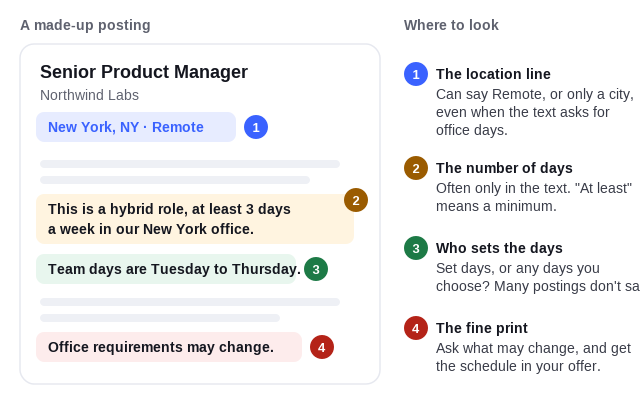
An illustration with a made-up company. The wording is typical of real postings in Blynk's count; what to make of each part is our reading. Find the number of days, and whether it's a minimum
“At least 3 days” is a minimum: some teams go in more. “Up to 2 days working from home” means at least three in the office. “2 to 3 days” means ask which. If there's no number at all, that's your first question.
Example: “Hybrid, 3 days in office” tells you the number but not who picks the days.Find out who sets the days
Some postings name them, like one in our count that requires Tuesday, Wednesday and Thursday onsite. Most only give a number. Set days matter if you have school runs, care duties or a long commute, so ask whether they're team days or your choice.
Find the office, and work out the commute
Check which office you'd report to, not just the city. Some postings set a distance: one in our count asks for people within 75 minutes' commuting distance of the office. Some are remote for people who live far from an office and hybrid for those who live near one, so read which applies to you. If you'd need to move for the job, that's a different decision from hybrid.
Read the fine print, then ask
Look for lines like “reserves the right to change in-office requirements” or “expectations of these days will be confirmed by your hiring manager”, both from postings in our count. They mean the number can move. Ask before you spend an evening on the application, and confirm the schedule in your offer. There are questions to copy below.

Remote vs hybrid vs on-site: what's the difference?
Remote. You work away from the employer's offices all the time, Gallup's “exclusively remote”. In our reading of postings, a remote job still says where you can work from, often a country or a few states. Our guide to how to find remote jobs covers that location line and where to look.
Hybrid. Some days in an office, some away. You have to get to that office on your office days. So a hybrid job ties you to a place in a way a remote job usually doesn't.
On-site, or in person. You work at the employer's location almost all the time. Gallup counts you as on-site if you work remotely less than 10% of the time. Postings say “on-site”, “in office”, “in person” or “5 days a week”.
Is remote the same as hybrid? No. Remote means no regular office days. Hybrid means regular office days, just not every day. A posting that says “Remote” in one place and gives office days in another is hybrid for anyone near that office, so ask.
Hybrid work: the upsides and the trade-offs.
The upsides. Gallup says hybrid workers report significantly better work-life balance, less burnout and higher productivity than their fully on-site peers. You commute less than on-site workers and still see your team in person.
The cost of office days. In Owl Labs' 2025 survey, hybrid workers said they spend an average of $55 a day at the office, against $18 a day for remote workers at home. Commute time adds up too.
Schedules can tighten. In the same survey, 73% of workers said their employer hadn't changed its remote or hybrid policy in the past year. Yet more hybrid workers were going in four days than in 2024. Fortune called this “hybrid creep.”
What managers worry about. Microsoft surveyed 20,006 workers in 11 countries in 2022. 85% of leaders said the shift to hybrid work had made it challenging to have confidence that employees are being productive. 87% of employees said they were productive. Our advice: be easy to reach on your home days, and make your work visible.
Questions to ask about a hybrid job, ready to copy.
Short enough for a recruiter screen or an email. Swap in your own details.
On the recruiter call
Ask in the first call, before the interviews start.
How does the hybrid schedule work for this team?
How many days a week are in the office, and are they set days or my choice?
Which office would I go to?
Is the schedule the same for new hires in the first few months?
Has the office policy changed in the last year?
An email before you apply
When the posting says hybrid but gives no number, and you know who to write to.
Hi [Name],

I'm interested in the [Job title] role and plan to apply this week. The posting says hybrid, and I couldn't find how many days a week are in the office or which office the team uses. Could you let me know?

Thanks,
[Your name]
Confirm the schedule with the offer
Before you sign, so the schedule is written down.
Hi [Name],

Thank you for the offer. I'm excited about the role. Before I sign, could you confirm the work arrangement in writing? My understanding is [number] days a week in the [City] office, on [set days or days I choose]. Could that go in the offer letter?

Thanks,
[Your name]
Ask for a different arrangement
When the days are close to what you can do, but not quite.
Hi [Name],

Thank you for walking me through the schedule. The role asks for [3] days a week in the office, and my commute is about [time] each way. Would [2 days], or [set days such as Tuesday and Wednesday], work for this team? I'm glad to talk it through.

Best,
[Your name]
Questions about hybrid jobs, answered.
What does it mean when a job says it's hybrid?
It means you'd work some days at the employer's office and some days remotely, usually from home. The posting should say how many days, which office, and whether the days are set. In Blynk's count of 61 postings that state office days, three days a week was the most common. If the posting doesn't give a number, ask before you apply.
What is the difference between a remote and a hybrid job?
A remote job has no regular office days. A hybrid job does, just not every day. Gallup counts you as exclusively remote if you work remotely all the time, and hybrid if it's 10% to less than 100% of the time. A hybrid job also ties you to living near an office.
Which is better, hybrid or remote work?
It depends on your work and your life. Most people with jobs that can be done remotely prefer hybrid: 61% in Gallup's November 2025 survey, against 33% for exclusively remote and 6% for on-site. In our view, the better one is the schedule you can keep for years, with the commute that comes with it.
What are the disadvantages of hybrid work?
The commute and its cost on office days: Owl Labs found hybrid workers spend an average of $55 a day at the office. You need to live near the office. The number of days can rise, as it did for many hybrid workers between 2024 and 2025. Built In's list also includes communication challenges between people in and out of the office, and proximity bias, where people seen in person get more notice.
Do hybrid jobs pay more?
We haven't found a source we trust showing hybrid jobs pay more, or less, as a rule. Pay follows the job, the level and the place. What hybrid changes is your costs and time: in Owl Labs' 2025 survey, workers said they'd give up 8% of their salary, on average, for a flexible location. So in our view, the office days are part of the offer, like the pay.
What is hybrid work like?
For most postings in Blynk's count, it would mean three days at an office and two at home. Gallup says hybrid workers report better work-life balance and less burnout than their fully on-site peers. Some employers in our count say the office days are for working together in person, so expect those days to be about the team.
Is remote work going away in 2026?
Not in the numbers we've seen. As of August 2026, Gallup counted 25% of US employees with jobs that can be done remotely working exclusively remote, and 54% hybrid. Gallup says the hybrid share has held relatively steady since 2022. But remote jobs are a small share of postings: 9% of paid US job postings on LinkedIn in March 2026.
Why don't employers like remote work?
Many do allow it. In our reading, the worry is about what managers can't see. In Microsoft's 2022 survey of 20,006 workers in 11 countries, 85% of leaders said hybrid work made it challenging to be confident employees are productive. 73% of employees said they needed a better reason to go in than company expectations.
Which company is 100% remote?
Several well-known companies describe themselves as fully remote or distributed on their own sites. Our guide to how to find remote jobs names some. Even fully remote companies may hire only in certain countries, so read the location line.
How can I make $70,000 a year working from home?
$70,000 a year is about $1,350 a week before tax, so it's a full-time professional salary, not a side job. In our reading of postings, the jobs that pay that from home are ordinary professional jobs done remotely or hybrid. In our view, an offer of that pay for easy work with no interview is a warning sign. Our guide to spotting job scams has the checks.
Sources, and where to go next.
Checked on November 12, 2026. The advice is ours, and marked as ours. Definitions come from the Social Security Administration's Choose Work blog, Gallup and Indeed; how common hybrid work is from Gallup (August 2026) and LinkedIn's Economic Graph team (March 2026); company office policies from the Flex Index's Q3 2025 report (8,709 US companies, re-weighted to the US workforce); what workers report from Owl Labs' 2025 survey (2,000 US full-time workers, July 2025) and Microsoft's 2022 Work Trend Index. Blynk's counts are its own: 1,535 job postings from Blynk's searches, mostly senior product roles, first seen between October 31 and November 12, 2026. We found every posting that gives a number of days with office, onsite, in-person or hybrid nearby, read each one by hand, recorded the minimum office days per week, dropped examples that weren't a requirement and the same job listed on more than one site, and kept the 61 that ask for fewer than five days. It's 12 days of searches, not the whole job market.
- How to find remote jobs
- How to reach out to a recruiter
- Job application questions, answered
- How to negotiate salary
- How to spot a job scam
- How to get a job in another state
- Four-day work week jobs
- Social Security Administration, Choose Work blog: What is a hybrid job? (September 30, 2024)
- Gallup: hybrid work indicator (August 2026 data, preferences November 2025)
- LinkedIn Economic Graph: US Monthly Economic Insights, April 2026 (remote and hybrid postings, March 2026)
- Flex Index: The Flex Report, Q3 2025 (PDF)
- Owl Labs: State of Hybrid Work 2025
- Fortune: employers are sneaking in a “hybrid creep” (October 9, 2025)
- Microsoft Work Trend Index: Hybrid work is just work (2022)
- Built In: What is a hybrid job?
- Indeed: What is a hybrid role?
