
How to start a cover letter. A first line built from the job, not a template.
The letter is half planned and the first line is still blank. “I am writing to apply” feels flat, and every clever hook feels like a gimmick. Here's how to start a cover letter: the greeting, then an opening paragraph built from the job posting, with lines you can copy.

The short answer
- Greet a person: “Dear [Full name],” if you can find their name, “Dear Hiring Manager,” if you can't.
- Make your first sentence name the exact job and one true reason you fit it, ideally the thing the job posting asks for first.
- Keep the opening paragraph to 2 to 4 sentences. Skip your name and “I am writing to apply”. They spend your opener on what the reader already knows.
On this page
Does the first line of a cover letter decide everything? Less than you've heard.
Four worries that stall the opener, and what the evidence says.
“Recruiters only read for 7 seconds.”
That number comes from a 2018 eye-tracking study by Ladders, and it measured a first look at resumes, not cover letters. We found no study showing that one line decides an application. Our reading: a clear opener still makes a good first impression, because hiring managers who skim get the job and the reason in one go.
What to do: Write your opener for someone skimming. The job title, plus one reason.
“Starting with ‘I am writing to apply’ will get me rejected.”
Resume Genius calls it acceptable but says it rarely grabs attention or sets you apart. Kickresume lists it as a cliché. So it wastes your best spot more than it hurts you.
What to do: Name the job inside a sentence that also says why you. Then the line does two jobs.
“I need a clever hook.”
Indeed lists seven ways to start, from enthusiasm for the company to a mutual connection or an impressive accomplishment. It suggests a creative story only where it suits the company culture, and Kickresume and Resume Genius both warn against forced or edgy humor. Career offices ask for something plainer. MIT says your opening sentence should state your purpose and give a brief professional introduction.
What to do: Choose specific over clever. One real result beats a hook.
“I don't know what to lead with.”
The job posting usually tells you. In 233 job postings Blynk has read line by line, mostly for senior product roles, 133 asked for a set number of years of experience, and in 44 that was the very first requirement. Handshake's advice is to keep the posting handy while you write.
What to do: Open the posting next to your letter. Find what it asks for first, and answer that.
How to start a cover letter greeting, the salutation comes first.
Use the hiring manager's name if you have it: “Dear Dana Ruiz,”. MIT's career office says to address the letter directly to the hiring manager by name.
No name? Write “Dear Hiring Manager,”. That's MIT's advice when you're not sure who to write to. Coursera adds that a personal greeting is better than a generic one.
Then leave a blank line and start the paragraph below it. In an email or a form box, the greeting is the only line above it.
Finding the name takes most people longer than writing the greeting. Our guide on how to address a cover letter covers who to write to, “To Whom It May Concern”, and Mr., Ms. or the full name.
How to write a cover letter opening paragraph, in four steps.
A good opening paragraph says which job you want, why you fit it, and why this company, in 2 to 4 sentences. Here's how to build one from the job posting, so the opener is yours and not a template's.
Open the job posting and find what it asks for first
Read the requirements list, sometimes headed “What you'll need” or “Qualifications”. Note the first one or two lines. Our reading: the first lines are often what the team cares about most, though no rule says so. Handshake suggests keeping the posting handy while you write.
What Blynk's postings show: in 233 job postings Blynk has read line by line, mostly for senior product roles, 133 (about 4 in 7) asked for a set number of years of experience, like “5+ years of product management experience”. In 44 of them, it was the first requirement listed.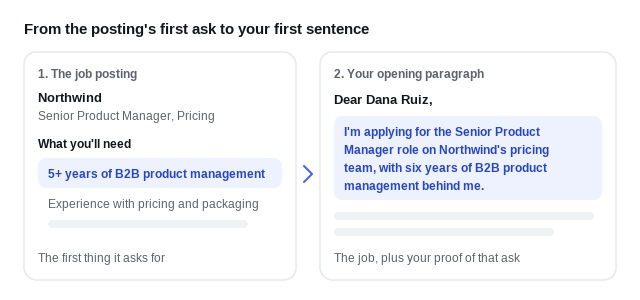
An illustration of turning the posting's first requirement into your opening sentence. The company and names are made up. Pick one true proof that answers it
Choose one thing you can back up: your years in the field, a quantifiable result, a mutual connection who referred you, or a genuine reason you want this company. A strong opener answers what the posting asks for first. Purdue's writing lab suggests stating two or three qualifications that match the job in your introduction. Our advice: put the strongest, most relevant one up front, and leave the rest for the paragraphs after it.
Write the first sentence, with the job and your proof
Use the job title as the posting writes it, so there's no doubt which role you mean. Add your proof in the same sentence. If someone referred you, Purdue suggests naming that contact in the introduction, so put their name here.
Before: “I am writing to apply for the position of Senior Product Manager on the pricing team at Northwind. I have six years of B2B product management experience.”
After: “I'm applying for the Senior Product Manager role on Northwind's pricing team, with six years of B2B product management behind me.”Add one or two sentences on why this company
Say what draws you to this company in particular, using something from the company's website or the posting, like a product, its mission or its values. Handshake suggests sharing why you're excited about the job and employer, and why you're the right candidate. Coursera says the opening should show you've researched the company. Kickresume suggests keeping the opener to 2 to 4 lines, and Resume Genius says concise cover letters work best at larger companies, where hiring managers may review hundreds of applications.
The full paragraph: “I'm applying for the Senior Product Manager role on Northwind's pricing team, with six years of B2B product management behind me. Most recently, I led a pricing change at a payroll software company that raised annual plan sign-ups by 18%. Northwind's move to usage-based pricing is the kind of problem I'd like to work on next.” (A made-up example.)

Cover letter opening examples, before and after, same facts, stronger openers.
Each “after” uses only the facts in its “before”. The difference is order: the job and the proof come first, and the filler goes.
A referral, before: “My name is Jordan Lee and I have been a marketing coordinator for three years. Sam Okafor, who works on your growth team, suggested I apply for the Content Marketing Manager job at Lumen.”
After: “Sam Okafor on your growth team suggested I apply for the Content Marketing Manager role at Lumen, and I bring three years as a marketing coordinator.”
A career change, before: “I am writing to express my interest in the Data Analyst position. Although I have been a teacher for eight years, I recently completed a data analytics certificate.”
After: “After eight years of teaching, and a data analytics certificate I recently completed, I'm applying for your Data Analyst role.”
A first job, before: “I am a recent graduate and I am very passionate about finance. I would like to apply for the Junior Analyst job.”
After: “I'm applying for the Junior Analyst role as a recent graduate who wants to work in finance.”
Our advice on that last one: a bare passion claim adds little, so keep only what you can show. Use the next sentence for a real class project, an internship or work experience that's relevant to the job.
All names and companies in these examples are made up.
Cover letter opening lines to copy, one for each situation.
Pick the line that fits your situation, swap the [square brackets] for real details, and only claim what your resume can back up. Each names the specific position you're applying for.
Years of experience
When the posting asks for a number of years and you have them.
I'm applying for the [exact job title] role at [Company], with [number] years of [field or kind of work] behind me.
A result with a number
When you have one result that matches what the posting asks for first.
As a [your current title], I [result with a number], and I'd like to do the same as your [exact job title].
A referral
When someone at the company told you about the job or suggested you apply. Ask them first.
[Full name] on your [team] suggested I apply for the [exact job title] role, and my [number] years in [field] match what the role asks for.
The company's product or work
When you use the product or know the company's work, and can say something specific.
I've used [product] for [how long or how], and I'm applying for the [exact job title] role to help build [part of the product or goal from the posting].
A career change
When your past roles are in a different field from this job.
After [number] years in [old field], where I [transferable skill or result], I'm applying for your [exact job title] role.
A student or first job
When your experience is school, an internship or a project.
I'm a [year or recent graduate] in [subject] at [school], applying for your [exact job title] role, and my [internship or project] taught me [skill the posting asks for].
An internal move
When you already work at the company.
I've worked on the [team] team at [Company] for [number] years, and I'm applying for the [exact job title] role on [their team].
A recruiter reached out
When a recruiter contacted you about the job first, by email or on LinkedIn.
Thank you for reaching out about the [exact job title] role. My [number] years in [field] line up closely with what the team needs.
Applying again
When you applied to this company before, or interviewed for another role.
I interviewed with [Company] for the [earlier role] in [year], and since then I've [new result or skill], so I'm applying for the [exact job title] role.
The whole first paragraph
When you want the greeting and all three sentences in one go.
Dear [Full name],

I'm applying for the [exact job title] role at [Company], with [number] years of [field] behind me. Most recently, I [result with a number]. [One specific thing about the company, from its own site] is the kind of work I'd like to do next.
Cover letter opening mistakes, and what to do instead.
The slips in a first paragraph that are easy to fix before you send it.
Do
- Name the specific position, as the job description writes it.
- Highlight one achievement you can prove, like years in the field or a quantifiable result.
- Say one specific thing about this company, from its own site or the posting.
- Match the company's tone, as Kickresume and Resume Genius both advise.
- Check every [bracket] is filled and the company name is right.
Don't
- Start with “I am writing to apply” or “My name is”. Kickresume lists the first as a cliché, and your name is already on the letter.
- Write a paragraph that could fit any job. Kickresume lists it as a common mistake.
- Use clichés like “I've always dreamed of working here” or “I'm a people person”, which Resume Genius warns against. Our advice: skip stock phrases like “proven track record” too.
- Make it all about you. Kickresume warns against ignoring the company's needs.
- Open with a joke unless you know the company's culture suits one.
Starting a cover letter in an email or a form box, where the first line goes.
In an email, start with the greeting, then the same opener. The subject line and what to attach are in our guide on how to email a resume.
In a cover letter box on the application form, keep the greeting and start your first paragraph straight after it. That's our advice, since the form already shows your name and the job.
In a “Why do you want to work here?” box, skip the greeting and start with your opener. Of 168 application forms we read, 17 asked a short why-this-company or why-this-role question.
Questions about how to start a cover letter, answered.
What's the best way to open a cover letter?
With a greeting to a named person, then an opener that names the job and gives one true reason you fit it. MIT's career office says the opening sentence should state your purpose and give a brief professional introduction. Our advice is to make that reason the thing the job posting asks for first, so the reader sees the match straight away.
What is a good opening line for a letter?
For a cover letter, it names the exact job and your strongest proof in one sentence. For other letters, the same idea works, so say why you're writing straight away. Here's an example for a cover letter: “I'm applying for the Senior Product Manager role, with six years of B2B product management behind me.”
What are some good phrases to start a cover letter?
“I'm applying for the [job title] role at [Company], with...”, “[Name] on your [team] suggested I apply for...”, “After [number] years in [field]...” and “As a [your title], I [result]...”. The full list, by situation, is in the opening lines above. Our advice: the phrase matters less than the proof that follows it.
Should I start a cover letter with my name?
No. Your name is already at the top of the letter and in the sign-off, so “My name is...” spends your opener on something the reader knows. Instead of introducing yourself by name, introduce your background, like “As a marketing coordinator...”. That's our advice, and it fits MIT's call for a brief professional introduction.
Is it okay to start a cover letter with “I am writing to apply”?
It won't sink you, but it wastes your opener. Resume Genius calls it acceptable but says it rarely grabs attention, and Kickresume lists it as a cliché. Swap it for “I'm applying for the [job title] role” followed by your proof in the same sentence.
What are 5 common cover letter mistakes?
Kickresume lists five for the opening. The first is starting with a cliché like “I'm writing to apply for”. The others are a generic paragraph for any job, too much about you and too little about the company's needs, no job title, and edgy humor in a formal setting. Our own check before sending: a misspelled name or an unfilled [bracket]. For mistakes in the rest of the letter, see what to include in a cover letter.
What is the rule of 3 in a cover letter?
It's a rule of thumb with no study behind it that we found. Some use it for three paragraphs, and some for three qualifications that match the job. For the opening, Purdue's writing lab suggests stating two or three qualifications that match the position. Our advice is to lead with the strongest one and save the rest for the paragraphs after it.
What is the purpose of a cover letter, and what should a simple one include?
It tells the employer which job you want, why you fit it and why you want this company, in your own words. It sits alongside your resume, and its aim is an interview. An application letter for a job vacancy is the same thing. A simple one has a greeting, an opener, one or two paragraphs of proof and a short close. Our guides on what to include in a cover letter and whether you need one cover the rest.
Can employers tell if you use ChatGPT for a cover letter?
Usually they can't prove it. In our reading, stock phrases and vague claims are what make a letter sound generic, and the opening is where they show first. An opener with your real job title and a real number reads as yours, in your own voice. Our guide on whether employers can tell if you used AI has the surveys and tests.
What is the 7 second rule in resume?
It comes from Ladders' 2018 eye-tracking study, which found recruiters spent an average of 7.4 seconds on a first look at a resume. It's about resumes, not cover letters, and no study we found applies it to cover letters. The lesson that carries over is ours: put the job and your proof where a skimmer will see them first.
Where the facts come from.
Checked in November 2026. The advice is ours, and we say so where it's given. Advice on the opening comes from the career offices and guides named in the text, and the 7.4 seconds from HR Dive's report of the Ladders study. The requirement counts are Blynk's own: 233 job postings whose requirements Blynk read line by line between November 2 and 12, 2026, from Blynk's searches, mostly senior product roles, first seen from October 31, 2026. A posting counted when a requirement line gave a number of years written as digits, so “several years” wasn't counted. We read 30 random matches by eye and all 30 were years-of-experience requirements. The form counts come from our guide on whether you need a cover letter.
- How to address a cover letter
- What to include in a cover letter
- How to end a cover letter
- How long a cover letter should be
- ChatGPT cover letter prompts
- MIT CAPD: how to write an effective cover letter
- Purdue OWL: cover letter introductions
- Indeed: 7 powerful ways to begin
- Kickresume: 9 great openings
- Resume Genius: 5 opening lines
- Coursera: prompts to help you begin
- Handshake: how to write a cover letter for a job, 5 essential tips
- HR Dive: eye-tracking study shows recruiters look at resumes for 7 seconds (Ladders, 2018)
- Blynk Auto-Apply
