
What to include in a cover letter. And what to write in the middle, where it counts.
You have the job posting open and a blank page, or a draft that reads like your resume in sentences. Here's what goes in a cover letter, in order, how to choose what the middle says, and what to leave out.

The short answer
- Six parts, in order. Your details, a greeting, an opening, one or two body paragraphs, a closing and a sign-off. Keep it to one page.
- The middle does the work. Name the posting's biggest need, then prove it with one or two things you've really done, with a number if you have one.
- Add what your resume can't say, and cut what it already does. A move, a career change, a gap or a referral goes here. Salary doesn't, unless they ask.
On this page
Why most cover letters say nothing new, and what to put in instead.
Four worries people have when they sit down to write the middle of a cover letter, and what helps.
“It just repeats my resume.”
That's the most common problem, and career offices say so plainly. MIT's career office says to “try not to simply repeat your resume in paragraph form.” Resume.io says the body should add the reasons and context that bullet points can't hold.
What to do: Give every sentence a job your resume can't do. Say why you want this role, or tell the story behind one result.
“The posting lists ten things. Which do I write about?”
Not all of them are must-haves. Of 1,330 job postings in Blynk's searches, mostly for product roles and first seen October 31 to November 12, 2026, 372 (28%) call some of their requirements preferred, nice to have, good to have, a plus or a bonus, in those words. Others rank them without saying so.
What to do: Answer the one or two needs that matter most. The steps below show how to find them.
“Will anyone read past the first lines?”
Many skim. In a 2022 survey by Resume Genius, a resume builder, of 625 US hiring managers, 36% said they spend under 30 seconds on a cover letter. 41% said the introduction leaves the biggest impression, and 21% the body paragraphs.
What to do: Put your best proof first. The first sentence of the body should say what you did for a need like theirs.
“I don't have the exact experience they want.”
That's what the cover letter is for. In ResumeLab's 2019 survey of 200 hiring managers, as Resume Genius reports it, 50% named explaining a career change as a purpose of a cover letter. MIT's career office says to stress the skills that carry over.
What to do: Say what carries over, plainly. The section on situations below shows what to write.
What to include in a cover letter, part by part, in order.
Six parts, from top to bottom. The body paragraphs are this page's focus. For the other parts, our sibling guides go deeper.
Your name and contact details
Your name, email, phone number and a LinkedIn link, at the top of a letter you upload. Indeed says there's usually no need for them in a cover letter typed into an online form, since you've likely entered them already. Our guide to cover letter length and format shows the layout.
A greeting
Use the hiring manager's name if you can find it. MIT's career office suggests “Dear Hiring Manager” if you can't. Our guide on how to address a cover letter covers the rest.
An opening paragraph that names the job, and why this one
Name the role and the one thing that made you apply. Skip “I am writing to express my interest”. Our guide on how to start a cover letter has opening lines for each situation.
The first body paragraph, with their biggest need and your proof
This is the heart of the cover letter. Name the need from the posting in its own words, then say what you did about a need like it, and what happened. Resume.io says to pick one or two accomplishments, shown as results rather than duties, and Indeed one or two key strengths with specific details.
Instead of “I am responsible for onboarding, reviews and renewals.” try “Your posting says reducing churn is the team's top priority. At Tandem Freight, I rebuilt our onboarding checklist in 2025, and churn in my book of 45 accounts fell from 14% to 8% that year.”A second body paragraph, only if it earns its place
Use it for a second proof the posting clearly asks for, or for what your resume can't explain, like a career change, a gap, a move or a referral. MIT's career office allows two or three body paragraphs; Kickresume says no more than three. Our advice: one strong one beats three thin ones.
A closing paragraph and a sign-off
Say once more why you'd like the job, and that you'd welcome a conversation. Then “Best,” or “Sincerely,” and your name. Our guide on how to end a cover letter has closing lines to copy.
How to write the body of a cover letter from the job posting, in four steps.
Every guide says to connect your experience to the job. Here's how to choose what to connect, so the middle of your cover letter answers what they asked.
Find the posting's biggest need
Read the posting once, looking only for the problem the team needs solved. It's often in the first lines, in the job title's main duty, or repeated twice. Lines marked preferred, nice to have or a plus come last. Harvard's career office says to reference skills from the job description and draw connections to your own.
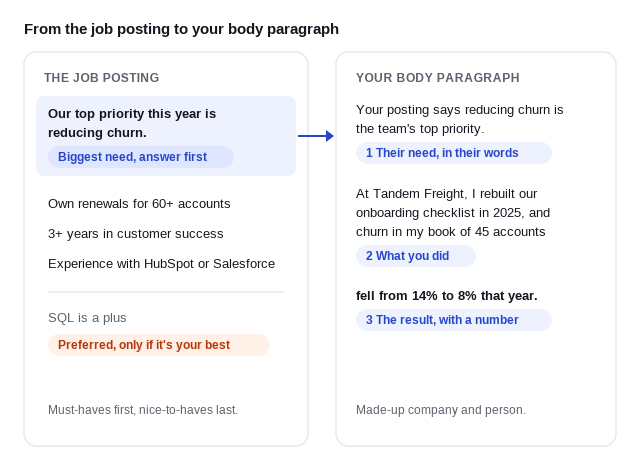
One posting, one body paragraph. The company and person are made up. Pick one true result that answers it
Look through what you've really done for the closest match, meaning a problem like theirs and what changed because of you. A number helps if you have one, like a share, a count or time saved. If you don't have the exact experience, pick the nearest thing and say what carries over. Never stretch it. Zippia lists untruths, even small exaggerations, as something to leave out.
Write it as their need, what you did, and what happened
Three moves, in that order. Start with their need in the posting's words, so the reader sees the match in the first line. Then what you did, in one sentence. Then the result. Add how you did it only if there's room.
Their need. “Your posting says reducing churn is the team's top priority.” What you did. “At Tandem Freight, I rebuilt our onboarding checklist in 2025,” What happened. “and churn in my book of 45 accounts fell from 14% to 8% that year.”Add why this company, only if it's specific
Resume Genius's survey found the top purpose of a cover letter, across all companies, was context on why the person is applying. One specific reason beats praise, such as their product, their customers or a plan the posting describes. If all you can say is that you admire the company, leave it out.

What to write in a cover letter when your story needs explaining.
The cover letter is where you explain what the resume can't. In ResumeLab's 2019 survey, as Resume Genius reports it, 63% of hiring managers named explaining your motivation as a purpose of a cover letter. 50% named a career change, and 49% gaps in employment. ResumeLab is a resume company, so read these as one survey, not a rule.
Little or no direct experience. Use the body for the nearest proof you have, like a school project, a part-time job or volunteer work. MIT's career office says to stress skills that carry over, like leadership, communication and problem-solving. Our advice: show one, with what you did, rather than naming three.
Changing careers. Say it in one sentence, then show the one result from your old field that matters most in the new one. Our guide to the career change resume covers the resume side.
A gap in your work history. One plain sentence is enough, like caring for a parent, a layoff or a course, and then back to what you can do for them. Our advice: don't apologize, and don't spend a paragraph on it.
Moving for the job. If your address is in another city, say when you'll be there. Our advice: one sentence near the end, like “I'm moving to Denver in March and can start then.”
Someone referred you. Name them early. Phil Blair of Manpower San Diego puts a contact the reader knows in the first paragraph.
A box on the form, not a file. Many forms now ask “Why do you want to work here?” instead. In our count of 168 application forms on November 11, 2026, 14 of 87 on the hiring system Ashby asked a short why-this-company or why-this-role question. Give it the same care, in two or three sentences. Our guide do I need a cover letter? has the rest of that count.
A cover letter body paragraph, before and after, then one to fill in.
One made-up body paragraph for a made-up customer success job, first as many people write it, then reordered. The second version uses only facts from the first. Then a fill-in version. Swap the [square brackets] for your details.
Before, the resume in sentences (73 words)
Every fact is true and useful. But it opens with duties, buries the result, and saves the posting's need for last.
In my current role at Tandem Freight, I manage a book of 45 accounts. I am responsible for onboarding, quarterly business reviews and renewals, and I use HubSpot and Gainsight every day. I have excellent communication skills and I am a team player. I rebuilt our onboarding checklist in 2025, and churn in my book fell from 14% to 8% that year. I know reducing churn is your team's top priority this year.
After, the same facts reordered (57 words)
Their need first, then the result, then the duties as support. The “team player” line is gone, because nothing proves it.
Your posting says reducing churn is the team's top priority this year. At Tandem Freight, I rebuilt our onboarding checklist in 2025, and churn in my book of 45 accounts fell from 14% to 8% that year. I run onboarding, quarterly business reviews and renewals for all 45, and I work in HubSpot and Gainsight every day.
Body paragraphs to fill in
Use the first paragraph in every cover letter. Add the second only if it applies. Keep every claim true and specific.
Your job description says [the posting's biggest need, in its own words]. At [Company], I [what you did about a need like that], and [what happened, with a number if you have one]. [One sentence on how you did it, or a second, shorter result that fits another line in the posting.]

[Only if it applies. One or two sentences your resume can't say, like the career change, the gap, the move or who referred you.] [One specific reason you want this team or company, from the posting or their product.]
What not to include in a cover letter, and what to do instead.
Most of these come from the same lists at Resume.io, Zippia and MIT's career office.
Do
- Give one or two results with specific details.
- Use the posting's words for skills you really have.
- Explain a gap, a move or a career change in one sentence.
- Give a salary range only if the posting asks for one.
- Keep it to one page.
Don't
- Retell your resume, job by job.
- Call yourself a “hard worker” or “team player” with nothing to prove it.
- Mention your age, marital status, religion or family.
- Criticize a current or past employer.
- Stretch the truth, even a little.
Cover letter tips that change what the reader sees.
Write a new middle for each job. In Resume Genius's survey, 72% of hiring managers said tailoring a cover letter is important or very important. In ResumeGo's experiment with 7,287 applications, run from July 2019 to January 2020, tailored cover letters got 53% more callbacks than no cover letter. ResumeGo is a resume-writing company. Our advice: keep your details, your opening style and your sign-off, and rewrite the body every time.
Use the posting's own words. Indeed says to use keywords from the job description, because hiring software may scan for them. Use them only for skills you really have.
One number beats five adjectives. “Churn fell from 14% to 8%” tells the reader more than “passionate and results-driven”. Resume.io lists vague claims without an example as something to leave out.
Keep it to one page. Our guide to how long a cover letter should be has the word counts.
Read it aloud, then check the names. Zippia lists typos, especially in names, as a mistake to avoid. Our advice: check the company's name and the job title twice, since a reused cover letter often keeps the last company's name.
Questions about what to include in a cover letter, answered.
Can employers tell if you use ChatGPT for a cover letter?
Not reliably by software. OpenAI withdrew its own AI text detector in 2023 for its low rate of accuracy, and its help pages say ChatGPT can't reliably tell if text was written by AI. But some hiring managers object, and in TopResume's May 2025 survey of 600 US hiring managers, 19.6% said they would reject a candidate with an AI-generated resume or cover letter. Our advice: if you use AI for a draft, make sure the need, the result and the reason are yours and true. Blynk can also write a cover letter for each job and show you every change before anything is sent.
What is the rule of 3 in a cover letter?
There's no official rule. It usually means three paragraphs, each with one job. Phil Blair of Manpower San Diego describes one version. Name the job you want, prove you can do it with measurable results, then restate your interest and ask for an interview. Our advice: treat three as a limit, not a goal.
What are 5 common cover letter mistakes?
The lists at MIT's career office, Resume.io and Zippia name repeating your resume in paragraphs, vague claims like “team player” with no example, raising salary when nobody asked, criticizing a past employer, and typos, especially in names. A sixth is sending a generic letter. Resume Genius's survey found 72% of hiring managers say tailoring matters.
What is the 7 second rule in a resume?
It comes from Ladders' 2018 eye-tracking study, which found recruiters spend 7.4 seconds on average on a first look at a resume, up from 6 seconds in 2012. It's about resumes, not cover letters, and HR Dive's report of it doesn't say how many recruiters took part. The lesson carries over. Put your strongest proof in the first lines of the body.
How do I address a hiring manager in a cover letter?
By name if you can find it, like “Dear Dana Ruiz,”. MIT's career office suggests “Dear Hiring Manager” if you can't. Our guide on how to address a cover letter covers what to write with a name or without one.
How do I write an application letter for a job vacancy?
For most jobs, it's a cover letter by another name, with the same six parts. Kickresume lists the application cover letter as one kind of cover letter, written for a specific opening. Name the vacancy in the first line, answer its biggest need in the body with one true result, and close by asking for a conversation.
Should you include examples in a cover letter?
Yes. Harvard's career office says to “give examples that support your skills and qualifications”, and Indeed suggests measurable results. Our advice: one or two specific examples, each tied to a line in the posting, are worth more than a list of skills.
Is a cover letter the same as a CV?
No. A CV or resume lists your work history, skills and education. A cover letter is a short letter about how that background fits one job, and why you want it. You send the cover letter alongside it, not instead of it.
Should I mention salary in a cover letter?
Not unless the posting asks. Resume.io lists salary expectations as something to leave out unless the employer asks, and Zippia says the same. If the posting does ask, our advice is to give a range in one sentence near the end. Our guide to desired salary on a job application shows how to pick one.
Do I need to include my address in a cover letter?
Not a full street address. Your name, email, phone number and a LinkedIn link are enough at the top of a letter you upload. Our advice: add your city only if you're local, or if you're moving and want to say so. In a form box, Indeed says there's usually no need for contact details, since you've likely entered them already.
Where the facts come from.
Checked in November 2026. The advice is ours. Advice on what goes in a cover letter comes from each guide's own page and from MIT's and Harvard's career offices. Survey figures come from their publishers, or from Resume Genius where it reports ResumeLab's survey; resume companies' surveys are named as theirs. Facts about AI detection come from OpenAI's own pages. Blynk's counts are its own. The postings are 1,330 job postings with text from Blynk's searches, mostly product roles (1,281 have “product” in the title), at 798 companies, first seen October 31 to November 12, 2026, searched for the words preferred, nice to have, good to have, a plus or bonus, with a sample of matches read by hand. The forms are the 168 application forms read on November 11, 2026 for our guide on whether you need a cover letter. Nothing was submitted.
- How to start a cover letter
- How to end a cover letter
- How long should a cover letter be?
- Do I need a cover letter?
- How to address a cover letter
- The best AI cover letter generators
- Indeed: how to write a cover letter
- Resume.io: what should a cover letter include?
- Zippia: what to include in a cover letter
- MIT Career Advising and Professional Development: how to write an effective cover letter
- Harvard Mignone Center for Career Success: resumes and cover letters
- Kickresume: what is a cover letter and how to write one
- Resume Genius: cover letter statistics (its survey, and ResumeLab's 2019 survey)
- PR Newswire: Phil Blair's three-paragraph cover letter formula, 2015
- HR Dive: Ladders eye-tracking study, 2018
- ResumeGo: cover letter field experiment
- OpenAI: new AI classifier for indicating AI-written text (withdrawn July 2023)
- OpenAI Help: does ChatGPT tell the truth?
- TopResume: AI in hiring survey, 2025
- Blynk Auto-Apply
