
How to ask someone to be a reference. Then help them say the right things.
You've been asked for three references, maybe by tomorrow. Here's how to ask so people say yes and sound ready, with who to pick, what to send, messages to copy, and what a reference check usually asks.

The short answer
- Ask before you name anyone. Say which job, why you picked them, and give them an easy way to say no.
- Pick people who saw your work up close. Start with a former manager, then a senior colleague, a client or a teacher. You don't have to name your current boss.
- Brief each one. Send the job description, the resume you sent and two or three things to mention, and give a heads-up when a call is likely. Then thank them and tell them how it went.
On this page
How to ask someone to be a reference, in five steps.
Most of the work happens before the employer calls. These steps follow what MIT's and Alberta's career offices advise, with our own advice marked as ours.
Ask early, before an employer asks you
MIT's career office recommends lining up your references “at the start of your job search”, so you're ready when asked. Alberta's career site adds one more rule. Ask again each time you use someone, even a person who said yes last year.
Out of touch with an old manager? Send a short, friendly update first, then ask a few days later. There's a message for this below.Ask first, and make no an easy answer
“Always ask the reference's permission before sharing their name with a company,” MIT's career office says. Give them a real way out. In a Zety survey of over 1,000 US workers, reported by CPA Practice Advisor in October 2026, 52% said they had been asked to recommend someone they weren't comfortable endorsing, and 22% gave a positive reference anyway. A reluctant yes can sound lukewarm on the phone, and Xref, a reference-checking company, says a lukewarm reference can sometimes do more harm than good.
Listen to how they answer. “Sure, happy to” is a yes. “I suppose so, if you need me” is a reason to ask someone else (our advice).Use the channel you'd normally use
Alberta's career site says to ask in person, by email or by phone. Call a close manager, email most people, and text only someone you already text (our advice). On LinkedIn, send a message, not a recommendation request. A recommendation is a public note on your profile, which is a different thing.
Send a short brief once they say yes
Send the job description, the resume you sent, and two or three things you'd like them to mention. MIT suggests pasting the description into your note rather than only linking to it, since a posting can come down. Here's a brief with its parts labelled.
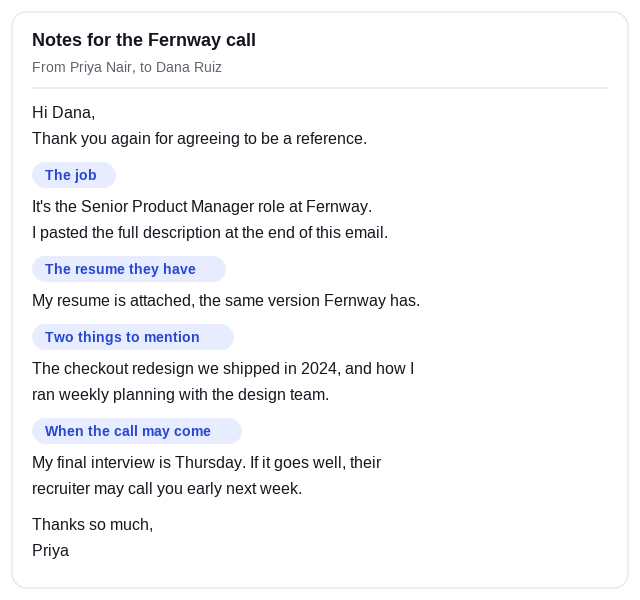
An illustration of a reference brief. The names are made up. Give a heads-up, then thank them
Alberta's career site suggests giving references a few days to prepare for a phone call and two weeks for a written letter. When you reach the final round, tell them a call may be coming. Afterwards, MIT says to thank them and share the outcome, whether or not you got the job.

Reference request messages to copy, by email, text and LinkedIn.
Fill in the [square brackets] and send. Each ask names the job, says why you picked them, and leaves an easy way out.
Email to a former manager
Email. Subject line “Would you be a reference for me?”
Hi [First name],

I hope things are going well at [company]. I'm applying for a [job title] role at [company], and I'm getting close to the final round.

Would you be willing to be one of my references? You saw my work on [project] more closely than anyone, which is why I thought of you first.

If now isn't a good time, I completely understand. If you're happy to, I'll send the job description, my resume and a few notes.

Thanks,
[Your name]
[Phone number]
A text
Only for someone you already text.
Hi [First name], it's [your name]. I'm in the final rounds for a [job title] role at [company]. Would you be OK being a reference? No pressure at all if not. If yes, I'll email you the details.
Someone you haven't spoken to in years
Email or LinkedIn message. Remind them who you are before you ask.
Hi [First name],

It's [your name]. We worked together on [team or project] at [company] in [year]. I still use [something they taught you] most weeks.

I'm now applying for [job title] roles, and I'd value having you as a reference if you're comfortable with it. I know it's been a while, so please say no if you'd rather not.

Either way, it's good to be back in touch.

[Your name]
A LinkedIn message
A direct message to a connection, not a recommendation request.
Hi [First name], I'm applying for a [job title] role at [company] and would love to list you as a reference, since you saw my work on [project]. Would that be OK? If yes, I'll send the job description and my resume by email. And no worries if not.
The brief, once they say yes
Email, the same day they agree. Paste the job description below your name.
Hi [First name],

Thank you so much for agreeing to be a reference.

The role is [job title] at [company]. The full description is pasted below.
My resume is attached. It's the same version [company] has.

If you're asked, these would help most.
1. [A project you did together and its result]
2. [A skill the job asks for that they saw you use]

The recruiter may call in the next [one to two weeks]. I'll let you know when I hear more.

Thanks again,
[Your name]
The heads-up
Text or email, when you reach the final round or they ask for your list.
Hi [First name], quick heads-up. [Company] asked for my references today, so their recruiter, [recruiter's name], may call you this week. The role is still [job title]. Thank you again for doing this.
The thank-you
Email, once you hear back, whether it's a yes or a no.
Hi [First name],

I wanted you to hear it from me. [I accepted the offer at company, and I start on date / The company went with another candidate this time].

Thank you for speaking up for me. It meant a lot. If I can ever return the favour, just ask.

[Your name]
Who to use as a reference, professional references first.
Most employers mean professional references, the people who saw you work. MIT's career office suggests three. Alberta's career site says 3 to 5.
Who to ask for a professional reference
Start with former managers you worked with closely. MIT's career office says their view carries the most weight, and that colleagues carry less. Northeastern's alumni career site suggests senior colleagues over peers. People who saw your work from another angle also count, such as clients, direct reports and partners on other teams.
Five examples of professional references
A strong list mixes angles on the same work. Start with your last direct manager and another manager you worked for, such as your manager's manager. Add a senior colleague and a client or partner who relied on you. If you're new to work, a teacher or volunteer leader can be the fifth. You need three to five, so pick the ones closest to the job you want (our advice).
Personal references, and when to use one
Alberta's career site describes personal references as people such as teachers, coaches, elders, neighbours, landlords or volunteer contacts. They're useful when you're starting out and have little work history. Use one only when the employer asks for a personal or character reference, or alongside your work references (our advice).
Do you have to give your current boss?
No. San José State's iSchool career blog says leaving one off isn't a red flag. In its words, “It is not necessary to use a current supervisor or even a past supervisor as a reference.” Northeastern's alumni site says employers won't expect your current manager's name, because many people search in confidence. A trusted colleague or a former manager can stand in.
If an employer insists, offer your current boss only after you have a written offer, and ask that the call happen then (our advice). See our guide to the offer stage for offers that depend on checks.Who not to put as a reference
MIT's career office says to avoid classmates, friends and relatives. Also leave off anyone you haven't asked, and anyone who sounded unsure when you did. Never ask a friend or relative to pose as a former boss. In Zety's survey, 10% said they had asked a friend or family member to pose as a former coworker or manager. A false reference can end an offer (our reading).
What goes on your reference list
For each person, give their full name, job title, company, phone and email. Add one line on how you worked together, such as “my direct manager at [company], 2022 to 2025”. Keep the list on its own page, not on your resume. Our resume sections guide shows how to lay it out.
What happens in a reference check, and when the call comes.
A reference check is the employer's call or email to the people who can speak to your work. It usually comes late. Of 1,535 job postings in Blynk's searches from October 31 to November 12, 2026, 12 mentioned reference checks. In all 6 that listed their hiring steps in order, references came after the last interview, as the last step or just before the offer or a closing call. We found none that asked for references with the application.
Do they always call? In the same Zety survey, 15% said their references were contacted every time they were hired. 47% said sometimes, and 38% said rarely or never. When they do call, it can count. In a 2019 Accountemps survey of more than 2,800 senior managers, managers said they remove as much as 34% of candidates after reference checks.
They may call people you didn't list. In the same Zety survey, 37% said a potential employer had contacted a former manager or coworker they never listed. Asked whether that's acceptable, 48% said only with the candidate's permission, 25% said yes even without it, and 27% said no. So assume anyone who managed you recently could get a call (our advice).
A former employer's HR may say very little. SHRM reports that companies often send reference requests to HR, which will “confirm only dates of employment and positions held” under a neutral reference policy. Rules differ by state and by company. This page isn't legal advice.
If an offer is made “subject to references” or a background check, that's the offer stage. Our guide to job offers and what can undo them covers it.
Reference check questions, what employers ask your references.
In the Accountemps survey, what managers most wanted from references was a candidate's strengths and weaknesses (38%). Next came past duties (22%), job titles and dates (19%), and preferred work culture (12%). LinkedIn's hiring blog lists 14 questions for a reference call, using “Pat” as a stand-in name. We sort the main ones into five groups. Brief your references on each.
How they know you, and what you did
Expect questions like “Tell me about Pat's role and responsibilities” and “Did Pat have any major accomplishments while working for you?” at the start. Your reference should know your title, your dates and one result in numbers. That's why the brief names a project.
Your strengths, and what you could improve
LinkedIn's list asks “What are Pat's greatest strengths?” and then “Are there any areas where Pat could improve?” as well. Expect the second one. Xref's advice to referees is to be honest about weaknesses and specific to the person's work. It says most hiring managers expect candidates can improve, and that an honest weakness isn't necessarily a deal breaker.
How to answer areas of improvement for a reference. If you're the reference, name one real, small area, give an example, and say what the person did about it. “She took on too much at first, then learned to hand work off” is better than “nothing comes to mind” (our advice).How you work with others, and a hard moment
Expect “In your experience, does Pat work better alone or with a team?” as well as a request for a setback and how you dealt with it. Remind your reference of one hard moment you handled well. They may not remember it on the spot.
Why you left, and would they hire you again
Expect “Why did Pat leave your company?” and “Would you rehire Pat?” near the end. Make sure your reference's answer matches what you told the employer. Our guide to your reason for leaving a job helps you word it the same way in both places.
How you compare, and anything else
One question asks the reference to rate you from 1 to 10 against other people they've hired. The list closes with “Is there anything else I should know about Pat?” as the last question. That open question is where a well-briefed reference brings up the two things you asked them to mention.
Asking for references, do this, not that.
Do
- Ask before you list anyone, every time.
- Give an easy way to say no.
- Paste the job description into your brief.
- Send the same resume the employer has.
- Tell them when a call is likely.
- Thank them and say how it went, even if you didn't get the job.
Don't
- List someone who sounded unsure.
- Name your current boss before you have an offer.
- Use family, or a friend posing as a manager.
- Put your references on your resume.
- Ask a reference to say anything that isn't true.
- Forget that recruiters may call people you didn't list.
Questions about job references.
How do you politely ask someone to be your reference?
Ask before you list them, say which job and why you picked them, and leave an easy out, such as “If now isn't a good time, I completely understand.” MIT's career office says to always ask permission before sharing a name. Indeed suggests paying attention to how your request is received, and a hesitant yes is a sign to ask someone else (our advice).
How do I text someone to ask them to be a reference?
Text only someone you already text. Keep it short, with the job, the ask, an easy way to say no, and an offer to send the details by email. There's a text you can copy in the messages above.
How do I ask someone to be a reference on LinkedIn?
Send a direct message, the same way you'd write an email, and offer to send the details by email. Don't confuse it with a LinkedIn recommendation, which is a public note on your profile. LinkedIn lets you request one from “your 1st-degree connections you work with or have worked with”. In our reading, it's nice to have, but it doesn't replace a person an employer can call.
How do you ask someone to be a reference on your CV?
Ask the same way you would for any job, then keep their names off the CV itself. San José State's iSchool career blog says “Never list your references directly on your resume.” Put them on a separate page and send it when you're asked. Our resume sections guide covers the page.
What are 5 professional references?
Five people who saw your work from different angles, such as your last direct manager, another manager you worked for, a senior colleague, a client or partner who relied on you, and a teacher or volunteer leader if you're new to work. MIT's career office suggests three, and Alberta's career site says 3 to 5.
Can a family member be a reference?
Usually not. MIT's career office says to avoid relatives, and Alberta's career site says “Don't use family members as personal references unless you have worked for them.” If you worked in a family business, name someone else who saw your work there, such as a customer or supplier, if you can (our advice).
How far back should references go?
There's no fixed rule, and we found no official one. Our advice: choose people who still remember your work clearly, usually from your last two or three jobs. An older manager is fine if the work they saw fits this job. Add one line on when you worked together, so the caller isn't surprised.
Do employers even check references anymore?
Many do, but not every time. In a Zety survey of US workers, reported in October 2026, 15% said their references were contacted every time they were hired, 47% sometimes and 38% rarely or never. In the job postings Blynk read that list their hiring steps in order and include references, the check comes after the last interview. So by the time you're asked, it's usually close to an offer.
What are you not allowed to say in a reference?
It depends on the state and on the company, and this isn't legal advice. Many companies route requests to HR, which SHRM reports will “confirm only dates of employment and positions held” under a neutral reference policy. If you think a former employer said something false about you, ask an employment lawyer or your state's labor department.
I was rejected after a reference check. What should I do?
Ask the recruiter once, politely, whether anything came up that you could address. Then ask each reference how the call went and what they were asked. Swap out anyone whose answers sounded mixed. Remember the call may have gone to someone you didn't list. 37% in Zety's survey said that had happened to them (our advice, with Zety's figure).
Where the facts come from.
Checked in November 2026. The advice is ours, and marked as ours. What career offices advise comes from their own pages, survey figures from the people who ran or reported them, LinkedIn's rules from LinkedIn, and facts about Blynk from its own pages. The posting count is Blynk's own, from 1,535 job postings from Blynk's searches, mostly senior product roles, from company career sites and job boards, first seen between October 31 and November 12, 2026, each searched for reference checks and read by eye. Most postings never mention references, which doesn't mean those employers skip them.
- Resume sections, including references
- Job offer rescinded
- Reason for leaving a job
- Follow-up email after an interview
- How to negotiate salary
- Networking email templates
- How to give two weeks notice
- MIT Sloan Career Development Office: how to ask for a professional reference
- ALIS, Government of Alberta: how do I ask someone to be a reference?
- Indeed: how to ask someone to be your reference via email (updated June 2026)
- San José State University iSchool career blog: frequently asked questions about references (2020)
- Northeastern University alumni: strategic references (2021)
- CPA Practice Advisor: Zety's Professional References Report, over 1,000 US workers (October 2026)
- Zety: Professional References Report (2026), the original. Our figures are as CPA Practice Advisor reported them.
- HR Dive: Accountemps survey of more than 2,800 senior managers on reference checks (2019)
- LinkedIn Talent Blog: 14 reference check questions (2024)
- Xref: how to respond to questions in a reference check (2023)
- SHRM: job references can be misleading (2018)
- LinkedIn Help: recommendations on LinkedIn
- Blynk: free AI resume builder
