
Two weeks’ notice, done right. How much to give, what to write, what to say.
You’ve decided to leave, and now you have to tell them. Is two weeks required? Who do you tell first? What if they walk you out? Here’s how to give two weeks’ notice well, with official sources for the rules.

The short answer
- Two weeks is the custom. We found no federal law that requires it. But a contract, a union agreement or a public employer’s rules can set your notice period, so check yours.
- Give notice only once the new offer is final, in writing, and you know your start date.
- Tell your manager first, in person or on a call. Then send a short letter or email with your last day. A reason is optional.
On this page
What two weeks’ notice means, and when it’s more or less.
It’s a heads-up, not a law. Two weeks’ notice means you tell your employer you’re leaving about two weeks, or 10 working days, before your last day. Our advice: count from the day you tell your manager. It gives your team time to hand over your work.
We found no federal law that sets it. In California, Legal Aid at Work says most employees can quit at any time, and “there is no legal requirement” to give notice. The state still plans for both cases. Give 72 hours’ notice and you’re paid all your wages, including accrued vacation, on your last day. Without it, they’re due within 72 hours.
Sometimes your notice period is set for you. A contract, a union agreement or a public employer’s rules can name one. Washington’s rules, for example, say state employees should give at least 15 calendar days’ notice before they resign. Your offer letter or handbook may name a period too. Read it before you pick a date.
Forms for jobs outside the US ask about it more. On November 12, 2026, we read 218 live application forms for jobs in Blynk’s searches. 13 asked for your notice period. That was 8 of the 60 forms for jobs outside the US, and 5 of the 158 US forms. One US form asked, “If you were to receive an offer, how much notice would you need to give to your current employer?”
You’re in good company. The Bureau of Labor Statistics (BLS) counted 3.4 million quits in the US in September 2026 alone.
How much notice should you give your employer? Your notice period, by situation.
Most jobs, two weeks. It’s the US custom, and in our view it’s enough for a clean hand-off. If you give notice on a Monday, your last day is usually the Friday of the next week.
Your contract or handbook says more. Follow it, or ask your manager to agree a shorter period in writing. Our advice: don’t just leave early and hope.
A senior or hard-to-fill role. Three or four weeks can help the hand-off. Our advice: offer the extra time, don’t promise it, because some employers end the notice early. As one person on Blind wrote, “I gave my 2 weeks and was let off a day later.”
You’ve been there for years. Google’s related searches ask how much notice to give after 1, 2, 10 or 20 years. In our reading, the custom doesn’t change with tenure. What changes is how much work you have to hand over.
Less than two weeks. Sometimes you can’t give two weeks. The work is unsafe, you’re being harassed, there’s a family emergency, or the new start date won’t move. Give what notice you can, in writing, and say why in one line. If you’re unsure about your rights, your state’s labor office is the place to ask.
No notice at all. In our reading, unless a contract or your employer’s rules say otherwise, you can usually walk out. But it often costs you the reference. In California, it also changes when your final pay is due. Our advice: even a one-line email naming your last day is better than nothing.
Before you give two weeks’ notice, check these five things.
Ten minutes now saves you a bad surprise later. Do them in this order.
The new offer is final, and in writing
A verbal yes isn’t a job yet. Wait until you’ve signed the offer, and any background check or other condition is cleared. Our guide to when a job offer is rescinded covers the offer stage in full.
Your start date, then your last day
Agree your start date with the new employer first. Then count back two weeks, plus any days off you want in between. Some application forms ask for this early. 25 of the 218 forms we read asked your start date or notice period.
For example: you start on Monday, March 15. You want a week off first, so your last day is Friday, March 5. So you give notice on Monday, February 22.Your contract, handbook or union agreement
Look for a notice period, and what happens to unused vacation, a bonus or stock that vests later. Federal law doesn’t require employers to pay out unused vacation, the US Department of Labor says. It’s a matter of agreement between you and your employer, and some states, like California, require it.
Your last paycheck and health coverage
Ask when your final pay arrives and when your health plan ends. Federal law doesn’t require an immediate final paycheck, but some states do. If your coverage ends, COBRA lets many people keep their employer’s group health plan for a time. It generally applies to employers with 20 or more employees.
Be ready to leave that day
Some employers end your job the day you give notice. Our advice: before you tell them, save your own files, such as pay stubs, reviews and personal contacts. Never take company data. Then you’re fine whichever way it goes.
How to give two weeks’ notice, in four steps.
The talk first, then the letter, then everyone else. It usually takes one morning.
Tell your manager first, in person or on a call
Ask for 15 minutes early in the day. In the first minute, say you’re leaving and give your last day. Then thank them for one specific thing. Tell HR after your manager, so your manager hears it from you. The words to use are below.
Put it in writing the same day
Send a short letter or email that gives your last day as a date. That way there’s a record of when you gave notice and when you’re leaving. Email is fine for most jobs. Some companies ask for a signed letter, or a form in the HR system.
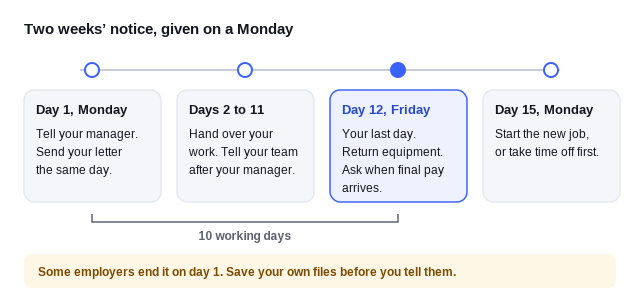
An illustration of two weeks’ notice given on a Monday, with 10 working days to the last day. Offer a hand-off plan
List what you own, where it stands, and who could take it over. Offer to write notes and show someone the ropes. Our advice: offer the plan, not extra weeks or work after you leave.
Tell your team after your manager
Agree with your manager when and how the team hears. Keep the reason short and positive. If someone asks why, one true line is enough. Our guide to your reason for leaving a job has lines for later forms and interviews.

Two weeks’ notice letter and email examples, to copy.
Send one after you’ve told your manager. Swap the [square brackets] for your details. Keep it this short.
Two weeks’ notice letter
The standard letter, printed or attached to an email. It gives your last day as a date.
Dear [Manager’s name],

Please accept this letter as my two weeks’ notice. My last day at [Company] will be [Day, Month Date].

Thank you for the chance to work on [team or project]. I’ve learned a lot here.

Over the next two weeks, I’ll finish [main task], write up handover notes, and help [name or team] take over my work.

Best regards,
[Your name]
Two weeks’ notice email
Send it the same day as the talk. A plain subject line works, like “Resignation, [Your name]”.
Hi [Manager’s name],

As we discussed today, I’m resigning from my role as [job title]. My last day will be [Day, Month Date].

I’ll send you a handover plan by [day]. Thank you for your support.

[Your name]
Shorter notice
When you can’t give two weeks. One line on why, no more.
Dear [Manager’s name],

I’m writing to resign from my role as [job title]. Because of [a family matter, a start date I can’t move, or another short reason], my last day will be [Day, Month Date].

I’m sorry for the short notice. Before I go, I’ll [the most important handover task] and leave notes on [open work].

Thank you,
[Your name]
Longer notice
When a contract sets a longer period, or you’re offering more time in a senior role.
Dear [Manager’s name],

Please accept this letter as my notice of resignation. In line with my [contract or company policy], my last day will be [Day, Month Date].

I’d like to use the time to hand over [main responsibilities] properly. I’ll send a draft plan this week, and I’m happy to adjust it.

Thank you for [one specific thing].

Sincerely,
[Your name]
Email to HR
After your manager knows. It gets the money and benefit questions answered in writing.
Hi [HR contact’s name],

I’ve told [manager’s name] that I’m resigning. My last day will be [Day, Month Date].

Could you tell me when my final paycheck will arrive, what happens to my unused vacation, and when my health coverage ends?

Thank you,
[Your name]
What to say when you give two weeks’ notice, word for word.
Say it in your own words. Short is kind. The talk should take five minutes, not fifty.
Opening the talk
The first minute. Lead with the news, then the date.
Thanks for making time. I wanted you to hear it from me first. I’ve accepted another role, and my last day will be [Day, Month Date]. I’ve really valued [one specific thing]. I want to make the handover as easy as I can.
If they ask why
One true line. You don’t owe a list of complaints.
It’s a role with [one true reason, like more scope or a shorter commute]. It wasn’t an easy choice, and I’m grateful for my time here.
If they make a counteroffer
If you’ve decided, say so kindly and once.
Thank you, I really appreciate that. I’ve made my decision, and I’ve committed to the new role.
If they ask you to stay longer
When your start date is fixed.
I can’t move my start date, but I’ll make these two weeks count. Here’s my plan for handing over [main work].
If they ask you to leave today
Stay calm and get it in writing.
I understand. Could you confirm in writing that today is my last day, and tell me when my final pay will arrive?
What happens after you give two weeks’ notice, from counteroffers to your last paycheck.
Usually, they accept it. Your manager thanks you, you agree the hand-off, and you work your two weeks.
They may ask you to leave now. Some employers end your job the day you give notice. Whether you’re paid for the days you offered depends on your state, your contract and your employer. So does whether you can claim unemployment for the gap.
Unemployment rules are set by each state, the US Department of Labor says, and CareerOneStop lists every state’s office. Asked about unemployment after quitting in California, Legal Aid at Work answers “Normally, no”, unless you had a good reason. This isn’t legal advice.
A counteroffer. Our advice: if more pay would have kept you, you’d have asked before you looked. Take a day if you need one, then give a clear answer. If you say no, say it once and kindly.
An exit interview. HR may ask why you’re leaving. Keep it short, true and calm. What you say may be kept on file.
Your last paycheck and benefits. Ask HR in writing when final pay arrives, what happens to unused vacation, and when your health plan ends. The answers depend on your state and your plan, so check the official pages in the sources below. This isn’t legal advice.
Your last day. Return equipment, hand over passwords the way IT asks, and say goodbye. Leave your manager and team a personal note if you like. The people you worked with are your future references.
Two weeks’ notice do’s and don’ts, for the letter and the talk.
What to say, and what not to say, in a resignation letter and in the room.
Do
- Wait until the new offer is final and in writing.
- Tell your manager before anyone else.
- Give your last day as a date, in writing.
- Keep the letter to a few short lines.
- Offer a hand-off plan.
- Ask HR about final pay and benefits in writing.
Don’t
- Complain about your manager, team or pay in the letter.
- Name your new employer or salary if you’d rather not.
- Promise extra weeks or work after you leave.
- Let your team hear it before your manager.
- Take company files or data with you.
- Post about it before your manager and team know.
Questions about two weeks’ notice, answered.
How should I give my 2 week notice?
Tell your manager first, in person or on a call. Say you’re leaving and give your last day. Then send a short letter or email the same day with that date in writing, and offer a hand-off plan. Tell HR next, then your team. The letters above are ready to copy.
Can an employer reject a two week notice?
Our reading: notice tells them you’re leaving, so there’s nothing for them to approve. But they don’t have to keep you for the two weeks, and some end your job the day you give notice. Whether you’re paid for the rest of the period, or can claim unemployment, depends on your state and your contract. Your state’s unemployment office can tell you. This isn’t legal advice.
Do I tell HR or my boss I'm quitting?
Your boss first. Your manager should hear it from you, not from HR or a coworker. Then tell HR, often by forwarding your notice email. Ask them about final pay, vacation and benefits in writing.
Can I just walk out of my job and quit?
In our reading, usually yes, unless a contract or your employer’s rules say otherwise. In California, for example, Legal Aid at Work says most employees can quit at any time. But walking out often costs you the reference, and can change when your final pay is due. Our advice: unless you’re unsafe, send at least a short email with your last day.
How to write a notice of resignation?
Keep it to three or four short lines. Say you’re resigning, give your last day as a date, thank them for one thing, and offer to help with the hand-off. Leave out complaints. Sign with your name. You can copy the two weeks’ notice letter above.
How much notice should you give for a job?
Two weeks is the US custom for most jobs. Give more if your contract, handbook or union agreement sets a longer period, and consider more in a senior role. Give less only if you must, such as for unsafe work or a family emergency, and say so in writing.
Is it better to resign by email or letter?
Either is fine for most jobs, as long as it’s in writing and gives your last day. Email is quickest, and it’s dated. Some employers ask for a signed letter or a form in their HR system, so check. Tell your manager in person or on a call first.
What not to say in a resignation letter?
Leave out complaints about your manager, team or pay. Don’t list grievances, and don’t promise work you can’t do, like weeks of help after you leave. You don’t need to name your new employer or salary. The letter may stay in your file.
Should I explain why I am resigning?
You don’t have to. A letter can just say you’re resigning and when. If you want to give a reason, keep it to one true, positive line, like more scope or a move. Save the details for the talk, if you share them at all.
Will I get paid for unused vacation when I quit?
It depends on your state and your employer’s policy. Federal law doesn’t require employers to pay for time not worked, such as vacation, the US Department of Labor says. California requires accrued vacation to be paid with your final wages. Ask HR in writing, and check your state’s labor department.
Where the facts come from.
Checked in November 2026. The advice is ours. The rules come from official pages (the US Department of Labor, California’s Labor Commissioner, Washington state’s rules), Legal Aid at Work, and the BLS. The quote is from a public post on Blind. This isn’t legal advice. Rules vary by state, contract and employer, so check yours. Blynk’s count is its own. On November 12, 2026, we read the live application forms of 218 open jobs in Blynk’s searches, at 199 companies (Greenhouse 97, Ashby 96, Lever 25), mostly product roles at tech companies, 158 of them US jobs, through each system’s public job-board data. A form counts if a question’s label says “notice period” or “how much notice”. Nothing was submitted.
- Your reason for leaving a job
- How to negotiate salary
- How to decline a job offer
- Job offer rescinded
- How to ask someone to be a reference
- Legal Aid at Work: quitting your job (California)
- California Labor Commissioner (DIR): paydays, pay periods and final wages
- Washington Administrative Code 357-46-150: resigning from state service
- US Department of Labor: last paycheck
- US Department of Labor: vacation leave
- US Department of Labor: how to file for unemployment insurance
- CareerOneStop: find your state’s unemployment benefits office
- US Department of Labor: COBRA continuation coverage
- BLS: Job Openings and Labor Turnover, September 2026
- Blind: gave my manager 4 days’ notice (November 2022)
- Blynk Find Jobs
