
How to ask for a coffee chat. Then make 15 minutes count.
Someone told you to set up coffee chats, and writing to someone you barely know feels awkward. Here's what to send, the questions worth their 15 minutes, who pays, and what to say if their team is hiring.

The short answer
- It's a short, casual talk, not an interview: 15 to 20 minutes, often a video call, with someone whose job or team you want to learn about.
- Keep the ask small: how you found them, one reason you picked them, 15 minutes, and an easy out.
- Have three to five questions ready that no website answers, stop when your 15 minutes are up, and send thanks before the day ends.
On this page
What is a coffee chat? Three kinds share the name.
A coffee chat is a short, informal talk with someone at a company or in a role you're curious about. Yale's career office describes it as a way to build relationships and gather information, and sometimes to explore internships or jobs. It doesn't have to involve coffee. Cornell's Human Ecology career blog notes it can be virtual.
The one you ask for yourself. Most of this page is about this kind. It works in any field and at any stage, from your first year of college to ten years into a career. It also works inside your own company, with a colleague on another team.
The firm-run kind. Some consulting firms run their own coffee chats, and you sign up for one instead of writing to someone. They work a little differently, so they have their own section below.
The workplace kind. At some companies, an app pairs colleagues for a social chat. That isn't about the job search, so it isn't covered here.
Coffee chat or informational interview? Mostly the same idea, and some guides use the two names for the same thing. In our reading, a coffee chat is shorter and looser, often with a peer a step or two ahead. An informational interview is a bit longer and more structured. If that's what you're planning, our informational interview guide has the full format and a longer list of questions.
What makes someone say yes to a coffee chat, from a survey of more than 400 people.
Tessa West, a psychology professor at NYU, asked more than 400 working people in nine countries how they'd answer a career chat request from a stranger. She shared the results in her newsletter in February 2024. These are what people said they would do, not what they did, and the full method isn't published. In our reading, the pattern still matches what career offices advise.
“Why would a stranger say yes to me?”
Many would. In West's survey, 51% said they'd set up a career chat with a stranger, 38% said maybe, and 11% said no.
Do: Make yes the easy answer. A small, specific ask is what moves a maybe, in our reading.
“We don't have anything in common.”
Look again. The answer that ranked first, at 84%, was "They came up to me at a conference". 81% said a coworker in common would make them more likely to say yes, 74% said a friend in common, and 62% a shared LinkedIn connection. With no shared connections at all, 51% said they'd be less likely. Saying how you found them counted too, as 69% said it would make them more likely.
Do: Lead with what you share. Or say exactly how you found them.
“Is half an hour too much to ask?”
Ask for less. 61% said a request for 15 minutes would make them more likely to say yes. 66% said a request for an hour would make them less likely.
Do: Ask for 15 minutes. If it goes well, they can choose to keep talking.
“Can I just send my calendar link?”
Not in the first message. 48% said a calendar link would make them less likely to say yes. A short list of topics or questions worked the other way: 63% said it would make them more likely.
Do: Offer two or three times, and name your topics. Send the invite once they've said yes.
How to ask for a coffee chat, in one short message.
Picking the person, finding what you share and nudging once work the same way as for an informational interview, and our informational interview guide walks through those steps. Two things are particular to a coffee chat.
Already working? Start with a colleague on another team
If you have a job, the easiest coffee chat to get is inside your own company. A team's job posting can tell you who runs it. In 1,204 job postings Blynk read from its searches for product roles in November 2026, about 1 in 5 said who the role reports to, and fewer than 1 in 200 gave a person's own email.
A few years in and changing direction? Ask a peer at the level you want before you ask their boss. If you'd rather know who runs the team before you write, see our hiring manager guide.Write a short ask that fits on a phone screen
Break Into Tech suggests three parts, what you share, two or three things you'd like to learn, and a short call, with email as a fallback. It also says to keep an email under 120 words. Ask for 15 minutes, not 30, and send a calendar invite only once they've said yes. Here's a finished ask, with its parts labelled.
On LinkedIn, the note is the whole ask. LinkedIn caps a connection note at 200 characters ("Each message can be up to 200 characters", LinkedIn Help, checked November 12, 2026), and without Premium you get three personalized notes a month.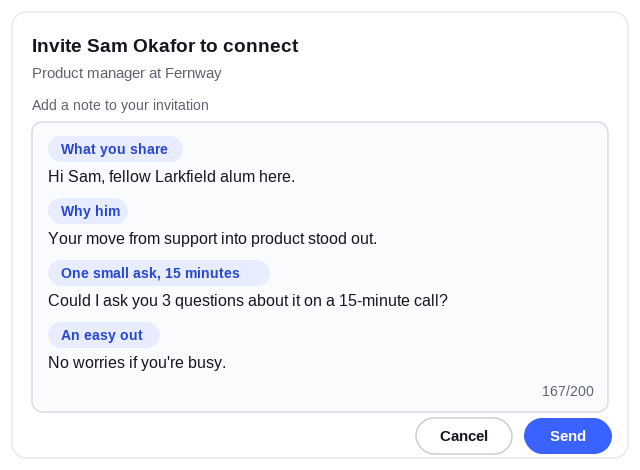
An illustration of a finished ask. The names are made up.

Coffee chat messages to copy, five short asks.
Fill in the [square brackets] and send. Each ask names how you found them, why them, 15 minutes, and an easy out, and none runs past a phone screen.
A LinkedIn note, under 200 characters
189 characters as written. Your own details may run longer, so check the count before sending.
Hi [First name], fellow [school] alum here. Your move from [earlier role] into [current role] stood out. Could I ask you 3 questions about it on a 15-minute call? No worries if you're busy.
An email, when you share a link
Email. For the subject line, try “[Mutual contact's name] thought I should ask you”.
Hi [First name],

We both know [mutual contact's name], who thought you'd be the right person to ask about [topic]. I'm [one line on who you are], and I'd like to understand how [their team or field] works before my next move.

Would you have 15 minutes for a video call in the next couple of weeks? I'd ask about [topic one] and [topic two]. [Two days and times] work for me, or any time that suits you.

If it's a busy stretch, that's fine.

Thanks,
[Your name]
A colleague on another team
Your company's chat or email. For people already working, this is the easiest yes.
Hi [First name],

I'm on the [your team] team, and I've been curious about how [their team] works, especially [one specific thing]. Would you have 15 minutes for a coffee or a quick call next week? I'll bring three questions and keep to time.

Thanks,
[Your name]
When their team has a posted role
Email or LinkedIn message. Say it up front, so nothing feels hidden later.
Hi [First name],

I saw the [job title] role on your team, and I'm planning to apply. Before I do, I'd like to understand the work better. Would you have 15 minutes for a call this week or next? I'd ask what the team is focused on this year and what helps someone do well there.

I'm not asking for a referral, only your view of the work. If now isn't a good time, I understand.

Thanks,
[Your name]
[Link to your LinkedIn profile]
The one nudge, a week later
Same thread, about a week on. Then let it go.
Hi [First name], bringing this back to the top of your inbox. If 15 minutes isn't easy right now, a line or two by email on [your one question] would help just as much. Thanks either way.

[Your name]
Coffee chat questions to bring, three to five for 15 minutes.
RBC suggests about 5 to 7 minutes a question, in a chat of up to 30 minutes. So for 15 to 20 minutes, our advice is to bring three to five and expect to get through three. Lead with the question that matters most to you. For a longer talk, our informational interview guide has a fuller list.
To open, one easy question about them
A light start helps you both relax. RBC recommends a little small talk first.
What made you pick [company] when you joined?
What's one thing about your job that surprised you?What they're working on now
Ask about this month, not their whole career. It's fresher, and no job posting tells you this.
What's taking most of your time right now?
What part of your work would people get wrong from the outside?
Which project are you proudest of this year?The team, as it is today
Keep it about the team, not a job for you.
What is the team trying to get better at this year?
When someone new joins, do they usually come through a referral, an internal move or an application?
What would you want a new person on the team to know already?To end on
Always ask the last one. A name is often the most useful thing you leave with.
If you were me, what would you do in the next month?
Is there one person you'd suggest I talk to next?Coffee chat questions for a senior leader
Our advice: bring fewer and bigger questions, and ask about the view from where they sit.
What do you look for when you hire for this team?
Where do you see this kind of work going in the next few years?Three to leave out
What they earn. It's personal, and in our view it puts them on the spot. "Can you refer me?" Extern advises against asking a near-stranger for a referral in the first chat. Anything the company's site answers. It tells them you didn't look.
Coffee chat etiquette, from the length to the bill.
How long. Our advice: ask for 15 to 20 minutes, and end on time. Extern says most coffee chats run 15 to 30 minutes, MIT's career office suggests asking for 20 to 30, and RBC says no longer than 30. At 15 minutes, say you want to respect their time, and let them decide whether to go on.
Video, phone or a real coffee. Let them choose. If you meet in person, our advice is to go somewhere near them, at a time that suits them, and arrive first.
Who pays. Offer. RBC suggests offering to buy their drink and saying so in advance. Leland says the person who asked is generally expected to pay. If they insist on paying, Extern says to accept, so thank them for the coffee too.
How to start. A line or two of small talk, then a short introduction of you, then your first question. RBC suggests steering clear of politics, religion, appearance and age.
While they talk. Listen more than you speak, and jot down one thing they said. You'll use it in your thank-you.
When their team has an open role, say so once, then ask who to talk to.
This is the moment most guides skip. You've found someone on the team, and the team has a posting up. Our advice: don't hide it, and don't make it the point of the chat.
Say it once, early. Put it in your ask or in your first minute: "I saw the [role] posting on your team, and I'm planning to apply." In our reading, saving it for the last minute feels like a trick.
Ask about the work, not for the job. "What will the person in this role take on first?" is easy to answer. "Can you get me an interview?" is not.
Ask who to talk to. Near the end: "Who would be the right person to talk to about the role?" Often it's the hiring manager or the recruiter. Then apply through the posting yourself.
If they offer to refer you, say yes and thank them. If they don't, don't push in the same call. For how to ask for a referral later, see our networking email templates.
Firm-run coffee chats, the kind you sign up for.
Most of the coffee chat guides we read were written for students recruiting into consulting and banking. There, firms sometimes run coffee chats themselves, and you sign up instead of writing to someone. A candidate asking on PrepLounge's consulting forum describes one as official and organized by the firm through its website.
Is it a screening? The coaches answering that PrepLounge question disagree. Several call it networking rather than a formal screening, others say it is one to a degree, and a few say a very strong or very weak impression may be remembered. One says the people who review applications aren't the ones hosting the chats. A good chat can lead to a referral, or to HR asking you to apply.
Treat it as a conversation, but prepare as if it counts. That's our advice. Have two short answers ready, why this field and why this firm, in under a minute each, in case they ask.
Ask what only they can tell you. "What were your first few months like?" and "What surprised you after you joined?" beat anything the careers page already answers.
Thank them the same day. If you have their email, the thank-you below works here too.
After the coffee chat, a thank-you, then an update.
Send the thank-you while the chat is fresh. Extern says the same day, MIT's career office within 24 hours, and Leland within 48 hours. Same day is our advice. A month or two later, Extern suggests checking in, and one line on how things are going is reason enough to write.
A same-day thank-you
By email, or on LinkedIn if that's where you talked. For the subject line, try “Thanks for the coffee chat, [First name]”.
Hi [First name],

Thanks for the 15 minutes today. What you said about [one specific thing] changed how I'm thinking about [decision or next step], and this week I'll [one thing you'll try].

I'll reach out to [person they suggested] and mention you sent me.

Thanks again,
[Your name]
A short update, a month or two later
Same thread. One step you took, and how it's going.
Hi [First name],

It's been [a month or two] since our coffee chat about [topic]. Since then I've [one step you took], and so far [one line on how it's going].

That came straight out of our 15 minutes, so thanks again. I hope [something they mentioned, like a launch] went well.

Best,
[Your name]
Coffee chats, do this, not that.
Do
- Ask for 15 minutes, not an hour.
- Name two topics, not a calendar link.
- If you're already working, start with a colleague on another team.
- Offer to buy the drink, and say so in advance.
- Mention a posted role in your ask, not at the end.
- If a firm runs the chat, prepare as if it counts.
- Thank them the same day, naming one thing they said.
Don't
- Ask for a referral in the first chat.
- Run past your 15 minutes unless they choose to.
- Ask what they earn.
- Ask what the company's site already answers.
- Hand over your resume unless they ask.
- Send a second nudge. One is enough.
Questions about coffee chats.
What do you do in a coffee chat?
You introduce yourself in a line or two, ask three to five questions about their work, and mostly listen. RBC suggests a little small talk to open and about 5 to 7 minutes a question. End on time, ask for one name to talk to next, and send your thanks that day. Yale's career office adds one more step: follow through on the people they suggest.
What are some good conversation questions about coffee?
That question is about the drink, but it has a place here. A light line about the coffee, or about their week, is fine small talk before your first real question. RBC recommends a little small talk to open, and suggests avoiding politics, religion, appearance and age. Then move to the questions you came with.
How do I ask for a coffee chat email?
Keep it to a few short sentences: how you found them, one reason you picked them, who you are, and a request for 15 minutes with a couple of times. End with an easy out. Break Into Tech suggests staying under 120 words. The emails above are ready to copy.
Is 30 minutes enough for a coffee chat?
Yes, and you can ask for less. Extern says most coffee chats run 15 to 30 minutes, MIT's career office suggests asking for 20 to 30, and RBC says no longer than 30. In Tessa West's survey, 61% said a request for 15 minutes would make them more likely to say yes. Our advice: ask for 15 to 20, and end on time.
How many questions should I ask in a coffee chat?
Three to five for a 15 to 20 minute chat. RBC suggests about 5 to 7 minutes a question, so expect to get through three, and keep the rest as spares. That's our arithmetic. Ask the one that matters most first, in case time runs out.
Are coffee chats worth it?
In our view, yes, if you go to learn rather than to ask for a job. In Tessa West's survey, 51% of working people said they'd set up a career chat with a stranger, and another 38% said maybe. A chat isn't a job offer. For firm-run chats, several of PrepLounge's coaches say a good one can lead to a referral or to HR asking you to apply. Most of the value is what you learn, and who they send you to next.
Is a coffee chat the same as an informational interview?
Close. Both are short talks to learn about someone's work, and some guides use the names for the same thing. In our reading, a coffee chat is shorter and looser, often with a peer a step ahead, and an informational interview is more structured. Our informational interview guide covers that format.
Do you have to buy the coffee?
If you meet in person, offer. RBC suggests offering to buy their drink and saying so in advance, and Leland says the person who asked is generally expected to pay. If they insist on paying, Extern says to accept, so thank them. On a video call, there's no bill.
Should I bring a resume to a coffee chat?
Don't send it with your ask, and don't hand it over unless they ask. That's our advice, because you asked to hear about their job, and a resume turns it into a review of you. Have it ready to send afterwards if they offer to pass it on, and keep a link to your LinkedIn profile in your email signature.
Is it OK to ask for a referral after a coffee chat?
Not in the first chat, as a rule. Extern advises against asking a near-stranger for a job, referral or resume review in the first conversation. If they offer one, say yes and thank them. Later, once there's a real role and some trust, a clear ask is fine. Our networking email templates include referral requests.
Where the facts come from.
Checked in November 2026. The advice is ours, and marked as ours. What career offices and other guides recommend comes from their own pages, the survey numbers from Tessa West's newsletter, LinkedIn's limits from LinkedIn's help center, and facts about Blynk from its own pages. The posting count is Blynk's own: 1,204 job postings from Blynk's searches for product roles, most of them senior, from company career sites and job boards, first seen between October 31 and November 11, 2026, each read for a reporting line and for email addresses.
- Informational interview
- Networking email templates
- How to find the hiring manager
- How to reach out to a recruiter
- Follow-up email after an interview
- How to find someone's email address
- How to change careers
- Yale SOM Career Development Office: what is a coffee chat? (2025)
- Extern: coffee chat guide (2026)
- RBC: coffee chats, what questions should you ask (2025)
- Leland: consulting coffee chats (2026)
- Leland: coffee chat, what it is and how to make the most of it (2025)
- MIT Career Advising and Professional Development: conducting informational interviews
- Cornell Human Ecology Career Exploration Center: what is a coffee chat? (2023)
- Break Into Tech: how to ask for coffee chats (2021)
- Tessa West @Work: how to reach out to a stranger (2024)
- IEDP: Tessa West, professor of psychology at NYU
- PrepLounge forum: Bain coffee chat and candidate screening
- LinkedIn Help: personalize invitations to connect
- Blynk Find the Hiring Manager
