
Your ATS score, explained. What it means, and what to fix.
If a checker gave your resume a 54, a 68 or a 72, and you're wondering if that's why nobody calls back, here's the plain version: what the number is, what each checker calls good, what employers' systems really do, and how to use your score to fix the right things.

The short answer
- An ATS score is a resume checker's estimate of how well your resume matches one job. The checker makes it, not the employer, and it doesn't travel with your application.
- There's no shared pass mark. Jobscan recommends 75%. Enhancv, SkillSyncer and TripleTen put the bar at 80. So 70 is close, 80 is good on all of them, and 54 means something is missing or misread.
- Use it as a to-do list, not a target. Check that it read your file right and that the job's must-haves are there in your words, next to proof. Then stop chasing points.
On this page
What is an ATS score? The meaning, and who makes it.
It's a resume checker's estimate of how well your resume fits one job posting. You'll also see it called an ATS resume score, a match rate (Jobscan's name) or a match score (SkillSyncer's). It's usually a number out of 100.
The checker makes it, not the employer. The name points at the applicant tracking system (ATS), the software employers use to collect applications. But the score comes from the checker you used, on the file you uploaded. Enhancv, which shows a score of its own, says in its FAQ that there's no such thing as an ATS score.
How the score is worked out depends on the checker. Jobscan weighs hard skills first, then education (only if the job asks for an advanced degree), job title, soft skills and other keywords. It doesn't count word count or measurable results. SkillSyncer gives more weight to the words the employer repeats. Enhancv mixes how much of your file it could read with the issues it finds, across 27 checks.
So the score is about one posting, not your resume in general. Check the same resume against a different job and the number changes, because it's measuring fit with that job.
What's a good ATS score? Each checker's own answer.
There's no shared pass mark. Each checker sets its own bar for its own way of counting. Here's what each one says on its own site.
Jobscan: 75%. “We recommend a match rate score of 75%,” it says, and adds that many career counselors and Jobscan users “see success even with just a 65% match rate.”
Enhancv and SkillSyncer: 80. Enhancv calls a score above 80 “mostly good”. SkillSyncer recommends 80 or more.
TripleTen: 80, with a band below it. At 80 or more, a resume covers the posting's key terms. From 60 to 79 it has gaps, and under 60 it misses core language.
NextRaise: 70 to 85. Under 50 is “Needs work”, 50 to 69 is “Getting close”, and 70 to 85 is what it calls its “Shortlist range”.
Teal, Resume Worded and Rezi: 80, 85 and 80, according to a side-by-side by Resumeble, which also says there's no universal pass mark for employers.
Our reading: the only bar that means anything is the one set by the checker you used. Past it, fix only what's true and still missing.
Is 70% a good ATS score? And what about 80, or 54?
70 (or 77): it depends whose 70. It's above Jobscan's 65% line but under its 75% recommendation. It's inside NextRaise's 70 to 85, in TripleTen's “gaps” band, and under the 80 that Enhancv and SkillSyncer use.
Then read what's missing, not the number. If it's things you've done and didn't write, add them. If it's things you haven't done, the 70 is accurate, and that's fine.
80: good on almost every checker here, so stop chasing points. It meets or beats every bar above except Resume Worded's 85. Check that it read your file correctly, then send it.
54: below every bar, for one of two reasons. Either the checker couldn't read your file properly, or the job's main requirements aren't in your resume. Find out which before you rewrite anything.
A misread file is a quick fix. Greenhouse's help lists what can break a read: columns, complex tables, text boxes, headers and footers, graphics, and image-only files. Missing requirements mean the job is a stretch, or your resume undersells what you've done.
Whatever your number, it stays with the checker. What the employer works with is your resume itself, and what their system does with it is below.
Five things people believe about ATS scores, and what's really true.
Most of the worry around a score comes from a few beliefs. Here's what the checkers and the hiring systems say themselves.
“Two checkers gave me 93 and 64. One of them is wrong.”
Both are right by their own rules. Each checker counts different things and weighs them its own way. One person on Reddit's r/ResumeTips ran the same file through five checkers: “Scores ranged from the 40s to the low 90s.” Nothing about the resume changed. Only the rules did.
Instead: Pick one checker and stick with it. Compare your score with its own bar, not with another tool's.
“The employer sees my score.”
The score is worked out by the checker, on your file, for you. Resumeble says it “doesn't transfer into the employer's system”. SkillSyncer says the resumes you upload aren't shared with employers.
Instead: Treat the number as one tool's opinion. What employers' own systems do is a different thing, covered below.
“A higher score gets me more interviews.”
No checker we read publishes a link between its score and interviews. “I scored 98% on Jobscan... but was rejected within an hour,” one person wrote on r/jobs. That's one story. But a score can't see the screening questions or the person reading.
Instead: Get the score good enough, then put your time elsewhere. Our advice: jobs you fit, and a note to the person hiring, are a better use of the time than the last 10 points.
“A low score means the ATS rejected me.”
In Greenhouse, automatic rejection rules act on your answers to the application's own questions, on its Plus and Pro plans, not on a checker's score. In a small survey by Enhancv, a resume builder, 23 of 25 US recruiters said their system doesn't reject for formatting, content or design.
Instead: Answer every screening question carefully and honestly. That's where automatic rejection rules are set up in Greenhouse.
“I should get it to 100%.”
Jobscan itself says a score past 75% may take keyword stuffing. CareerOneStop, from the US Department of Labor, says to use the posting's exact terms only for skills you have. MIT's career office adds that you must be able to account for everything on your resume.
Instead: Stop when the must-haves you've really done are there. Past that, extra points mean words you can't back up.
What employers see instead of your ATS score, from the hiring systems' own help pages.
“There's no score at all” goes too far. Some hiring systems do rate how well an applicant fits, in their own way, on criteria the employer sets, and only if the employer turns it on. Here's what three of them describe.
Greenhouse uses words. Its Talent Matching sorts applicants into Strong, Good, Partial or Limited match, or Needs manual review. It weighs skills the employer sets, works only in the first Application Review stage, and “does not automatically advance or reject candidates.”
Workday uses letters. HiredScore grades applicants from A to D on how well a resume matches “the skills and qualifications specified in the job description”. A C meets most of the basic qualifications; a D doesn't.
Ashby uses a share of the employer's criteria. Its AI-Assisted Application Review marks each criterion set for the job as met, not met or undecided, and shows the share of criteria met. Employers opt in, and candidates can be told and opt out.
In Blynk's searches, about 1 in 4 job postings (404 of 1,477) was on one of these three systems: Workday 184, Greenhouse 114 and Ashby 106. That's three different ways of rating fit, and none of them is the number a checker shows you. None of their help pages we read says the candidate sees the result.
How much recruiters lean on it varies. In Enhancv's survey of 25 US recruiters, 44% had an AI fit score in their system, and 8% used it to reject applicants outright. It's a small sample from a company that sells resume tools, but it matches the help pages: a rating, if there is one, is the employer's own.
How to check your ATS resume score, and what to look at first.
Do this for each job you really want. The number comes last.
Pick one real job you'd take
A score measures fit with one posting. Checking against no job, or a job you wouldn't take, tells you little about the applications you're actually sending.
Find your checker's own bar
Look on the checker's own page for what it calls good, and read your number against that bar only. A 70 lands in a different place on each checker.
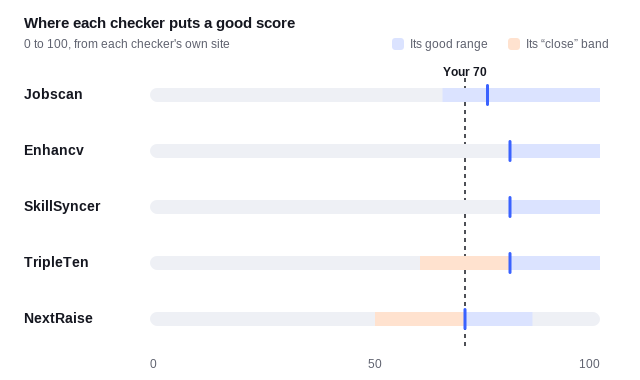
Each checker's bar, from its own site (November 2026). The same 70 clears Jobscan's 65 line, sits inside NextRaise's range, and falls short of three. Check it read your resume right
Before the score, look at what the checker pulled from your file: your name, email, job titles and dates. If something is wrong or missing, fix that first, because a hiring system's parser may trip on the same thing. For a quick test, MIT's career office suggests saving your resume as a .txt file and reading it.
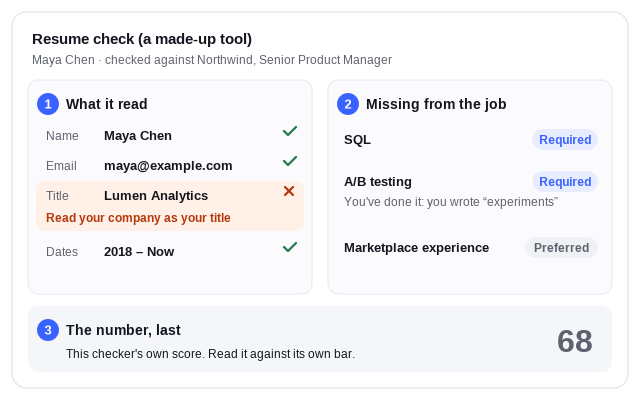
An illustration with a made-up checker, person and job. Read it in this order: what it read, which missing words are must-haves, then the number. Sort the missing words: must-have or nice to have
Open the job description and mark which of the missing words sit under required, and which under preferred or “a plus”. In 1,102 job descriptions from Blynk's searches, almost all for product roles, about 1 in 3 (344) said in so many words that some requirements were only preferred. A checker that counts every word the same can't tell those apart. You can.
Add what's true, in the job's words, next to proof
For each must-have you've really done, use the posting's own term in a bullet point, next to a result. Leave out what you haven't done: CareerOneStop says to use the exact terms only for skills you have.
The job: “Experience running A/B tests on pricing.”
Before: “Ran 60 pricing and onboarding experiments in a year, lifting paid conversion from 4% to 7%.”
After: “Ran 60 pricing and onboarding A/B tests in a year, lifting paid conversion from 4% to 7%.”Stop when it reads right and the must-haves are there
That's our advice. Once the checker reads your file correctly and the job's must-haves you've done are in your words, more points mostly mean more repeated keywords. Send it, and spend the time on the next job you fit.


Raising your ATS score: what helps, and what backfires.
The fixes that help a checker also help the employer's system and the person reading. The tricks that only move the number don't.
Do
- Fix anything the checker read wrongly before anything else.
- One column, real text you can select, and plain headings: Experience, Skills, Education.
- The job's title words in your summary, if they're true for you.
- Each must-have you've done in a bullet point, next to a result.
- The posting's exact term, where it's the same skill you have.
- One version of your resume per job you really want.
Don't
- Keywords hidden in white text.
- A block of skills you haven't used.
- Pasting the job description into your resume.
- Chasing 100%, or every word the checker lists.
- Rewriting the same resume to please a second checker.
- Anything you couldn't talk about in an interview.
Going further: the formatting is in our guide to an ATS-friendly resume, and the wording in how to find the right resume keywords. To compare the tools, see our round-up of free ATS resume checkers.
Questions about ATS scores, answered.
What is a good score on ATS?
It depends on the checker, because each one sets its own bar. Jobscan recommends 75%, and Enhancv, SkillSyncer and TripleTen put it at about 80. Use the bar of the checker you used. Past it, stop chasing points and make sure the resume reads well to a person.
Is a 70% ATS score good?
It's close. 70% is above Jobscan's 65% line but under its 75% recommendation, and under the 80 that Enhancv, SkillSyncer and TripleTen use. Add the missing words that are true for you. If the rest are things you haven't done, the 70 is an honest result.
Is 80% a good ATS score?
Yes, on almost every checker: it's above Jobscan's 75% and reaches the 80 line that Enhancv, SkillSyncer and TripleTen draw (Resume Worded asks for 85). Jobscan says going past 75% may take keyword stuffing, so check the checker read your file correctly, then send it.
Is a 54 ATS score good?
It's below every checker's bar, so something is worth fixing. First check that the checker read your file correctly: columns, complex tables, text boxes and image-only files can break a read. If it did read it, the job's main requirements are missing. Add the ones you've done, or treat the job as a stretch.
Is 77% ATS resume percent good?
Mostly, yes. 77% is above Jobscan's 75% recommendation and inside NextRaise's 70 to 85, but it's in TripleTen's 60 to 79 “gaps” band and under the 80 that Enhancv and SkillSyncer use. Check what's still missing: add it if you've done it, and if you haven't, 77 is an honest result.
Do employers see my ATS score?
No. A checker's score is worked out by that checker, on your file, and Resumeble notes it doesn't transfer into the employer's system. Some employer systems rate fit in their own way, with letters, words or a share of their own criteria, and only if the employer turns it on.
Why do two checkers give me different ATS scores?
Each one counts different things and weighs them its own way. Jobscan puts hard skills first, SkillSyncer gives more weight to words the employer repeats, and Enhancv mixes how well it read your file with the issues it found. Neither number is wrong, and neither is the employer's.
How do I check my ATS score?
Paste one real job and your resume into a checker that takes both. TripleTen's is free with no account, and SkillSyncer's free tier gives 2 scans a week. Read what it pulled from your file before you read the number. Blynk's ATS Check shows what the system reads, checked against the job you paste.
Does a high ATS score guarantee an interview?
No. No checker we read publishes a link between its score and interviews. A score can show what's missing from your resume for one job. Who gets a call depends on things it can't see, like the screening questions and the person reading.
Can ChatGPT check my ATS score?
It can compare a job and a resume you paste and list the job's words you don't use. In our reading, any number it gives is its own guess. And even with your file, it reads it its own way, not the way a hiring system's parser does, so it can't show you what that parser would pull. Check every suggestion is true before you use it.
Every fact about ATS scores, from the source.
Checked in November 2026. Each checker's bar comes from its own site; what hiring systems do comes from their own help pages; the advice is ours. Reddit posts are quoted from Google's search results. The posting counts are Blynk's own: 1,477 job postings from our searches, almost all for product roles, first seen between October 31 and November 11, 2026. We counted the hiring system named in each posting's link (about half are job boards that don't show one, so 404 is a floor), and read the 1,102 with a full description for phrases like “preferred qualifications”, “nice to have” and “is a plus”. One person's searches over 12 days, not a market survey.
- What an ATS-friendly resume really is
- The best free ATS resume checkers, compared
- How to find the right resume keywords
- How to tailor your resume to a job description
- What Workday HiredScore does
- Jobscan: resume scanner and match rate
- Enhancv: resume checker and FAQ
- Enhancv: do ATS reject resumes (25 recruiters)
- SkillSyncer: match score
- TripleTen: ATS resume checker
- NextRaise: ATS resume checker
- Resumeble: ATS score
- Greenhouse help: Talent Matching
- Greenhouse help: application rules overview
- Greenhouse help: unsuccessful resume parse
- Workday HiredScore: candidate grades
- Ashby docs: AI-Assisted Application Review
- CareerOneStop: write your resume for current hiring practices
- MIT CAPD: make your resume ATS-friendly
- Blynk ATS Check
